

Protect or profit? The fight for Utah’s public lands
Spanning 2.26 billion acres is a mosaic of geologic diversity known as the United States, from the red rock deserts of Moab and the evergreen forests of the Sierra Nevada to the icy blue glaciers of Alaska. Of these acres, 840 million are deemed public lands: federally managed areas open to all and safe from private development.
Federally held public lands are managed by agencies such as the Bureau of Land Management, the U.S. Department of the Interior and the National Park Service. Land policy regulates the acreage in accordance with the Federal Land Policy and Management Act, which aims to take a balanced approach to thoughtful development and preservation.
In an August 2024 lawsuit, the State of Utah sought to challenge this designation, claiming federal possession of unappropriated lands is unconstitutional. As filed, the lawsuit could have had dramatic implications not just for Utah but for over 150 million acres of U.S. landscapes.
“The net result would have been the undoing of the federal lands system in the American West,” said Steve Bloch, legal director for the Southern Utah Wilderness Alliance.
Utah’s lawsuit, directly filed with the Supreme Court of the United States, targets unappropriated lands: public lands lacking a congressionally defined purpose, unlike national parks, monuments and conservation areas.
Unappropriated lands encompass around 18.5 million acres in Utah, according to the Utah Senate.
“The State of Utah was asking the United States Supreme Court to skip the line — to not have to bring a case in federal district court through the court’s appeal and ask the Supreme Court to hear it that way, which is the way most cases are built up,” Bloch said.
In Utah, anti-public land sentiment is not new. Despite ceding all rights to federal land in 1812 as part of becoming a state, Utah has historically vied for state control.
“This has been a big fight since at least the 1980s — people wanting to have what is federal land turned over to state or private ownership,” said Nichelle Frank, assistant professor of U.S. history at Utah State University. “Utah has been a big part of that discussion.”
Born from the 1970s movement, the Sagebrush Rebellion, states dominated by public lands would first push against federal management via legislative action. Dubbed the “sagebrush rebels,” members of the movement saw public lands as federal oversight.
“These are ranchers who want to continue using lands for grazing,” Frank said. “They feel the government has too much of the land and want to see more state, county or private control of these lands.”
The movement reached a tipping point with the enactment of the FLPMA in 1976. In July of 1980, hundreds of sagebrush rebels bulldozed a road through a wilderness study area near Grandstaff Canyon Trail in Moab, declaring independence from the BLM.
“They then get a lot of lip service support from the [Ronald] Reagan administration, who aligns very politically with them,” Frank said. ”Over the course of the 1980s, you see a lot of cuts to federal spending for public land management.”
Despite appeasements made on behalf of the Reagan administration, the ideals of the rebellion continue to circulate today.
“Reagan is actually very disappointing to them, so the sagebrush rebels ultimately continue to exist,” Frank said. “There are people today who are a part of that story. They transition into something called the wise use movement, and it’s the same idea of anti-federal government control.”
Utah currently runs on the “Stand for our Land” campaign, stating unappropriated lands should fall under state management. According to a public statement from the campaign, Utah hopes to manage unappropriated land for multiple uses, “prohibiting the privatization of these public lands except in rare situations.”
However, environmental organizations and other entities argue this land would fall into private hands.
“Utah’s congressional delegation in the halls of Congress is talking about the sale, disposal or transfer of federal lands into state or private hands,” Bloch said. “We’re tackling this at a variety of levels, both in the courts and in the court of public opinion.”
Patrick Belmont is the department head of watershed sciences at USU.
“I think there is a very legitimate concern about this land being taken from public hands and given out to private landowners,” Belmont said. “The historic record is not very good in terms of conservation and biodiversity protection, and there is a history of privatizing the profits of these lands.”
Lands under private ownership are not held to the same environmental protections, creating potential for irreversible damage.
“When land becomes privatized, often the landowner is managing it in a way to maximize short-term profits,” Belmont said. “That usually involves some degradation, which is often irreversible or very costly to fix.”
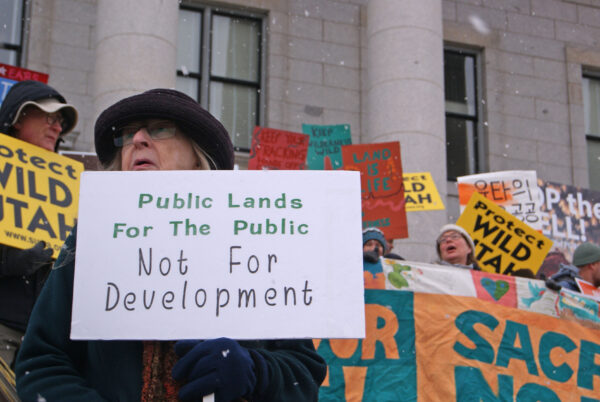
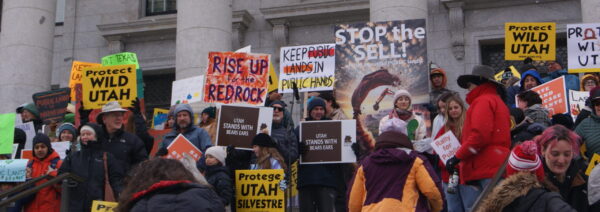 Lacey Cintron
 Protestors at SUWA rally at the Utah capitol on January 11, 2025.
Belmont argues the best way to protect these environments is through public lands, as federal entities can be better held accountable for the stewardship of the land.
“Stewarding the land in perpetuity means keeping it ecologically healthy,” Belmont said. “These are all ecosystems we are trying to manage, and these ecosystems are fragile. You start breaking one or two pieces, and the entire system can break, and it may not come back.”
Bradley Parry is the vice chairman of the Northwestern Band of the Shoshone Nation. According to Parry, any decisions regarding public lands should first consider the tribes.
“The first line of federal property, if it’s going to go to someone, should go to the tribes,” Parry said. “But as long as our federal and trust land is protected, we’ll work with Utah however they move forward.”
Parry argues imbuing indigenous values into people’s regard for land provides a proper framework for decisions about the land and its preservation. The Shoshone Nation is manifesting some of these values in its Wuda Ogwa project, a full ecological restoration of the Bear River Massacre site.
“Water is life, land is life, and you have to respect all of these things,” Parry said. “We didn’t set out to save the Great Salt Lake in our Wuda Ogwa project, but it’s a byproduct of cultural beliefs and spiritual values we are implementing on our own land.”
While Utah’s lawsuit claimed it “would not directly challenge” federal lands held in trust on behalf of Native American tribes, maps depicting “lands in lawsuit” from the “Stand for Our Land” website do include lands managed by the Bureau of Indian Affairs, notably the Uncompahgre Reservation. The Ute Indian Tribe filed a subsequent lawsuit in November 2024 asking the state to remove claims on this land.
Later statements from Utah government officials denied any claims to tribal lands. With a long history of broken treaties between governments and Native Americans in mind, however, tribal leaders continue to worry over what these implications could spell for tribal sovereignty.
“When it first came out, we were told this wasn’t going to impact the tribes, but then you start seeing different language and you ask, ‘What’s really going on here?,’” Parry said. “We just need to have a sit down, government to government, and get some assurance this isn’t going to impact us.”
On Jan. 13, the Supreme Court rejected Utah’s lawsuit, for now upholding federal management over public lands in the U.S.
“The legal arguments Utah has been trying to raise have been rejected for more than 100 years,” Bloch said. “Their real play was that maybe the conservative justices on the Supreme Court would be interested in changing the fabric of the American West.”
Despite the Supreme Court’s decision, the fight over public lands is far from over. Mass federal layoffs and budget cuts have gutted agencies such as the BLM and the U.S. Forest Service, putting public lands protections at risk. A push for “restoring energy dominance” from the second Donald Trump administration aims to revise national monument designations, such as Bears Ears National Monument and Grand Staircase, opening these lands up to mining and drilling.
“We’re calling people to action,” Bloch said. “Let’s make sure that our elected officials know that Utahns support conservation of some of the most important lands in the country, whether that’s Grand Staircase and Bears Ears or wild places in Southern Utah like Labyrinth Canyon and Dirty Devil River.”
Utah’s land is a finite resource — there is only one Bryce Canyon, Capitol Reef and Zion. The decisions made about these lands will have implications for some of America’s most unique landscapes for generations to come.
“Generations from the future are going to look back at how we’ve damaged a lot of these lands, and they’re going to regret it because they’re inheriting that damage,” Belmont said. “People looking back from the future would prefer we protect these amazing, unique and intricate ecosystems.”
Efforts were made to reach Gov. Spencer Cox and the Utah Attorney General’s Office for comment, neither of which responded.
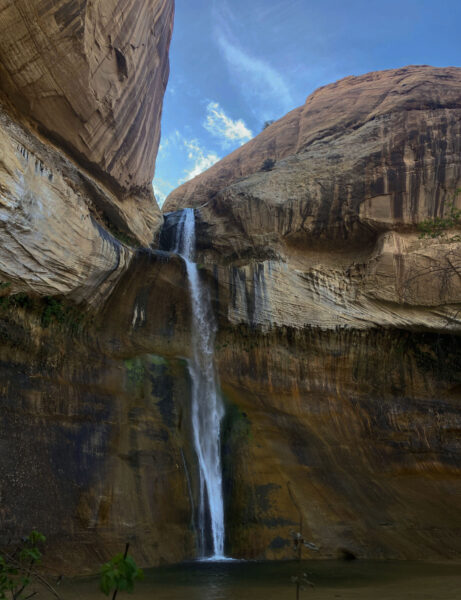
Lower Calf Creek Falls, located on BLM land inside the Grand Staircase-Escalante National Monument.