

PRSSA hosts Utah Rep Jason Thompson at empathy workshop with the Stephen R. Covey Leadership Center
Jason Thompson’s role as a member of the Utah House of Representatives not only requires knowledge of politics and business but also empathy. From founding a company to becoming a father, Thompson has realized the importance of understanding people. Thompson could be found in Utah State University’s Carolyn & Kem Gardner Learning and Leadership Building on March 19 leading an empathy-based workshop.
The Covey Empathy Workshop was put on through the Jon M. Huntsman School of Business Stephen R. Covey Leadership Center. It was part of a series of workshops with themes such as adaptability and communication. According to huntsman.usu.edu, the workshops are designed to “elevate leadership potential by developing skills that research shows students lack and employers actively seek.”
Before Thompson began his section of the workshop, Presley Whitesides, a Covey leadership fellow and the director of experiences and human resources for the center, explained that many students were there to earn a leadership credential. The requirements for students to earn the credential include studying “The 7 Habits of Highly Effective People” by Covey, attending eight workshops, attending four approved “experiences” such as trips and conferences and completing a capstone project.
“We are now wrapping up the year,” Whitesides said. “The capstone project is a really unique opportunity for you to present to your peers and to some of us what you’ve learned through your experience through the Covey Leadership Center.”
This specific workshop was in collaboration with USU’s Public Relations Student Society of America.
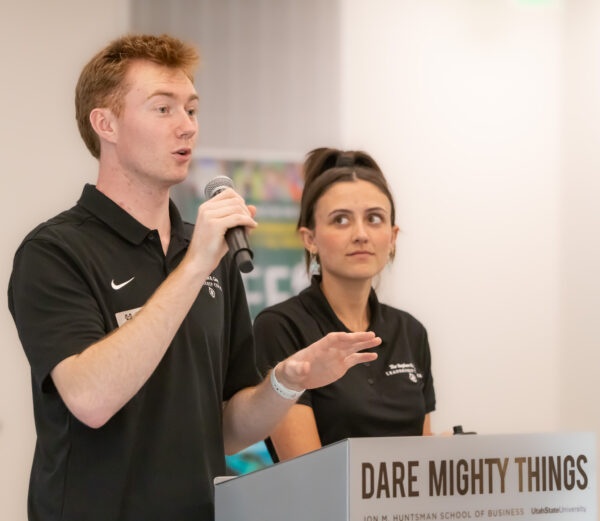
Covey Leadership Fellow Braylen Carlson introduces Jason Thompson at the Gardner Learning and Leadership Building on March 19.
Chloe Miller, a senior majoring in journalism and communications is the president of this chapter.
“We do all kinds of things like PR, marketing and comms,” Miller said. “Students who are interested in anything like that should definitely give our club a look. We have a lot of resources for national opportunities, for internships, jobs, things like that.”
Miller said the reason she chose to collaborate with the center for this workshop was because ethics is a large focus of their club, making her feel as though empathy is relevant and important to discuss.
Thompson grew up in Miami, attending five different high schools and graduating with a 1.9 GPA. He mentioned growing up around crime and drugs, noting many people are surprised when they learn about his early life due to how successful he has become.
He said one of the first things to really transform his life was joining the Church of Jesus Christ of Latter-day Saints at the age of 16.
“From that point on, I had leaders show up for me in my life,” Thompson said. “Suffice to say, there were tremendous challenges in my life — a ton of instability and moments where the future felt ridiculously uncertain for me. If I’m being honest, there were times I didn’t see much in myself at all.”
According to Thompson, one of the most important aspects of empathy in leadership is vulnerability. Being vulnerable about his past has allowed him to connect with others and offer transparency with those he leads.
“I am honestly frustrated with the lack of true leadership that we have at the highest levels of government and business,” Thompson said. “Maya Angelou said, ‘I’ve learned that people will forget what you said, they will forget what you do, but people will never forget how you made them feel.’ How often do we wonder, ‘How am I making this person feel?’”
Thompson said it was important to emphasize that empathy towards others is not weakness but strength under control. The ability to understand varying perspectives while leading is one of the most important leadership skills, he said.
Thompson stressed the understanding of mental health.
“Mental health is real. Yes, I am in the political world, but I have social anxiety,” Thompson said. “All of you, to some degree, have anxiety. To some degree, all of you have good and bad days, and we all have to see each other as human beings. We’re all the same, dealing with similar things, just a little bit different.”
In a leadership context, Thomspon is a state representative and an entrepreneur, but he wants people to remember he is human and believes society forgets the “human side of things” far too often.
“Empathy is not just a leadership skill — it’s a human responsibility. When you understand people, you can lead them. When you invest in people, you can change them,” Thompson said. “When you change people, you change everything. If you want to increase your influence, start by increasing your empathy.”