
Pumped-up prices
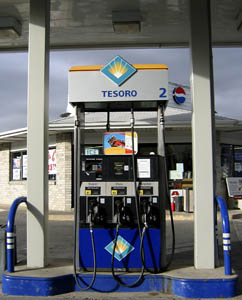
Three dollars and nine cents per gallon and rising.
This all-too-familiar figure hanging on gas station signs on almost every Main Street in almost every city in America is hitting closer to home and driving the Logan community to make some changes – in more ways than one.
From May 2005 until now, the price for regular gasoline per gallon increased $.65, from about $2.25 to $2.90 in Utah alone.
As the prices continue to rise, people throughout the community and Utah State University students are making lifestyle changes to adapt to this recent problem.
Daneen Deuel, an English major from St. George, said she uses the bus instead of her car because she can’t afford to pay for any more gas.
“I think they’re ridiculous. In the course of two or three weeks it has risen $.50,” she said.
William Kennick, an environmental engineering major from Price, said he saves about $10 a week since he stopped driving his car.
“I stopped driving and I ride my bike,” he said.
Carrie Schafer, an art major from Burley, Idaho, lived in California over the summer and she said the gas prices were a lot higher there. She hopes after the problems in New Orleans have settled down that gas prices will start to fall.
But in the meantime, there are several steps students can take to save on their gas. Richard Beard, associate professor for USU Agricultural Engineering Extension, offers some suggestions.
“If [students] are trying to reduce fuel costs, one of the best ways is to reduce commuting trips back and forth,” he said. “Those are usually the most expensive trips.”
Carpooling is a good way to do that, Beard said. As for driving around town, trying to lighten the amount of things, such as toolboxes, ski racks and bike racks on or in a car can help it drive more smoothly and efficiently, eventually saving on gas.
If possible, Beard suggests students leave their cars in their parking lots and, instead, walk, ride a bike or take the bus to school.
Aside from the campus shuttle, the Logan Transit District and the Cache Valley Transit District also provide free transportation throughout the entire valley. They have three separate stops on USU’s campus as well as throughout Logan, said Lisa Peterson, LTD alternative transportation coordinator.
Since gas prices have begun to rise, the bus system has already seen an increase in ridership. In August, the LTD buses had 12,000 more riders than they in August 2004.
“Just this last week, we’ve had several more riders and we have noticed that the buses are fuller,” Peterson said.
For students who live farther from campus, there are also designated LTD sites where they can park their cars and the buses will pick them up and take them to campus, Peterson said.
Bus schedules, times and locations can be found at www.ltdbus.org.
University officials have also had to make a few changes with the 650 university-owned vehicles on campus and at various extension sites. The vehicles that use the most gas are those traveling back and forth from the extension sites, said Darrell Hart, assistant vice president for Facilities.
But overall, the university hasn’t been hit too hard. Of the 10 campus shuttles, nine of them use natural gas, which has been a great benefit to the university in the long run, Hart said.
However, it won’t be until years in the future that the general population will be able to use vehicles that aren’t gas-powered.
“I think that we’ll see more electrical vehicles and more of what we call hybrid vehicles that use fossil fuel plus batteries,” said Byard Wood, department head for mechanical and aerospace engineering.
Although several car companies are manufacturing these kinds of vehicles right now, they are still very expensive because the production numbers are still low.
“These high prices just open up the door for a lot of new technologies,” Wood said. “The reality is that with the growth of oil consumption throughout the world, I’m pretty sure we will not see lower gas prices again,” he said.
Most of the gas stations throughout Logan have had as difficult time with the rising prices as anyone else.
Roger Baer, a mechanic for Bob’s Gas Garage and Groceries in Logan, said they only make about a $.04 or $.05 profit on gas, which is about the same as before the prices went up.
“I have to drive, so I pay for it and I don’t like it, but I do,” Baer said. Bruce Carlsen, from Carlsen Gas for Less in Logan, said they receive their gas from Severe Valley Oil in Wyoming and they don’t have much control over the prices.
“I’d like to see it go down to $2 a gallon again, but I don’t know if it will ever happen,” said Carlsen.
In the meantime, most people can only hope, Beard said.
“I think the gas prices will equalize, they’ll kind of go back down, but not to where they were before,” he said.
-mmackay@cc.usu.edu
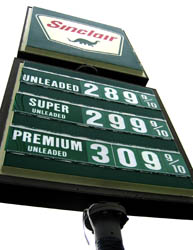
Prices in Logan have reached more than $3 per gallon at most gas stations. (Jamie Crane)