
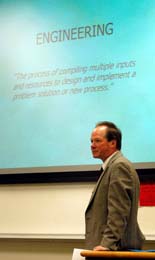
Questar VP encourages personal integrity
Ron Jibson, vice president of operations for Questar Regulated Services, gave students some advice Tuesday about being a successful engineer in today’s world.
Utah State University’s College of Engineering, in celebration of Engineering Week, invited Jibson to be the keynote speaker.
“I’m one of those old guys now, but hopefully I can still provide some important insight for you,” Jibson said.
Jibson spoke about everything from prerequisites he believes every engineer should have, to the heavy course load that is guaranteed for engineering majors.
“I know how it feels to be in labs or classes when your friends, who are in other colleges, are out having fun on the QUAD or whatnot. But believe me, it’s worth it,” he told the students.
The definition of engineering is “the process of compiling multiple inputs and resources to design and implement a problem solution or new process,” Jibson said.
Jibson said he believes every engineer in industry must work on and develop four things before they enter the industry: Personal integrity, intelligence, communication and execution.
Personal integrity and honesty are most important to Jibson: “It’s imperative that we always continue to give the right answers.”
He mentioned the recent Enron scandal, saying the company was focused more on the short-term benefits of foregoing their personal integrity than the long-term consequences.
Accountability also falls under personal integrity. Jibson said he “can guarantee you that not every project you work on will be successful.” He believes it is important to be willing to step up and be held accountable for your own mistakes.
Intelligence is the next prerequisite Jibson discussed. He was quick to clarify what he means by intelligence, however.
“I wasn’t in the top 10 percent of my class. I’m lucky if I was in the top 50 percent of my class,” he said, saying he was talking about being people smart, not only book smart.
“Very few of you will remain in an entirely engineering job for your entire careers,” Jibson said.
Business and leadership skills are important tools necessary for success. These skills, according to Jibson, can be acquired from individual or continuous education courses, or “in the fire” of the job itself.
Another skill helpful to aspiring engineers is communication. Jibson said often a project that would be incredibly successful does not receive funding because the person presenting the project has not developed his communication skills. The opposite is sometimes true, too; a project with foreseen problems will receive funding if the presenter is able to communicate well enough.
A project presentation, according to Jibson, should be based on facts, emotions and symbols.
“Be passionate about your presentation,” he said. “Show them that this is something more than just a job to you.”
He also advised the future engineers to know their audience’s learning levels and personality traits.
Execution is the final prerequisite Jibson discussed.
“One of the last things the people you work for are going to want is a surprise,” he said.
These surprises can be avoided by being sure to adhere to details. One strategy that Jibson and his company follow is to “under-promise, over-produce and deliver.” It’s far better, in Jibson’s view, to under-promise than over-promise.
In response to a question from a student, Jibson gave some advice for making a good impression at that first interview right out of college. He said students should “focus on educational accomplishments” since the experience section of their resume is probably lacking. To develop the experience section of your resume, Jibson says it is a good idea to seek out “job opportunities where you can work in an engineering-type environment.”
Interviewees should also spend a considerable amount of time discussing their extracurricular activities, because “it shows you’re a person that has an interest in something more than just engineering,” Jibson said. He also suggested learning something about the company before arriving at the interview.
Jibson closed by thanking those who attended, saying, “I would assume that you probably have other things you could be doing right now … studies and such. I wouldn’t say golf, because it’s still snowy out. But, I do commend you for coming.”
-sophisan@cc.usu.edu