
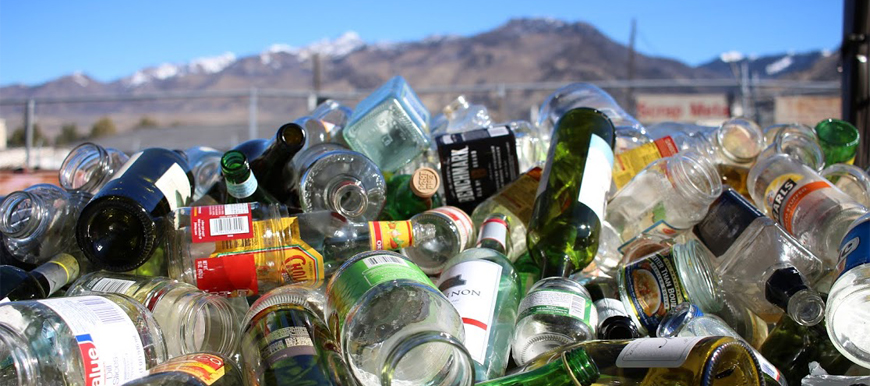
Reduce single-use: A history of container consumerism
Whether it’s cracking open a can of Coke, grabbing a bottle of water or purchasing a Sprite from McDonald’s, Americans drink and discard billions of single-use beverage containers everyday without a second thought. Under a century ago, this form of consumption was nonexistent.
On April 16, Cody Patton, Utah State University alum and professor of history at the University of Montana Billings, came to the Friends of the Library Lecture Series. His lecture, “Canned History: Beer, Branding, and Waste in 1930s America” examined the American brewing industry.

Dr. Cody Patton answers a question after his lecture, entitled “Selling Single Use” in the Merrill-Cazier Library on April 16th.
“The brewing industry was the first to normalize the idea you would consume something out of a container you would use once and throw it away,” Patton said. “Before 1935, if you wanted a soda or a beer, you would drink out of a reusable glass bottle.”
Prior to the 1930s, Americans relied on the reusability of glass bottles. One could purchase a glass of beer or soda for seven cents, return the bottle and get two cents back — essentially leaving a deposit on the purchase.
“They would wash and reuse these bottles. A lot of these bottles would be used 30–50 times before they were retired,” Patton said.
With the repeal of Prohibition in 1933, brewing companies needed a new way to establish their place in the lives of Americans. On Jan. 24, 1935, the country’s first single-use can of Krueger’s Cream Ale and Finest Beer would hit the shelves in Richmond, Virginia.
“The brewing industry used this container as a vehicle to rehabilitate its image,” Patton said. “They made beer a home beverage and made it easier for people to consume their product at a time when sales were half of what they had been before Prohibition.”
From this point onwards, single-use packaging became standard for brewing, soda and food industries, and consumers shifted from reusability to convenience.
“As you move from the 1960s into the 1970s, single-use throw-away containers are now the norm in the United States,” said Elmore Bartow, professor of history and faculty member in the Sustainability Institute at Ohio State University, who also spoke at the lecture. “There’s no longer a price associated with the packaging.”
“The beer can normalizes this idea that consumption is convenient and fun and we don’t have to think about the back end of it,” Patton said. “Steel and aluminum are valuable resources — these are the things we make airplanes out of. All of the sudden, we’re using it once for a beverage and then just throwing it away. When you step back and think about it, that doesn’t make sense.”
Plastics make up a huge portion of single-use products, from water bottles and plastic bags to soft drink containers and straws.
“Plastics became a really exciting option because plastic production exploded in the post-war era,” Bartow said. “It was a lightweight material, and it didn’t break.”
According to Patton and Bartow, this model greatly benefits and frees companies of the environmental costs associated with single-use packaging — the burden instead falls to the consumer.
“A key for the retailers is that they didn’t have to take on the labor and cost of processing dirty bottles,” Bartow said. “They can now outsource the cost of the packaging waste and processing.”
The first major environmental issue came in the form of litter.
“The brewing and soda industry have been very keen on disabusing people that litter is their problem,” Patton said. “They say it’s the consumer’s fault for not disposing of the container properly.”
Aluminum mining is one of the most environmentally intensive processes. According to a World Economic Forum Report in 2020, each ton of aluminum produces 16 tons of CO2 emissions, with the world consuming around 95 million tons of aluminum annually. Aluminum mining is also a major contributor to deforestation and fossil fuel emissions.
Plastics have an equally devastating carbon footprint, with Coca-Cola being the biggest contributor of plastic pollution in the world according to Greenpeace.
“More than 70% of our [polyethylene terephthalate] plastic bottles end up in waste streams, rivers and ultimately, out in the environment,” Bartow said. “When it ends up in the environment, it can generate microplastics, and almost all of us have high concentrations of microplastics in our bodies.”
Recycling does not keep up with the rates at which waste is produced. According to the New York Times, 10% of plastic and 43% of aluminum cans in the U.S. are recycled.
“The issue is that we don’t recycle at high enough rates,” Patton said. “If these businesses are interested in reducing their carbon footprint, they wouldn’t focus so much on recycling — they’d switch back to reusable bottles.”
Patton and Bartow argue one of the best ways to reduce the environmental impact of single-use packaging is to change the system altogether.
“We’ve got to fundamentally rethink the logic of using a finite natural resource to produce a container we use once and throw away,” Bartow said. “We need to get back to a circular economy that values usability and returnability over this throw-away system that evolved in the 20th century.”
The biggest challenge in returning to a circular economy is the current scale of single-use packaging, an industry valued at $44.5 billion in the U.S. alone, according to Global Market Insights Inc.
“I definitely think it’s feasible to move away from single-use packaging,” Patton said. “We just have to teach ourselves to consume in a new way, and history shows we can do that.”
As concern for the environment reaches a critical point, Patton asks readers to think critically about consumerist culture and remember convenience is a recent priority in the timeline of human history.
“I hope people come away from my lecture questioning some of their own consumption habits and why it is that we do things this way,” Patton said. “Ask questions about who these systems benefit — is it the consumers, or is it the corporations?”