
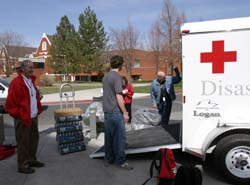
Rescue teams practice with mock earthquake
As part of Emergency Preparedness Week, an earthquake disaster scene was simulated Thursday at 9 a.m. near the David B. Haight Alumni Center so rescue teams and the Red Cross could practice their skills.
Ambulances and fire trucks filled the parking lot and “victims” were taken from the Alumni Center to the LDS Institute of Religion where the Red Cross had set up a temporary shelter. The mock disaster was planned by the President’s Ambassadors in coordination with Sgt. Lynn Wright of Utah State University Campus Police to help increase coordination between rescue groups. Wright is also the emergency management coordinator on campus.
Paramedics, firefighters, police, Red Cross workers and campus CERT (Community Emergency Rescue Team) members were also involved in the planning and were all on hand at the event.
Wright said many important things occurred during the disaster, including an opportunity to allow response teams to review their skills and coordinate efforts between groups.
“If there is a mass casualty, we’re all going to have to work together. I think it is so vital that we understand what they do and they understand what we do,” Wright said concerning coordination between the Red Cross and public response teams.
CERT responders were in charge of identifying which victims needed the most help, as well as assisting victims to the treatment center. Mark Fishburn, a CERT trainer, said CERT responders are trained to take care of medical needs within their own homes and neighborhoods in the case of disasters.
“Part of the reason for CERT is that in the first 72 hours of a disaster, the medical response will all be overwhelmed. They will be going to places where the large majority of people are, like schools and malls,” Fishburn said. “If there’s a disaster and you have a heart attack or your house is on fire, nobody’s coming.”
So CERT members are trained to deal with medical emergencies on smaller levels, Fishburn said.
If a disaster were to occur on campus, CERT members would act as they would if they were in a community, with each building acting as its own neighborhood. Ideally, Wright said, there should be four to five CERT-trained people in each building on campus. There are 274 people already CERT-trained on campus and 21 were available for the mock disaster, Wright said.
“It’s always a challenge, especially in the daytime, to get enough volunteers. The big challenge with CERT responders is they all work on campus,” Wright said. “They’ve got their daily jobs and that’s tough for them to walk away from the office for three or four hours. They’re busy.”
Kory Jenkins and Eric Hansen, both from the USU research foundation, are CERT volunteers and attended the mock disaster.
“It was just nice to have a really good refresher. I certified a year ago and hadn’t
practiced or done anything with it since, until today,” Jenkins said.
Hansen said it is important to be constantly reviewing the skills needed to help people.
“The need for a refresher was one of the biggest reasons to come – to put into practice what we have learned and try to remember what the priorities are, what we need to do to coordinate with other teams and what the things are we need to do to treat people,” Hansen said.
He said the most important part of the day to him was coming back afterward and trying to evaluate what went well and what needed improvement.
“It’s great to me that you can take people from different walks of life, different areas on campus, and different responsibilities,” Wright said. “You may have a doctorate, a professor, and you may have a custodian that get together as a team and work together as a team. That, to me, is what it’s all about. You lay aside your title so to speak and you’re in it for the good of the victim that needs assistance.”
“Victims” were members of the President’s Ambassadors and were made to look as if they were suffering real injuries ranging from fractures to sucking chest wounds.
Dustin Carlson, an ambassador who played a victim suffering from a head injury, said his favorite part of the experience was getting the CERT teams trained.
“I had to play a crazy man, suffering a bruise on my head so they had to comfort me and get me tied down to the point where I wasn’t running around everywhere,” he said. “A lot of the other people had serious injuries, but I was just dazed so getting the CERT teams trained was my favorite part.”
Once victims had been triaged, they were taken to the treatment center and the shelter created by the Red Cross, where in a real emergency, victims would be provided with food, clothing and shelter until more permanent means of assistance could be made available.
Nurses and mental and emotional health experts would also be on hand at Red Cross shelters, said Roxanna King, director of the Cache County American Red Cross, to help victims and their families deal with shock and trauma following a disaster.
Carlson said the mock disaster had gone as well as had been hoped and will hopefully achieve its goals of making the community more aware of disaster preparedness.
“I thought the fire trucks would come in with sirens blazing and really get people’s attention, but they didn’t,” he said. “I do think we raised a few eyebrows though. Emergency preparedness and its importance is what we wanted to get out there to people.”
Wright said, “We’re never prepared enough, but we have come a long ways.”
While Hansen said he agrees there is room for improvement, he said, “I think this is a step in the right direction.”
Both Wright and Fishburn said real preparedness begins at home with individuals.
Wright hopes USU students will take preparedness seriously, saying, “Students need to look around their environment and ask themselves, if all of a sudden they had to take care of themselves, are they in a
situation where they could take care of themselves for 72 hours?”
Wright also recommends that students designate an out-of-state contact that students will promise to call in case of an earthquake or other disaster, so concerned family and friends are able to call for information using phone lines that aren’t being flooded.
Fishburn said a CERT training session will be taught on or near campus starting May 5, and all classes are free. Anyone wishing to become certified should contact Wright at 797-0806 or by e-mail at lynn.wright@usu.edu. The Red Cross is also available for contact about emergency preparedness classes and other safety questions at 752-1125.
-bnelson@cc.usu.edu