
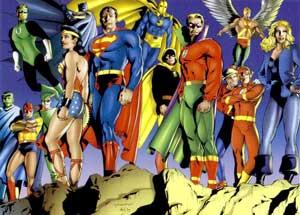
Rise of the American Legends
While “Watchmen,” Alan Moore’s prolific analysis of the postmodern superhero, is often considered the highest point in contemporary panel-based storytelling, the comic book industry itself has an elaborate history. From Stan Lee’s introduction of multi-faceted heroes that saw special abilities as a hindrance in the 1960s to the current trend among the industry’s top publishers to establish strict continuity and create events with far-reaching repercussions, several factors have yielded a robust graphic novel industry with much to offer older readers, including university-aged students.
Birth of the Superhero: The creation of Superman – 1938
Faster than a speeding bullet! More powerful than a locomotive! Able to leap tall buildings in a single bound! The creation of one the most recognizable pop culture symbols of the 20th century ushered in a “Golden Age” of comic book recognition, an era that established and reinforced the association between the comic book medium and the newly created superhero sub-genre. Debuting in “Action Comics #1” in June of 1938, Superman was the brainchild of Toronto-born newspaper boy Joe Shuster and pulp fiction enthusiast Jerry Siegel. The two met in high school and together they periodically published “Science Fiction,” a fanzine that featured the first incarnation of the Man of Steel in a story known as “The Reign of the Superman.”
While the Superman that appeared in this story was more or less a villain imbued with powers thanks to a mad scientist that bore striking similarities to Superman’s eventual arch-nemesis, Lex Luthor, Siegel and Shuster realized that a pulp character with superhuman abilities may find greater success as a hero. Inspired by Philip Wylie’s “Gladiator” novel, Edgar Rice Burroughs’ “Tarzan,” and Fleischer Studio’s “Popeye” character, “the Superman” evolved to eventually become a messianic beacon of hope from the planet Krypton; employing the use of super-strength, speed, and, later, the power of flight to battle criminals in the art deco cityscape of Metropolis.
The squinting strongman in circus attire was a breath of fresh air for an industry that lacked cohesion and a weary public that sought escapism during the Great Depression. As the archetypical template for the entire superhero sub-genre, the early Superman stories introduced all of the conventions of contemporary comic book mythology including the hero’s utilization of a dual identity and the establishment of a recurring rogue’s gallery.
Making Superheroes Human: Stan Lee’s vision – 1960s
In response to DC’s successful resurgence of the superhero genre in the late 1950’s (often labeled the “Silver Age” of comic books), up-and-coming Marvel writer Stan Lee was asked to create a superhero team that would be able to compete in sales against the “Justice League of America” books. Anticipating a career change, Lee decided to introduce an element of humanity to the otherwise stagnant archetypes typically associated with iconic figures like Superman and Wonder Woman. Lee’s risky decision paid off and his success lead to the creation of several “flawed” heroes throughout the 1960’s.
Lee’s creations often emphasized the personal conflict presented by each character’s paranormal capabilities and his stories challenged convention because they often focused more on the hero’s everyman alter-ego than the costumed persona that typically took center stage in the competing DC books. Peter Parker had to juggle homework, a job, and a social life in addition to battling colorful villains as the web-slinging Spiderman. Additionally, nuclear physics doctor Bruce Banner had a “Jekyll and Hyde” relationship with his alter-ego, the savage Hulk, while Ben Grimm of the Fantastic Four resented his monstrous, rock-like appearance.
Stan Lee would also go on to create the X-Men, a group of heroes that, along with a significant portion of humanity, gained special abilities through the genetic development of the “X” gene. Considered the result of mankind’s next phase of evolution, these ‘mutants’ were usually feared by the general populace. The X-Men books became fertile ground for conflicts that were analogous to modern discrimination and complex social issues like race and homosexuality.
The Bat Factor: Frank Miller’s “The Dark Knight Returns” – 1986
Widely considered the most popular comic book based character because of the sheer number of writers and artists that have contributed to his expansive legacy, Batman has had a central role in a number of noteworthy titles, some of which have changed the face of the modern comic book and the way that the Dark Knight himself has been portrayed. 1986 saw the release of Frank Miller’s revolutionary “The Dark Knight Returns,” a gritty, cold war-era alternative tale featuring a more masochistic iteration of Batman that returned to Gotham City after a ten year hiatus following the death of Robin. A stunning reinterpretation of a character that was previously associated with camp (because of the popularity of Adam West’s portrayal in the ’60’s television show), “The Dark Knight Returns” inspired everything from the gothic sensibilities of the Tim Burton “Batman” films to the bulky, tank-like appearance of the bat mobile featured in the latest cinematic interpretation of the Caped Crusader.
Miller’s first Batman entry did more than just redefine the character, however, it reinforced the potential of the comic book medium to tell stories with significant literary merit. Frank Miller’s contributions to Batman’s legacy would continue with the release of “Batman: Year One” in 1988, a dramatic chronicling of Batman’s first year as a crime fighter in Gotham and Jim Gordon’s first year serving under Gotham’s corrupt police force. This emphasis on Batman’s early years would continue with countless tales set during this time period and would even lead to the creation of “Year One” books for other heroes and inspire an emphasis on this time period for the latest “Batman” film.
The “Vertigo” Imprint: “Sandman” and other popular “Vertgo” comics – 1980s
The critical success of Alan Moore’s “Watchmen” mini-series and other comparatively sophisticated works like Neil Gaiman’s ethereal “Sandman” and “The Saga of the Swamp Thing” turned a few heads at DC management in the late 1980s. It was clear there was an audience and reader-base for complex, adult-themed storytelling within the medium. The result was the establishment of DC’s “Vertigo” imprint, a line that would go on to publish some of the most distinguished graphic novel work of the 1990s. A deliberate departure from the anti-hero specific titles that cluttered the stands in the late ’80s and early ’90s, “Vertigo” stories typically featured a somewhat oxymoronic focus on realism and the supernatural aspects of the DC universe. The “Vertigo” imprint also emphasized the quality of a story’s writing over art, contrary to the retroactive practices that became associated with other comic labels like Todd McFarlane’s Image Comics. As a result, some of the industries most accomplished writers have contributed to books under the “Vertigo” imprint, including “The Authority” creator Warren Ellis and “100 Bullets” scribe Brian Azzarrello. One of the label’s most critically acclaimed titles is “Hellblazer,” the showcase of the otherworldly escapades of the taciturn, chain-smoking detective John Constantine that was loosely adapted into the 2004 film, “Constantine.” Other popular “Vertigo” titles include Garth Ennis’s “Preacher,” an impenitent analysis of religion and the American perspective through the eyes of Texan preacher Jesse Custer, and “Y: The Last Man,” the somber story of Yorrick Brown, an escape artist who becomes the last man on earth after a plague brings about the destruction of the Y chromosome.
A House of Crisis: “House of M” and “Infinite Crisis” – 2005
The year 2005 saw the emergence of two colossal crossover events that promised grand, earth-shattering consequences for both the “Marvel” and “DC” universes respectively. Although Marvel’s “House of M” and DC’s “Infinite Crisis” are not the only comic “events” in the medium’s history to develop an all-inclusive conflict for the purpose of cleaning up continuity issues that have developed over decades, they are the only comic event of comparable scope is DC’s original “Crisis on Infinite Earths.” Released as a 12 issue maxi-series in 1985, the original ‘crisis’ did away with concepts that appeared to compromise growing readership, including the idea of multiple earths with innumerable iterations of DC’s token heroes. Decades of convoluted DC history culminated in an epic conflict between the omnipotent Anti-Monitor and every single DC character that had appeared throughout the company’s 50 years of publication. The literally world-shattering maxi-series returned prominence to a company that was faltering in light of Marvel’s emerging popularity and it provided the foundation for the past two decades of DC stories. DC’s current crisis represents the culmination of plot threads developed over a series of tie-ins and precursors, including the top-selling 2004 “Identity Crisis” mini-series. Much like “Crisis on Infinite Earths” before it, “Infinite Crisis” will completely redefine the universe populated by Superman, Batman, and Wonder Woman. The first three issues have been released and have revealed the central conflict will revolve around the classic, pre-Crisis Superman’s attempt to restore the world to the idyllic “Silver Age” that he inhabited in response to the collective failure of DC’s contemporary heroes to live up to the standard set by the heroes of the Silver Age. Similarly, Marvel’s “House of M” miniseries involved the mentally frail Scarlet Witch’s attempt to change reality in order to recreate the children that she lost to the villain Mephisto. The fallout of “House of M” included the drastic reduction of the mutant population, the disappearance of several key figures, and the complete restoration of Wolverine’s fractured memory.
-mackp@cc.usu.edu