
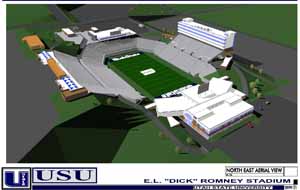
Romney Stadium renovation plans presented to ASUSU
For the first time since plans to renovate Romney Stadium were announced, students can see where their money will be going.
Athletics Director of Development Ken Beazer presented artist’s renderings and sample plans of the stadium renovation to the Associated Students of Utah State University Tuesday, giving many members of the council their first look at the future of the stadium.
USU students have given $7.75 million in support to the renovation by renewing the Stadium/Spectrum Bond for another 20 years, which will be paid for with student fees.
Beazer said the renovation would take place in three phases, with the first phase, a synthetic turf for the field, being completed by June. The new field will allow for the stadium to be used much more than it has been in the past.
“This is the largest seating venue north of Salt Lake City and we use it four, five or six times per year,” Beazer said. “It needs to be treated as such, it needs to be utilized more than four or five times a year.”
With the new field, the stadium will be able to host high school football games, band practices and intramural championship games, Beazer said.
While hosting high school football games wouldn’t be a source of revenue for the school, it would be a good way to recruit students.
“We want as many students on campus kicking our tires and checking under our hoods as possible,” he said.
USU students will see improvements to the east side of the stadium during the second phase of improvements.
A plaza will be created in the southeast corner of the stadium, with the current restrooms and concessions building being removed. A new building will be built south of the current structure, allowing for students to move about more easily on the concourse, Beazer said.
Beazer said a food court would be built on top of the new building, giving students a place to gather and socialize.
“If the students want to turn it into a social club, we’ve provided the means that they can,” he said. “We view athletics as a viable part of the overall educational experience of students.”
On the east side of the stadium, a covering will be put along the concourse to make the area look more like a stadium. Student entrance gates will also be installed on the east side to ease congestion at the current student entrance.
“When you come in from the east, you don’t know you’re in a stadium until you get to the edge and look down,” Beazer said.
The second phase will also see construction of a new press box, as funding becomes available.
“That thing right now is barely passing code as far as safety inspections are concerned,” Beazer said.
The new press box would consist of three levels, with the first being a club seating level with concessions areas, the second being called the skybox level and the third being the press box. Beazer said ASUSU could be given one of the skyboxes to help recruit or reward students.
Beazer said none of the money from the Stadium/Spectrum Bond would be used to build skyboxes.
“That money is going to allow a lot of the work to be done, but we have to finance and come up with the other portion before it can be completed,” he said. “None of the Stadium/Spectrum Bond will be going to the club seating or the skyboxes, it will only be used for safety, health and sanitary concerns.”
The third phase of construction, Beazer said, would build new locker rooms and team facilities at the north end of the stadium and a “hall of fame” facility on the south end.
The locker room facility would fill in the bowl of the stadium and would be capable of having bleachers put on top of it in the future. The locker rooms would be much larger than the current facility and coaches would have their own meeting rooms. The facility would also house the weight room and training facilities for all athletic programs, Beazer said.
The south end zone facility would have a banquet and reception area, as well as extra VIP boxes, Beazer said.
“We have such a rich tradition of athletic competition here and we have nowhere to display it,” he said. “We really think this facility is going to be kind of the flagship of what we’re doing.”
The north and south end zone facilities combined would be roughly 72,000 square feet, Beazer said, with the press box about 50,000 square feet. The project is expected to cost $17.5 million to $20.5 million total, but as plans change each day, so do costs.
“We have a lot of momentum going right now,” Beazer said. “We view that whole press box, the whole stadium experience, as an advantage to the university.”
-str@cc.usu.edu