

Russell/Wanlass Performance Hall celebrates 20th anniversary
Two decades to the day after its opening, the Russell/Wanlass Performance Hall celebrated its 20th anniversary on Jan. 14 with a celebratory performance.
The event featured mezzo-soprano Tamara Mumford and pianist Adam Nielsen — two Utah State University alumni who have ascended to the highest levels of the classical music world since their time in Logan. For the crowd of 400, the evening was a tribute to the venue’s legacy and the donors who made it possible.
“Since the main goal of the hall is to elevate the student experience, we invited Adam and Tamara as outstanding alumni to give our current students a glimpse of how far a USU music degree can take them,” said Nicholas Morrison, executive associate dean of the Caine College of the Arts.
The performance marked a full-circle moment for Mumford and Nielsen. Though they now grace stages at the Metropolitan Opera and Juilliard, the duo first performed together in a USU choir room.
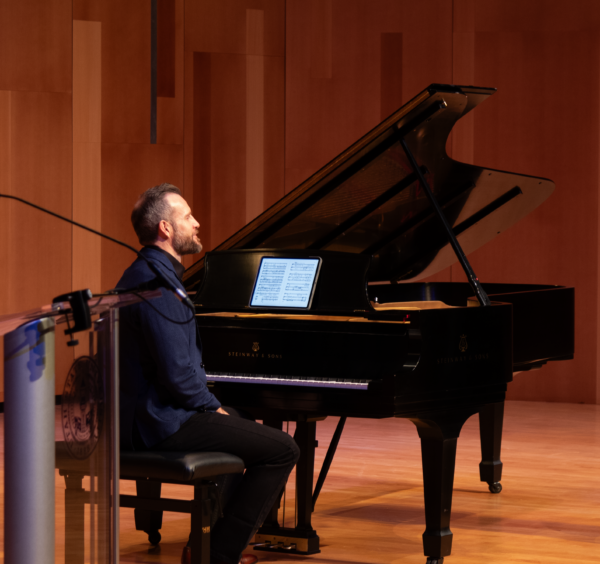
Adam Nielsen, Pianist
“We were little babies at USU together,” Mumford said. “He has known me from the beginning, and [it is] so important to have that trust with your pianist. I know him, I know his musicality and its instincts that I trust.”
The program was as varied as the careers of the performers, featuring selections from “Carmen,” “Bel Canto” pieces by Gioachino Rossini and American standards by Cole Porter, George Gershwin and Stephen Sondheim. Nielsen also performed solo piano pieces, including Claude Debussy’s “Clair de Lune,” a song Mumford noted was the inspiration for her daughter’s name.
Beyond the music, the evening served as a memorial to the hall’s namesakes, Manon Caine Russell and Kathryn Caine Wanlass. The sisters each donated roughly $6 million to construct the facility, which opened in January 2006.
For Mumford, the performance was deeply personal. She recalled how the Caine sisters supported her early career, attending her student recitals and helping fund her auditions for graduate school.
“Not only were they involved in the foundation that provided that financial support for me, but Kathryn and especially Manon were just big supporters of me in the physical sense,” Mumford said. “They came to my performances when I was singing at USU. They were able to help support me in that adventure as well.”
Architecturally, the hall remains a centerpiece of the university’s arts infrastructure. Designed specifically for acoustic perfection, the building features mechanical systems, such as heating and cooling, that are isolated from the performance space by a massive rubber gasket. This design ensures no mechanical vibrations transfer to the stage, creating a near-total silence Morrison said is essential for chamber music.
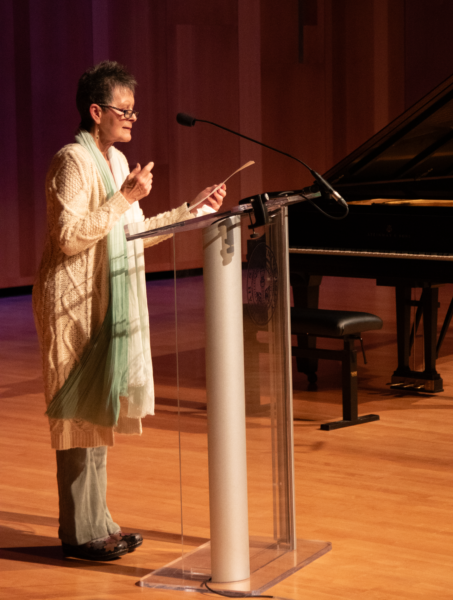
Star Coulbrooke
“Every sound in the hall is audible, so you hear the quietest whisper,” Morrison said.
While the hall is venue for the all of the Cache Valley community, its primary function remains academic. According to university data, 93% of the activities in the hall directly benefit students through recitals, master classes and professional recordings.
As attendees departed the hall after the performance, they passed under Ann Preston’s “Passacaglia” sculpture, an installation based on the mathematical principles of Pythagoras and Fibonacci. Morrison noted the sculpture serves as a permanent reminder that the arts and sciences are “inextricably intertwined.”
Reflecting on the milestone, Morrison emphasized the success of the hall is measured by its ability to foster human connection.
“Attending a performance or exhibition can remind us of the power of the arts to bring us together and of what it means to be a member of this great family we call humanity,” Morrison said.