
Safety the priority when replacing buildings
The safety of students and faculty is the most important issue university officials consider when deciding which buildings to replace or renovate on campus, said Darrel Hart, the associate vice president of USU’s facilities department.
Building age, how crowded the classrooms are and energy efficiency are all considered, but “the number one issue is life safety,” Hart said.
Because building methods and knowledge about safety have improved, building codes have changed, which means some buildings no longer meet safety requirements, Hart said.
“What was considered safe in 1965 does not necessarily apply today,” he said.
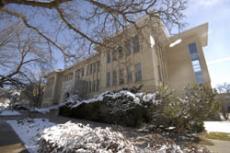
The Agricultural Science Building will be the next to come down, Hart said. It was built in the early 1960s and will be replaced within two or three years because of safety concerns, worn-out mechanical systems and other problems. Hart said the building has open corridors and stairwells, which could allow a fire to spread, and single-pane windows, which could be dangerous in an earthquake. There are also dangerous materials in the building such as asbestos.
Because USU is a state institution, Hart said requests to replace old buildings must be approved by the Division of Facilities Construction and Management, a state agency. DFCM considers factors such as the building’s safety issues, its energy efficiency and the amount of money private donors have contributed for a new building. Based on these criteria, the agency assigns each building a priority ranking.
The Agricultural Science building is currently high on the state’s priority list, Hart said. Demolition and construction cannot start until the money has been raised to pay for it, however, which may take two or three years. The project is expected to cost $84 million, and the university plans to ask the state to contribute half the cost.
The university doesn’t grant certain departments higher priority than others when it comes to requesting new buildings, but private donations can make a difference, Hart said. Donors contributing money toward a specific building can increase its priority ranking.
The Engineering Classrooms building, which was demolished this month, is being replaced because it did not meet earthquake safety standards, Hart said. The building that will replace it will be funded largely by a donation from USU alumnus David G. Sant and will be named after him.
The Merrill Library, which was built in the 1920s and added onto twice in the 1960s, was at the top of the state’s priority list when it was demolished last year, Hart said. It had severe safety problems, wasn’t energy efficient, and its mechanical systems were outdated and worn out.
In addition to new buildings, buildings often undergo major renovations, Hart said. For example, the Ray B. West building underwent a $5 million renovation about five years ago. Though it is an old building, “it’s still pretty solid,” he said.
In coming years, his department hopes to renovate and add onto the HPER building, Hart said. Other buildings, such as Animal Science, will also be improved eventually, he said. It can take years to raise the money necessary to pay for building projects, which limits the projects that can be undertaken at one time.
-dfelix@cc.usu.edu