

Saving the wetlands at the Great Salt Lake
Concern over the state of the Great Salt Lake, the largest saline lake in the Western Hemisphere, has steadily increased over the last few years.
Located in the Great Basin watershed, the lake is a natural feature that has garnered increasing attention. While shrinking water levels and toxic dust are major worries, researchers in the Wetland Ecology and Restoration Lab at Utah State University say water isn’t the only concern.
Karin Kettenring, head of the lab, said the presence of invasive phragmites grass, a type of common reed, presents problems for the lake and surrounding wetland.
“It takes up a lot of water, and then when you multiply that out over tens of thousands of acres, that’s a massive amount of water consumption,” Kettenring said.
Phragmites spread rapidly by releasing seeds into the wind. Previously, managers thought the plants mainly spread through root and stem expansion, but Kettenring’s lab discovered seeds play a bigger role, changing how experts manage the issue.
“It spreads much more by seeds than this clonal spread,” Kettenring said. “If you’re trying to manage it, you need to actually deal with those seeds.”
These invasive plants pop up in dense bunches that can grow up to 15 feet, thrive in disturbed areas like roadsides and compete well with other plant species.
“Once you know what it looks like, if you drive, you see it everywhere,” said Sam Kurkowski, lab manager.
Without natural predators to keep them in check, Kurkowski said phragmites crowd out native vegetation. Native plants are essential for healthy wetlands, providing food and habitat for wildlife.
“In the battle to have functioning wetlands, native plants are a key part of that,” Kurkowski said. “Our lab is trying to figure out how we can re-establish native plant communities that are dwindling and make them the dominant plant communities again.”
Another challenge with invasive phragmites is once it’s removed, it is likely to return unless it is replaced by another plant, which is where restoration efforts come in.
Montana Horchler, master’s student in the lab, is conducting growth chamber experiments to see how different temperatures affect seed germination.
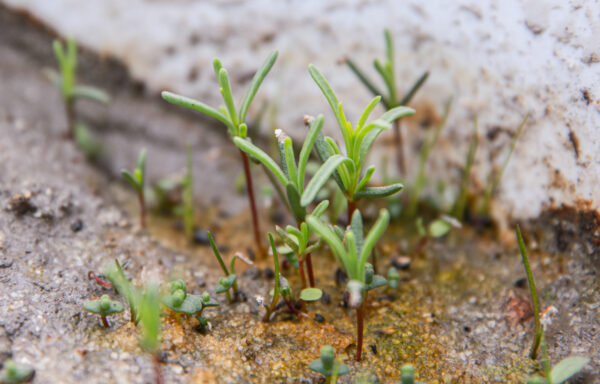
Seedlings planted by the Wetland Ecology and Restoration Lab sit in the research greenhouse as seen on Feb. 6.
She tested the effect of three different temperature regimes on seed germination and used a microscope to count the number of seeds germinated every two days.
From that, she was able to generate “germination curves” that visualize the process and “show us what conditions the seeds need to germinate to their fullest possible extent,” Horchler said.
As water availability continues to become more uncertain, Horchler said it might make sense to use species more drought and salt tolerant. She said this isn’t something groundbreaking, but it has yet to be done at the Great Salt Lake.
“Managers are already doing seed-based revegetation,” Horchler said. “Usually, they’ll seed in May or June, and it’s possible that with higher summer temperatures and increasing water availability uncertainty, it might make sense for us to put seeds out in the fall.”
Hailey Machnikowski, another master’s student in the lab, has a similar two-part setup with a field and greenhouse experiment she says is aimed at “adapting restoration for climate extremes and for weather extremes.”
Her field experiment compares two different types of restoration frameworks: a precision framework and a number of bet-hedging frameworks.
“[We want] to see which one is going to be most effective in a world with constantly changing and unpredictable water conditions,” Machnikowski said. “You’re essentially choosing the right species, seeding them at the right time and putting them in the right place.”
With the bet-hedging framework, also referred to as risk mitigation, the assumption is that conditions are unknown, variable and likely to be extreme.
“We put out a bunch of species, and hopefully conditions will be right for at least some of them to stick,” Machnikowski said.
The other two bet-hedging approaches involve separation of dormancy break time and seeding time, which Machnikowski said gives the seeds a chance to succeed if conditions aren’t right the first time.
Machnikowski is also testing how young plants handle drought and flooding.
“Seedlings are a lot more vulnerable because they haven’t yet developed the plant structures that adult plants have that makes them more resilient,” Machnikowski said. “We want to know that these young plants are still going to be hearty enough to survive potentially rough conditions.”
The goal of her research is to improve the outcomes of large-scale reseeding efforts for Great Salt Lake restoration, especially as climate change is projected to cause more severe drought and precipitation events.
“It’s important that we figure out how to adapt these practices so that they’re still going to be effective in a changing world, whether that’s from climate change or if it’s from anthropogenic impacts,” Machnikowski said.
With quality and long term sustainability in mind, Kettenring emphasized the importance of restoring lots of different plants back to the wetlands.
“We’re really trying to combat that homogenization of wetlands that’s occurring,” Kettenring said. “Particularly from a restoration standpoint, we’re trying to find lots more species that can be used in restoration.”
Ecosystems function much better and are more resilient in the long run when the biodiversity is higher, according to Kettenring. Healthy wetlands filter water, prevent floods and provide critical habitats for birds.
“We don’t know what the future is going to bring in any particular wetland because, you know, weather is so variable year to year,” Kettenring said. “If we can get more of that diversity in there, it’s kind of like an insurance policy.”
At the heart of Utah’s culture and its land lies the Great Salt Lake, and Horchler believes it is imperative it be taken care of.
“I strongly believe that it’s an important thing to steward the Great Salt Lake in a way that is good for future generations of people and all living things,” Horchler said.
According to Kurkowski, wetlands are one of those things people don’t think much about, and the trick is trying to get people to care about them before it’s too late.
“You take it for granted until it’s not working anymore and there’s not enough clean water or water at all,” Kurkowski said. “Wetlands do lots of really important things for us and for nature. It’s really important to be able to restore that diversity back into wetlands.”