
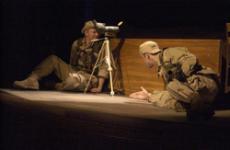
‘Scope’ offers an in depth look at the dehumanization of war
The Fusion Theatre Project’s original production of “Scope” play might feature lots of rock ‘n’ roll which, according to Neil Young, is revolutionary music.
The play, opening today at the Caine Lyric Theatre, is consistently provocative, thought-provoking and maybe even a little revolutionary in how it examines war on the individual level.
“Scope” is the story of two army soldiers, a sniper and his spotter (the man who sets up the sniper’s shot). The sniper (Brandon Sean Pearson) begins to question the morality of his job, which leads to conflict with his spotter (Chris Thames), a trigger-happy Southerner who never wavers on his commitment to their task.
The two are the most effective sniper duo in the field, notching 28 consecutive kills on intended targets. However, the woman who became their 29th target doesn’t die. Instead, she is severely wounded and waits in the Army hospital to die. While she lays there, the sniper begins to question if she was indeed an enemy. His concerns are exacerbated when the military begins to investigate the shooting.
Chris Martin, acting coordinator and actor in “Scope,” said the play talks about two types of dehumanization: that of one’s self which happens in war and that of the enemy which, is a necessary part of justifying killing.
The audience can examine the process of dehumanization through the eyes of the sniper as he struggles with these issues himself. The pressures of war are only heightened by his job as a sniper, which requires him to kill without direct provocation.
The sniper says he kills by imagining his targets as the same aluminum cans he would use for target practice as a teenager. However, he is repulsed by the idea of “finishing the kill” on his 29th target by killing her at close range. The idea of viewing his enemy’s humanity, “looking them in the eye” as his spotter warns, leads him to question what an “enemy” really is.
“Scope” has been a work in progress for two years now. USU theatre professor Shawn Fisher wrote the play with Jeremy Gordon, a graduate student at USU.
However, Fisher said it was an “open process” that invited comments and revision from the cast.
“Everyone has complete ownership of the show,” he said.
Fisher said he has two hopes for audiences of the play: first that they be entertained and emotionally affected by the play, and second that they have one slightly different thought about war and what the United States does in the world.
The dynamic between the sniper and spotter, including the juxtaposition of people from their past with the isolation and forced dependence of their current lives, helps the play remain entertaining and emotionally interesting throughout. Also, there is a surprising amount of dark humor throughout the play.
The play’s immediate relevance to the current situation in Iraq helps to make the play thought-provoking. However, although the play is about Iraq, the writers and producers said the play is meant to start discussion rather than take any particular position on the conflict.
Martin said by working with people of different political views in the production process, they realized the “gray area” of the conflict was most interesting. They said they invite the audience to join them in that area in their on-stage introduction to the play.
Ultimately, the play is the exploration of this “gray area” of war and the generalization of the setting-a “vast, empty desert” with little decoration, only a hospital bed and several benches and chairs surrounded by colors of desert and military fatigues-that make the play’s message more universal.
“Scope” is preceded by “Something In the News” and “Insurgency,” two short one-act plays about Iraq. “Scope” contains persistent strong language and discussion of topics that may offend viewers.
The play opens tonight at the Caine Lyric Theatre and continues Jan. 26, 27 and 31 and Feb. 1-4. All shows begin at 7:30 p.m.. The shows are general admission, but the theatre asks for a $5 donation, a portion of which will go to the Children of Fallen Soldiers Relief Fund. Audience members are encouraged to comment on the play and invited to join the producers, writers, directors and actors in a discussion of the play following its production each night.
-tliljegren@cc.usu.edu