

Skies clear just in time for USU public observatory night
Clouds hung over Cache Valley for much of the evening, threatening to cancel one of Utah State University’s few public observatory nights of the year. But just as visitors began to arrive, the sky opened enough to give hundreds of attendees a glimpse beyond it.
Annually, held near the end of the spring semester, the public observatory night invites students and community members to look through telescopes and learn about astronomy from volunteers and staff. This year’s event ultimately drew a steady crowd eager to take advantage of the rare opportunity.
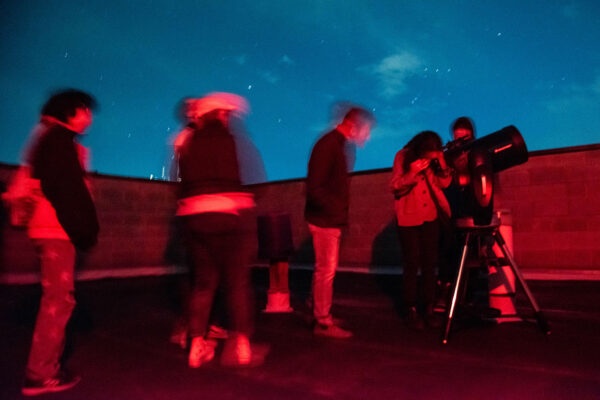
Attendees at the USU Observatory take turns looking through telescopes on top of the Science Engineering Research building on April 17.
James Coburn, USU observatory manager, said public nights are a smaller part of the observatory’s overall mission but an important one.
“The main purpose of it is to be a lab for astronomy classes,” Coburn said.
Built in 2009 and in use since 2010, the observatory primarily supports coursework, with hundreds of students visiting each semester to complete required lab work. Public nights, however, offer a chance to open that experience to a broader audience, Coburn explained.
Outreach events are limited. In the fall, the observatory typically hosts a public night once a month, but in the spring, there is usually only one opportunity due to weather and scheduling constraints, Coburn noted.
On a typical night, the observatory can accommodate about 400 visitors, cycling groups through the rooftop telescopes in timed intervals. Even with uncertain conditions, Coburn said demand remains high.
“There’s a lot of demand,” Coburn said. “People are interested. They want to see it.”
To manage the crowds, about 10 volunteers and staff members help run the event, guiding visitors, operating telescopes and explaining what they are seeing in the night sky.
Florance Diaz-Lapierre, a sophomore physics major and observatory employee, was among those helping visitors during the event. She said the goal is to make astronomy accessible, even for those with no background in the subject.
“I guess just outreach — get more people interested,” Diaz-Lapierre said.
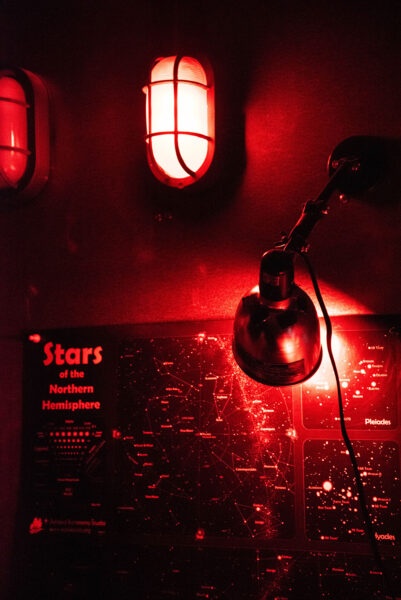
A poster viewed in the USU Observatory on top of the Science Engineering Research building on April 17.
Despite the less-than-ideal conditions, Diaz-Lapierre said the night still offered meaningful experiences for attendees.
“It’s kind of a bad night tonight. It’s really cloudy and snowed yesterday,” Diaz-Lapierre said. “But yeah, tonight’s going pretty well.”
She added that events like this build on growing public interest in space exploration.
“Especially with Artemis and everything like that, people are interested, and so it’s really cool to kind of get that momentum going,” Diaz-Lapierre said.
For Diaz-Lapierre, working the event is also a chance to move beyond classroom learning and engage directly with others.
“It’s cool to kind of get out here and do something a little bit more hands-on,” Diaz-Lapierre said.
Coburn said organizing a public night requires careful planning, often weeks in advance, without knowing what the weather will be like. Once the date is set, there is little flexibility.
“When the time comes, either it’s on or it’s off,” Coburn said.
That uncertainty made the clearing skies even more significant for attendees, many of whom waited in line for a chance to look through the telescopes.
The observatory typically sets up multiple smaller telescopes in addition to its primary instrument, allowing visitors to view a range of celestial objects depending on conditions, Coburn explained.
While not every detail of the night sky was visible, for student workers, the event still delivered on its purpose giving people a direct experience with astronomy.
For Coburn, that opportunity is what makes public nights worth the effort.
“A lot of people really want to go to the observatory,” Coburn said.