

Soil Club digs deep, sets sights on national stage
In a soil pit five feet underground, there are no shortcuts.
Students climb down into the earth, press damp soil between their fingers and attempt to identify its properties.
At Utah State University, that work happens through the Soil Judging Team, a competitive and academic organization housed in the S.J. and Jessie E. Quinney College of Agriculture & Natural Resources.
The team, often referred to as the soil club, trains students to analyze soils in field pits, interpret their characteristics and apply that information to real-world land-use decisions. This year, after placing No. 2 overall at the Northwest Regional Soil Judging Competition, the USU team qualified for the National Collegiate Soil Judging Competition in Raleigh, North Carolina.
Cody Manhard, a senior majoring in plant science and minoring in soil science and agronomy, explained what the club does.
“We dig a pretty large pit into the ground — about 150 centimeters, about 5 feet deep,” Manhard said. “What you’ll see is all these horizonizations occurring down in the soil.”
Those horizons — distinct layers formed over decades or centuries — tell a story. Students are trained to identify texture, color, structure and composition by sight and feel. From that data, they interpret what the land can sustain.
“Is this good agricultural land? Could you maybe do a forestry operation here? Could you build a house with a basement here? Would this be a good place for a septic field?” Manhard said. “You give your interpretation as to what it would be good for.”
Regionals, held within the northwest region of the United States, bring together universities from states including Washington, Oregon, Utah, Idaho and Colorado. Teams spend two days practicing in unfamiliar landscapes before one day of individual and group judging events.
Chelsea Duball, assistant professor in the USU Plants, Soils and Climate Department and soil club adviser, described it as “a place-based learning experience” where students assess not just the soil itself but the broader landform and geomorphology shaping it.
“They’re immersing themselves into those landscapes,” she said. “To describe more than the soil, they do some geomorphology assessments to understand the landform of that area and how those soils came to be in that place.”
Duball and Manhard both expressed how rigorous the competitions are.
“The learning curve is scarily steep for a lot of the students,” Manhard said. “You show them the scorecard, and it’s just, whoa, information overload.”
Competition days start before sunrise and stretch late into the evening. Students are in the pits by 5 a.m., sometimes before daylight, judging soils until nightfall. Still, Manhard insists the payoff outweighs the exhaustion.
“The quality of the education from this club, these events — it’s worth every penny of the degree if you were to get no classes,” he said. “It’s the networking. Everybody goes there who matters.”
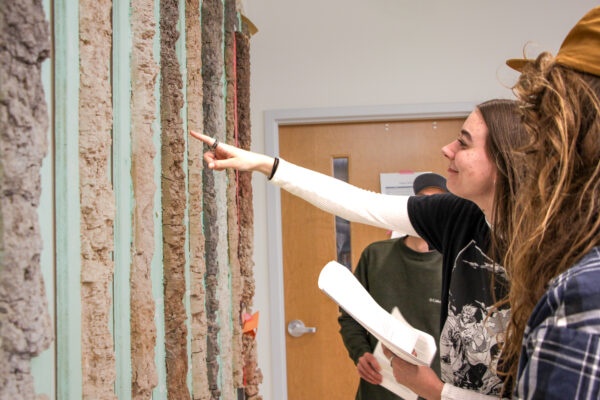 Hadley Sintay
 The USU Soil Judging Club analyzes soil monoliths on Feb. 27.
Manhard, now in his second year competing, started with no formal soils coursework. He attended his first competition before ever taking a class in the subject.
“I had no idea what I was doing, and it was amazing,” he said. “I learned so much.”
Each competition sharpened his skills. At the most recent regional event, he placed No. 9 individually — meeting a personal goal to score in the top 10 before graduating.
While competition remains central, Duball said the club is working to broaden its reach.
The organization is open to any student, not just those within the QANR. In recent years, members have included students in natural resources, wildlife and related disciplines. The club has also begun hosting events beyond team practices, including a World Soil Day celebration, where members created artwork using soil-based paints.
“We’re always looking for new students to join,” Duball said. “We welcome everybody to come and practice.”
Practice sessions during winter are typically held in the soil lab in the Stan L. Albrecht Agricultural Sciences Building, where students study sample profiles and review scoring methods. When weather permits, they travel to one of roughly 10 maintained soil pits throughout Cache Valley, many located on university property.
Standing in those pits, sometimes shoulder-to-shoulder with 15 other students, team members refine their ability to identify sand and percentages by touch alone and distinguish subtle variations in color that indicate drainage patterns or mineral presence.
For Manhard, the club’s competitive drive extends beyond personal achievement.
In the western conference, he said one university in particular has dominated in recent years. The prize is a ceremonial “golden shovel” trophy awarded to the top team.
“I would love to see that just spend one year here at USU,” he said. “It’s been here before several times, but it’s been a little while.”
That ambition now carries into nationals, where students will encounter soils unlike those found in Utah — a challenge Manhard described as both educational and rewarding.
Above all, he emphasized, the experience is about understanding soils as foundational to agriculture, infrastructure and environmental management.
“Soils are interconnected with everything,” Manhard said. “There are few things you can put on your resume more impressive than enhanced soil experience if you work in ag or natural resources.”
For Manhard, the soil club offers more than trophies. It offers field experience and professional networks.
The club will recruit anyone at any time during the school year but focuses on recruiting during the fall to ensure participation in competitions.
For Duball and Manhard, the soil club, although rigorous, is a fun experience that has a lot to offer. They both hope to keep the momentum going for next year.