
Solid concrete Bullships
A floating chunk of cement named El Guapo? Sounds like Bullship, but ask an engineering student: it’s not.
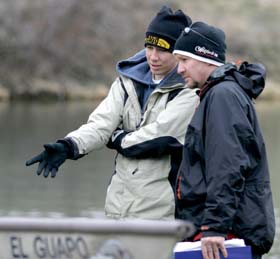
About 100 people gathered Saturday morning at First Dam to watch two teams of engineering students, Team El Guapo and Team Bullship, race concrete canoes in a competition to decide who will travel to a regional conference.
The heavyweight boats waged five heavyweight races with the winners getting a trip to the American Society of Civil Engineers Rocky Mountain Regional Conference this weekend in Fort Collins, Colo.
While Utah State University had two canoes vying for the chance to go to the competition, only one could make the trip, said competition organizer Tyler Mertlich.
“It turned out things were really close,” he said.
Scoring for the competition was based on four areas. The five races counted for 25 percent of a team’s score, Mertlich said, but the rest of the score came from papers, presentations and a final product score.
The 239-pound El Guapo lost the racing part of the competition, but beat out the 335-pound Bullship V to qualify for this weekend’s competition.
“I know we beat them in a couple of areas, the presentation and the final product,” El Guapo Team Leader Greg Jolley said. “They beat us today on the water.”
The difference in the competition perhaps came when Bullship lost 25 percent of its score for using an illegal stain on the canoe. Mertlich said the stain used to cover the outside of the canoe was heavier than the competition allowed.
“It’s kind of a stiff penalty for something that really doesn’t make a big difference,” Mertlich said.
Even though only one team gets to go to the competition, both teams built canoes that floated and raced successfully. Which brings up the obvious question: How does cement float?
“This isn’t the stuff you go down to Home Depot and mix,” said Chad Brown, a member of Team Bullship. “Water weighs 62.4 pounds per cubic feet, if your concrete weighs less than that, then you’re going to float.”
Special techniques are used in mixing the cement, Brown said.
“In order to get the weight down we used a bionic bubble, which gives it a lot of air, instead of gravel,” he said. “That gives you your buoyancy.”
If floating concrete isn’t amazing enough, the difference in weight between canoes is. With almost 100 pounds difference between the two USU boats, students will see even more disparity in weights at the competition.
“There will be canoes out there that weight less than 100 pounds,” Jolley said. “Ours is a little more slender and our concrete mix is actually quite a bit lighter than [Bullship’s] is.”
The heavier Bullship did encounter some problems Saturday. Before the canoes could race, team members had to submerge the vessel and see if it would still float while full of water. Initially, Bullship wouldn’t float, but after adding Styrofoam to each end of the canoe, it was successful.
“Our mix actually did float when we designed it, but then in the actual building and construction process, something went wrong,” Brown said. “We think what happened is that we worked it too much and we worked all the air out of it.”
With the Styrofoam installed and a lot of Duck tape securing it in, Brown said, Bullship probably lost some aesthetic points.
USU will join 12 other schools at the competition, Bullship leader Mike Hansen said. Representatives from the El Guapo team will join other USU students in the other events that include a steel bridge competition, multiple design competitions, presentations and technical papers. USU will send 20-25 students.
“Utah State isn’t really known for having great concrete canoes,” Jolley said. “We think we’ve got some really good things that we’ve done, we have a lot of things to build on.”
The two teams have invested hundreds of hours into perfecting their canoes, Brown said. USU hosted last year’s competition, but didn’t fare to well with their canoes.
“It wasn’t a pretty sight [last year,]” Brown said. “That was part of our motivation this year – to do well.”
-str@cc.usu.edu
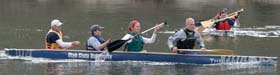
Students from the civil engineering program race their concrete canoes at First Dam, Saturday. The boats were designed and built by students. (Photo by John Zsiray)