
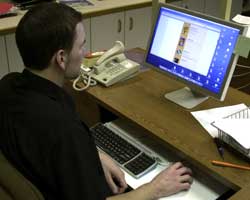
Some students are ‘Spacing out’
E-mailing was once the hottest new way to communicate. Then we began instant messaging. Now a new way to socialize through the Internet has emerged: online social networking.
Social networks, such as Facebook or MySpace, are online communities of people for the purpose of keeping in touch with old friends or meeting new ones. Wikipedia, an online encyclopedia, defines them as “a category of Internet applications to help connect friends, business partners or other individuals together using a variety of tools.”
The one that seems most popular at Utah State University is MySpace.com. Based on the results of a search for USU students on MySpace, 3,162 of almost 17,000 students at USU have a profile on the site.
Brooke Lish, a sophomore majoring in history secondary education, said that although she has only had her profile set up for about a week, she found herself checking at least once a day and now limits how often she checks it.
“I’m trying to make myself not be addicted by limiting myself to every other day or once a day max,” she said. “It’s so addicting. It doesn’t seem like it would be- I can just talk to my friends on MSN Messenger.”
According to Wikipedia, there were more than 300 known online social networking sites as of 2005. Most are open registration, but some are invitation only. Many have specialized purposes and some are specific to one country. Draugiem.lv is popular in Latvia. MySpace, with over 50 million members, is one of the most popular. Some other popular ones are Xanga, a Weblog with more than 31 million members, and Friendster, a friend network site with 20 million members.
Features offered on MySpace include blogs, music, browsing for friends, a personalized profile for each registered user, e-mail, discussion groups and games. Things posted on profiles may include videos, streaming music, photos, messages and personal information. Profiles and blogs can be so loaded with facts that journalists have used them to gather information about crime suspects, as in the case of the murder of a mother and father in Pennsylvania in November 2005.
The site was begun in July 2003 by current president Tom Anderson, CEO Chris DeWolfe, and a few programmers, according to Wikipedia. It was originally partially owned by Intermix Media, which was bought by Rupert Murdoch’s News Corporation in July 2005.
Users can post messages on each others’ profiles. According to many of the MySpace users on campus, checking their profiles can be habit-forming. Some people check their profiles several times a day to see if anyone has left them a message. Lish said she spends time on MySpace personalizing her page and leaving messages for friends. She said she only has about 15 friends so far, but since most people have the Webmaster, Tom Anderson, in their friends list, nearly every user is in their “extended network.” The extended network links users to their friends’ friends and so on.
Some, however, say they think the site, and the idea of being addicted to it, is just stupid.
Mike Johnson, a freshman majoring in business who only recently created his profile, said the whole thing was a big joke and he didn’t bother to put honest answers in his profile.
“Meeting sincere people on MySpace is like finding a needle in a haystack,” he said. “It’s a waste of time.”
Some use the site as more or less a self-service dating site. Some users at USU have been hit on over the Web by others using the site. Adam Christensen said he was embarrassed to receive comments from a girl from Brigham City.
“I was totally and completely embarrassed by the comments made on my page. They said, ‘Hey hot stuff, looking good,'” he said. “It’s okay if you’re 22 years old, but not if you’re a 16-year-old.”
Though some use the site to find dates, others say they only use it to keep in touch with friends. Steve Hughes, a junior majoring in political science, said he has been using the site for about a year and uses the site to talk to friends.
“I use it to keep in touch with high school friends and friends across the country,” he said. “Some people get on and add people they don’t know. I don’t do that.”
Hughes said he only checks every other day, but when he first got his profile, he checked every day.
Students who use the site often use school computers to check their messages between classes. Marcel Cochegrus, a sophomore majoring in interior design who works in the computer labs on campus, said the policy the lab employees usually take is if a user is not viewing inappropriate material and no one is waiting for a computer, using computers for recreation or entertainment is fine.
The official policy printed on the USU Web site says in section I of the Open Access Computing Facilities Policy Statement, “Recreational use is not supported or accommodated, but may be tolerated so long as it does not interfere with the management, operation or availability of the resource for its intended educational purposes.”
-ella@cc.usu.edu