
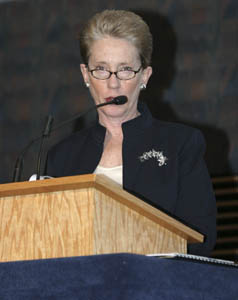
Speaker says global market is essential to students
International development ultimately helps the United States economy, defense and diplomacy, Susan Schram said Tuesday in the Taggart Student Center Ballroom.
International development assistance is the transfer of resources from the United States to developing countries, whether it be money, goods or technical assistance, Schram, a visiting speaker from Washington D.C., said.
Schram is the vice president of Agriculture and Cooperative programs for Agricultural Cooperative Development International and Volunteers in Overseas Cooperative Assistance and spoke as part of International Education Week [IEW].
IEW is sponsored by the U.S. Departments of State and Education in an effort to prepare American citizens to live, work, and compete in the global economy, and promote tolerance and the reduction of conflict, according to the IEW Web site, http://exchanges.state.gov/iew.
With the global economy of today, the money that the United States spends eventually comes back to improve the economy, she said.
“We are an interdependent world and are living in a global economy,” Schram said.
Foreign aid creates jobs and investment opportunities in America, she said. If the money sent to countries made their economy stronger that would in turn strengthen America because that country would be better able to afford our exports, Schram said.
Although the development assistance takes a long time, Schram said, 47 countries have graduated from United States assistance, including Costa Rica, Taiwan and South Korea.
Liz Allred, an adviser to the International Student Council, said “It’s through development activities that we can make a positive impact on people. It’s a way to promote peace and prosperity.”
Critic’s main problem with development is making sure the money gets to the people that need help, Schram said. The corruption and other problems in developing countries has impeded efforts from accomplishing their goals, Schram said.
The Millennium Challenge Account, created by U.S. President George W. Bush helps to make sure that such help does get to the right people, Schram said. The MCA has a set of criteria that must be met in order for a nation to receive development assistance, she said. The budget for the MCA was $1 billion last year and will be $1.5 billion in 2005, she said.
Since development is now a part of government programs it has become more political, Schram said. Development assistance now must help those in Iraq and the West Bank while the conflicts are still ongoing.
The government’s priorities for development assistance are to sustain the war on terror in foreign countries and fight HIV/AIDS in developing countries, Schram said.
“It’s important for students to understand what the U.S. does in the area of international development,” Allred said.
The state of Utah, Schram said, benefits from the global economy. The state exports $27 billion to 150 foreign markets.
Schram said students should take advantage of the many opportunities here on campus to form relationships with people that are from other countries.
“Chances are, your career will have an international component,” Schram said. “Take advantage of international assets on campus.”
Reynolds said students have many opportunities including international internships and study abroad, she said.
-krn@cc.usu.edu
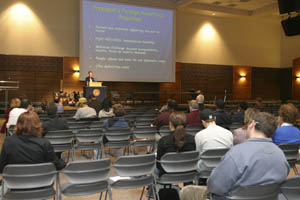
Students listen in the Taggart Student Center Auditorium to Susan Schram Tuesday. Schram´s lecture was a part of International Education Week and focused on the importance of a global economy. (Photo by Becky Blankenship)