

Student fees upsurging: Athletics, Campus Rec and more ask for a fee increase
Editor’s Note: This story has been updated to reflect the latest Fee Board Meeting.
The Utah State University Student Fee Board approved requests from Parking & Transportation Services and Campus Recreation. Their recommendations will be sent to USU President Brad L. Mortensen, after which they will be reviewed by the USU Board of Trustees and the Utah Board of Higher Education before final approval.
The board also voted in favor of the $10 increase to the spouse pass fee, which will follow a shorter approval process, as it is separate from student fees.
Tuition vs. Student Fees
This year, the university will conduct a five-year comprehensive review to determine whether certain costs should remain as fees or be moved into tuition.
USU Interim Vice President for Student Affairs Krystin Deschamps shared recommendations from the executive board after reviewing the fee board’s deliberations. Deschamps said one dean doesn’t believe any of the fees should be passed but should instead be moved to tuition.
“Shuttles take you to classes. It should be a part of your tuition. The museum where students might have a non-major art class, that should be tuition,” Deschamps relayed from the unnamed dean.
Fee board members voiced concerns that moving fees to tuition may eliminate the transparency of the student fee line-by-line system.
Parking & Transportation Services: increase of $1.73, Passed
Parking & Transportation Services requested a fee increase of $1.73 that would bring the total student transportation fee to $24. The fee increase would help to pay off bus upgrades, pay student employees and purchase a minibus.
Director of Parking & Transportation Services Tracy Hulse said they do not plan to ask for another fee increase for a few years. He outlined several ways the service is being improved, including a gradual shift to more accessible transit-style buses with a longer lifespan, a “request a ride” feature for the water lab route and a trial night route that will run from 10 p.m. to 12 a.m. for a two-week period during the spring semester. There are currently no set dates for the trial, but updates will be announced on the Parking & Transportation Services website and the Passio GO! app.
Hulse does not anticipate purchasing any new transit-style buses this year. Instead, they are considering purchasing a minibus to replace aging minibuses and to support chartering and “request a ride” services.
“If we didn’t see an increase, you wouldn’t see any kind of decrease in service,” Hulse said.
Student Kinsey Hill surveyed 578 students about their opinions on campus transportation and reported 87.89% of the participants supported a transportation fee increase of $1-3.
Campus Recreation: increase of $10.46, Passed
Executive Director of Campus Recreation Spencer Bitner proposed a fee increase of $10.46, the first fee increase from Campus Recreation since 2015.
The fee would cover staff wages for an aquatic coordinator, staff salaries, bouldering wall expansion, student fitness programs, hourly wages for group exercise classes, student wages and esports repairs.
Bitner explained 87% of USU students engage with Campus Recreation. They also hire over 200 student staff.
Currently, students can sign up for fitness classes for a fee of $35 per semester. Bitner said he hopes with the fee increase, these classes could be free.
School of Graduate Studies Senator Jamie Parry said that a PE credit could cost graduate students, who aren’t always considered full-time students, $600-700. Parry said she sees group fitness classes as a great alternative.
“I think that these group fitness classes at the ARC are a wonderful way — especially for graduate students, who I advocate for — to still be able to utilize those amazing instructors that we have on campus,” Parry said.
This year, Campus Recreation was in a $345,184.56 deficit, which it hopes to alleviate by increasing revenue and raising $195,552.56. This leaves $149,632, which it hopes to receive from student fees.
Student Alex Bodrero expressed concerns about Campus Recreation’s spending history.
“I would hate to throw money at a fire that might not be subdued,” Bodrero said.
Deschamps said the ARC bond, which Campus Recreation pays for, is very complex, but there is no evidence of fiscal mismanagement.
“These are programs that keep students here,” Deschamps said.
Spouse Pass: Increase of $10, approved by Student Fee Board
The Spouse Pass gives a student’s spouse, who is not enrolled as a student, access to campus services and events, including athletic events, Campus Recreation facilities, USUSA events, buildings on campus and concerts and shows for a $40 fee. The cost of the pass is separate from student fees, and married students who wish to purchase the pass must pay at the Office of the Registrar every semester. Each organization that gives access to student spouses receives a portion of the revenue generated by the pass fee.
Executive VP and Fee Board Chairmen Max Alder suggested raising the price of the pass, which has not changed since about 2010, to $50. The fee increase is less than it would be if adjusted for inflation.
“I am in full support of an increase,” said USUSA President Brandon Sorensen. “You’re getting a basketball, football, soccer, every athletics type of season pass for $14.25 a season, tickets to all the music and theatre for $3.50 and getting to use great gym spaces for $8.75.”
Some board members voiced concern the $10 is a random increase and not strategic but said they recognize the importance of keeping the pass affordable for young couples and families.
Nora Eccles Harrison Museum of Art: implement a $5 fee, Failed
Katie Lee-Koven is the executive director and head curator of NEHMA. She said additional funding will help the museum uphold its commitment to free admission for students and the community and allow the museum to offer more events for students such as art classes, date nights and concerts. She hopes to hire more student employees and increase hours for current student employees.
“We employ at any time eight to 12 students, and we have between four to six interns every semester,” Lee-Koven said.
Lee-Koven also noted with the addition of the Wanlass Center for Art Education & Research to the museum in April 2025, the museum is seeing more visitors.
“Ninety classes across the university come to the museum in a year,” Lee-Koven said. “With the new Wanlass Center, we’re already past 80 classes just from the fall semester.”
Student Events Executive Director and fee board member Josie Packer expressed concerns that the proposed fee is too high.
“I really can’t understand at this point why their events and marketing are so expensive. The budget that she had set aside for marketing is more than my personal events budget for the entire school year by over $10,000,” Packer said. “I’d really like to know exactly why that’s so expensive. I’m not saying it’s invalid, but I do think that their job is not to plan events, and so I think we should really be focusing on that when we vote.”
Other members of the fee board expressed appreciation for the museum and associated services.
“We are very fortunate to be a university that has an art museum of this size on campus. Most universities have art museums that are more the size of the Tippetts Gallery, which is very small,” said Caine College of Arts Senator Lily Takemoto.
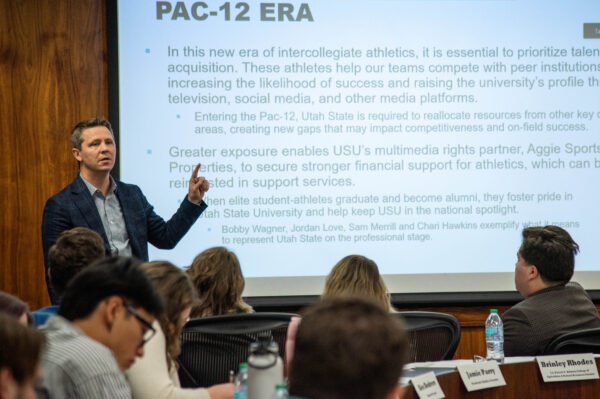
USU Athletics Director, Cameron Walker, talks about the change to the Pac-12 conference to USUSA Fee Board in the Senate Chambers on Jan. 21.
Athletics: Increase of $29.72, Passed
Vice President and Director of Athletics Cameron Walker requested a $29.72 fee increase that would bring the total student fee for athletics to $145.
Walker said the student fee would enhance the student athlete’s experience, improve mental health and wellbeing resources for student-athletes and elevate the university’s institutional profile.
This fee request comes after a $26 decrease a few years ago. Walker said he does not plan to return and request another student fee increase next year and noted universities with lower athletics fees charge students for tickets.
The university currently only employs a part-time nutritionist who Walker said cannot adequately support the needs of all student-athletes.
Fee board member Carter Guiness spent his first two years at Utah State on the Track and Field team and recognized the gap in nutrition support.
“To leave students that have just left home, that are working out for multiple hours every day, that probably don’t know a lot about nutrition or weren’t taught anything to just figure it out is kind of ridiculous,” Guiness said.
Beyond gaps in nutrition support, Guiness said stress adds another level of difficulty for student athletes the fee could help address.
“Student-athletes are consistently facing pressures where their spot or their scholarship is on the line,” Guiness said.
Beyond helping student-athletes, Walker said he believes a strong athletics program helps to showcase the university, something he finds more important than ever with the university’s decision to enter the Pac-12.
“We made a choice to compete with these schools. We need to be on par with these schools,” Walker said.
Walker described athletics as the university’s “billboard.” He believes improving the athletics program will bring awareness to university research and programs as well. He noted when the Indiana University Hoosiers achieved athletic success, the university saw more applications, larger first-year class sizes, more competitive students and more athletic revenue. He believes the same will happen at Utah State.
Some fee board members saw the possibilities for their departments more than others. S.J. and Jessie E. Quinney College of Natural Resources Senator Elijah Manwill hopes students in the nutrition program will be able to work with the USU athletes to gain relevant experience and believes that athletic broadcasts offer a significant opportunity to highlight student work in other fields.
“That little second clip where a robot that somebody built makes it onto a national TV commercial spot or you get a picture of students out in nature collecting samples that makes it into a national TV spot — that goes a long way,” Manwill said.
On the other hand, Takemoto said she doubts more money towards athletics would help fine arts students, many of whom, she said, don’t care about sports.
“There’s such little correlation with the fine arts and athletics, except for the marching band, which is not benefited at all by this fee,” Takemoto said.
Other board members also expressed hesitation. Packer recognized the need to improve certain areas of the athletics program but said she believes the athletics department should use other avenues to raise this money instead of raising student fees.
“I do not think it should be the student’s job to make sure that we have good athletics. I think that should be the athletics department job. We are an academic institution, and I really am against students paying for Bryson Barnes’s meal prep,” Packer said.