
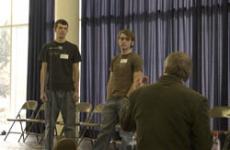
Student wins iMac computer in spelling bee
You have the right to repeat the word. You have the right to hear the definition. Anything you spell can and will be used against you in this spelling bee.
Participants in this year’s spelling bee were read their “spelling rights” and challenged by some of the English language’s hardest tongue twisters and rule breakers.
“I actually won a spelling bee in 8th grade,” speller Scott Seymour said. “But this ain’t junior high anymore.”
Twenty-five amateur spellers took the stage Tuesday to try their wits. Some spellers, like sophomore Gideon Oakes, even skipped class for a chance to win first place and take home a free $2,000 iMac computer donated by the Bookstore. The event’s organizer, Academic Senate President Michelle Lundberg, said the computer and other prizes represent the largest donation the bookstore has ever made to any single organization.
“Last time I did this I joined the Science Bowl,” said Oakes, even though he wasn’t in the math club. “We won $50 to the bookstore.”
This year’s participation was lower than previous years, Lundberg said. But there was a wide array of students without English intensive back grounds. Luis Ballester, a student from the Dominican Republic, said he was hoping for easy words. With English as a second language and having never participated in a Spanish spelling bee, Ballester said he wasn’t hoping to win the big prize.
“An iPod is enough for me,” he said.
While Ballester did not make his way to the final round, his first word was appropriately fitted to him: “barrio.” In English, a Latin subsection of a city. In Spanish, barrio simply means neighborhood. Ballester did advance past the first round.
A few students with backgrounds in ancient languages were expected to perform well. But some participants expressed frustration with the words they received. In the final round, some spellers received “mammonistic,” a word with Aramaic origins, while others received “monopsony,” deriving from Greek.
Possibly the most surprised participant was the winner, freshman Jordan Brimley from Salt Lake City.
“Hopefully they’ll have prizes for the other winners,” Brimley said before the competition began. “I could always get lucky and win the computer.”
Despite his surprise, Brimley, a mechanical engineering major, made it to the final round. In Business Week’s honor, one of the other sponsors of the event, the final round confronted the few finalists with the names of foreign coinage. Indonesia’s “rupiah” and the Netherlands’ “guilder” offered little challenge for the final contestants. But Brimley’s long-time friend, Eve Day, got worried when Thailand’s “baht” came up.
“When I heard ‘baht,’ I thought [he] was screwed,” Day said.
Brimley nailed the word. There was only one word left to go.
The other contestant, Tyler Pack, misspelled Hungary’s “forint.” Hearing Brimley discuss how he won is like listening to a coach explain a team’s tactic.
“He [Pack] threw an ‘h’ in there and I didn’t,” Brimley said. “I took the chance of going as simple as I could.”
Simplicity paid off for Brimley.
The event’s announcer, Professor Mark Damon, said the bee is like Jeopardy. He relies on a dictionary put together by the National Spelling Bee to provide words of equal difficulty. But, he admits, “It’s kind of luck of the draw.”
Some students majoring in ancient languages may have thought they possessed an advantage over their fellow students. Others felt they were treated unfairly by their word choices, such as ‘basilisk,’ a large serpentine creature.
“I knew I should have read Harry Potter,” said Matt Snarr after hearing his word.
-jfullmer@cc.usu.edu