
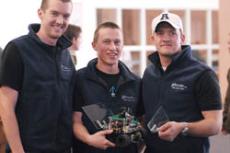
Student-made robots duke it out
Robots battled it out for a win in the Robot Sumo Competition in the Taggart Student Center Thursday afternoon where six teams of graduate students from the engineering department entered handmade robots in the competition for money.
The sumo competition was held to determine which robot could stay on a mat the longest. During battle, robots were only allowed to have ramps, made of plastic or aluminum, to help them potentially lift up other robots and push them off the mat. No other external devices or weapons, such as saws or blades, were allowed in the competition, said Yiding Han, an engineering student who participated in the competition.
“You can’t destroy the robots, no destructive methods,” Han said.
Han’s teammate Shayok Mukhopadhyay said, “We just hope that the (other) robots get on the ramp so we can push them off. We only have one, so maybe they will get on our ramp.”
During the competition, contestants were given a chance to compete their robot in three rounds of battle. The winners from those three rounds would then proceed to battle with other robots. The robots usually encircled each other or chased the other around the sumo mat.
In one battle, Jed Peters’ robot was flipped over by the opposing robot but still managed to break its plastic ramp.
“We did really well. We were returning champs from last year, so it was a lot of fun,” Peters said. “We put about 80 hours into our robot this year.”
Although Peters’ team didn’t win the grand prize of $250, they still walked away with $100 for participation and effort, and new ideas for next year’s competition.
In the end, Eric Ruben, Matt Pine and Chris Powell won the competition after pushing several opposing robots off of the sumo mat.
Team members Han and Mukhopadhyay said their robot took up to four months to build.
“We were up from 5 a.m. till today fixing problems. Our problem was that we kept burning (controller) chips,” Han said.
The controller chips are what allow the robot to move and react to the other robots, Han said.
When the robots are turned on, their internal processor signals the robot to move once they have seen the opposing robot, Han said. The teammates also explained that, after extensive trial and error research, they decided two batteries ran the robot efficiently.
“We used to use four batteries, but it was too much,” Han said.
Han and Mukhopadhyay were awarded $100 for their creativity.
-melissa.mcroberts@aggiemail.usu.edu
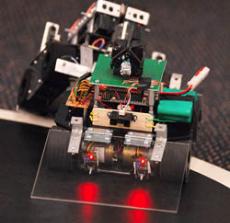
shown here pushing another robot over.