
Students advised tod rive safe in snow
Oh, the weather outside is frightful – and so are the driving conditions. Cache Valley got hit with its first major snowfall of the season just before Halloween.
With a combination of snow, ice and fewer hours of daylight to deal with during the winter months, drivers need to be extra cautious and remember some basic wintertime driving tips.
Utah Department of Transportation spokesman Nile Easton says it usually takes one or two storms before people remember how to drive in the snow.
“People seem to forget over the course of the summer [that] you should drive to the conditions of the road,” he said.
According to police reports, there were at least 22 minor accidents in Salt Lake City after the first snowfall and plenty in Cache Valley as well, especially in the canyons. Easton says the biggest problem that leads to accidents is people driving too close to other vehicles and driving too fast.
Officials say drivers should drop their speed down at least 10 to 15 mph in the snow – when roads are slick, drivers don’t have enough time to react. And when something does happen, people have a tendency to react quickly with jerky movements and by swerving, which cause more problems.
Easton recommends fighting the urge to react quickly and to allow extra space so you have room to correct.
“The number one thing if you’re in the snow is to maintain control of your vehicle,” he said.
Another important thing is to allow yourself extra time to get to where you need to go. Easton said it’s when people get impatient that they get into accidents.
Impatience is a big problem when drivers are behind snowplows, Easton said. He urges drivers not to pass snowplows – the fact that they’re out means there is snow on the roads.
“The safest place you can be is right behind a snowplow,” he said.
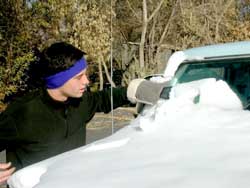
Lt. Joe Izatt of the Utah State University Campus Police Department also said it’s imperative before you get out on the road to clear all of your windows completely, rather than just scraping enough to make a little hole to see through.
Another key factor in staying safe on the roads in winter is to prepare your car for the cold weather.
“Winter is hard on vehicles,” Easton said.
Izatt said it’s important to make sure student’s vehicles are working properly and recommends keeping your car serviced, which includes getting a tune-up, having the oil checked and keeping an eye on the air pressure in your tires, which is affected by cold weather. If something is already wrong with your car, the cold weather isn’t going to help any.
Both Izatt and Easton also said snow tires are a good idea. Easton points out the importance of paying attention to the tread.
“Summer tires won’t do in the winter,” he said.
It’s also a good idea to keep your car supplied with essential items you’ll need to survive if disaster strikes, including a 72-hour kit, flashlight, extra clothing, blankets, a first-aid kit, water and extra food.
Driving in snow may be a new experience for some USU students from warmer states. Izatt advises students not comfortable with driving in snow to take the shuttle to campus or avoid driving until they are more familiar with how to handle winter road conditions.
-lstapley@cc.usu.edu
BEFORE DRIVING:
-Make sure your vehicle is in good condition, especially the tires.
-Have good snow tires put on early so you’re not caught without them.
-Clear ice and snow completely from your vehicle.
-Make sure the brakes, windshield wipers, defroster, heater and exhaust system are in good shape.
-Have freeze-resistant cleaning solution for your windshield wipers.
-Carry emergency items in your car, including a flashlight, first-aid kit, flares, washer fluid, jumper cables, tool kit, blankets/sleeping bags, gloves, paper towels, water and extra food.
-Always carry chains for your tires in your car. Know whether your car is front-wheel or rear-wheel drive – chains are installed on the drive wheels.
-Keep an extra ignition key in your pocket. Many people lock their keys in their car when they get out to scrape windows or do other things.
-Plan your route and allow enough travel time.
-Keep your gas tank full.
-Carry a CB radio or cell phone with you in case of trouble.
WHEN DRIVING:
-Slow down – cars need three times more space to stop on slick roads.
-Maintain a distance of six to eight seconds between your vehicle and the vehicle in front of you.
-Be deliberate in maneuvering your vehicle – don’t make any sudden stops or turns.
-If you start to skid, don’t hit the brakes. Ease off of the accelerator and steer into the direction of the skid.
-If you drive through standing water, lightly apply the brakes to dry them.
-If you hydroplane, hold the steering wheel steady and lightly apply the brakes. When your car regains contact with the road, slow down until you have full control of the vehicle.
-Never drive when you’re tired – stop every two hours or 100 miles to rest.
WHEN STUCK IN SNOW:
-Use sand, salt or non-clumping kitty litter and a small shovel to free your vehicle.
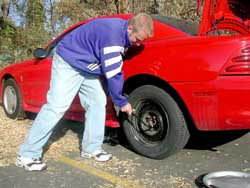
Chris Norris, a junior majoring in landscape architecture, tightens his lug nuts on his tire after putting snow tires on his car. (Photo by K’Lenna Murphy)