
Students Eat Bugs
They’re creeping and crawling – out of the dirt and onto your plate.
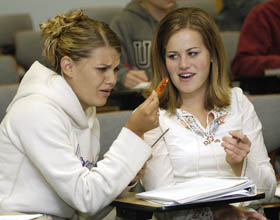
Thursday afternoon, Brooke Christensen, a student in Honors 1340, walked into class and was handed an orange sucker with an arthropod in the center.
She knew it was there, but proceeded to eat it anyway.
Christiansen, who is a sophomore majoring in elementary education and a teaching assistant for the class, said she didn’t know what to expect by eating the worm.
“I could feel the bumps and the ridges,” she said. “Then the girl sitting next of me told me to take a bite cause the worm was sticking out. I did – and it grossed me out.”
The bug eating was part of the lesson about different foods and cultures.
Sarah Gordon, assistant professor in French, said the purpose of the lesson was to show the myths most people hear about bug eating and also teach them about foods in different cultures.
Most people view eating bugs as a disgusting thing, she said, but that’s just how thay are viewed in our culture; even though some parts of pop culture try to mix in bug eating, it’s not fully accepted. Gordon said she knew the students would be able to understand that concept better through insect eating.
“I wanted to teach the extreme,” she said. “Bug eating is definitely something [this culture] is scared of.”
Gordon said the joke about returning soup because a fly was in it is where her inspiration to study insect consumption began. She has since taught her class much about entomophagy – the formal word for eating bugs.
People are always fascinated watching others eat insects, she said; it “thrills us, shocks us and pleases us.”
“Food creates community,” Gordon said. “Eating insects also creates community by getting the crowd involved.”
She said Fear Factor is a great example of the crowd supporting someone who is about to eat a worm.
“If you watch Fear Factor, the host tells them they’d eat it if they were starving,” Gordon said. “And the crowd loves it.”
The media even loves to report on it, she said. “It’s your typical man bites dog, not dog bites man.”
Gordon played three clips of Fear Factor to the class as it showed contestants eating bugs.
“Eating bugs can be food for fuel too,” Gordon said. “It even appears in some U.S. survival guides for the military.”
She said there are places all over the world that eat bugs as part of a meal.
After commenting on guidelines of the United States Agriculture Department (USDA), which allows peanut butter and jelly sandwiches to have 56 insect parts, Gordon asked the class who had a sandwich for lunch. The class responded witha few scattered sighs.
Even candies are made to look like bugs, Gordon said, which means people love to toy with the idea of eating them.
Kristen Young, a freshman majoring in nursing, described what it was like to eat a worm.
“It’s bitter and grainy,” she said. “Maybe if it was dipped into chocolate, I could do it again.”
David Sessions, a freshman majoring in psychology, said he wants to try a cricket sucker next time.
“I was sucking on the sucker. Then all of the sudden there was a worm in my mouth,” he said. “It had a sour ting to it and it was a little bitter.”
Gordon said she gave the class the suckers because the “chocolate covered ants weren’t that good.”
-srkrebs@cc.usu.edu