
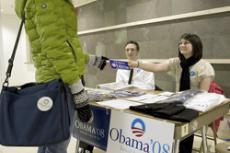
Students get ready for Super Tuesday
Tomorrow, Utah will join 24 other states holding primaries and caucuses to help determine the presidential nominees for the Democratic and Republican parties, and with a number of delegates up for grabs, Utah could have some influence in the decision process. Michael Lyons, USU political science professor, said he believes the fight for nominations could be over tomorrow. “The caucuses and primaries could, on Feb. 5, well establish the presidential nominee of at least one party and possibly both,” Lyons said. “Unless it is very, very close between two candidates, we’ll probably know who the nominees are.” There are so many states having elections, Feb. 5 has become known as Super Tuesday, and depending on the results of all those other states, Lyons said Utah will play a part in the final results. “Utah’s a factor,” he said. Candidates on the Democratic ballot are Joe Biden, Hillary Clinton, Christopher Dodd, John Edwards, Mike Gravel, Dennis Kucinich, Frank Lynch, Barack Obama and Bill Richardson. The Republican candidates are Rudy Giuliani, Mike Huckabee, Duncan Hunter, Alan Keyes, John McCain, Ron Paul, Mitt Romney and Fred Thompson. Lyons said for the Democrats, Utah could really be influential. With a close race between Clinton and Obama across the nation, every state matters. “The race between Obama and Clinton is fairly close. It’s unique, a lot of Utah voters are still undecided. Voters are still making up their minds, which could make Utah support matter. Utah won’t make a difference all by itself, but it certainly could make a difference.” With Republicans, however, Lyons said Utah’s winner is predictable. He said, “On the Republican side, it doesn’t matter. Mitt Romney will win Utah, and everyone knows Mitt Romney will win.” Polls in the area are open Tuesday from 7 a.m. to 8 p.m. Randy Guss, who works for Cache County and is part of their Information Technology personnel, said those who are affiliated with parties vote on their respective ballot. Those who are unaffiliated can vote on either ballot. However, to vote on the Republican ticket, unaffiliated voters must register with the Republican Party right before voting. He said those who wish to vote on the Democratic ballot need only verbally declare that they want to vote democratic. When casting ballots, Lyons said voters must realize their vote is dictating how delegates will vote at party conventions, which are held later this summer. Utah offers 23 delegates for the democrats. The Democratic Party divides the delegates proportionally based on votes, Lyons said. The democrats also have six superdelegates in Utah. He said superdelegates are higher party members who are elected officials that get to be a delegate. In the Republican Party, winner takes all, he said. There are 36 delegates in Utah for the republicans. A Democratic candidate need a majority of 4,049 delegates to win the nomination. Republicans need a majority of 2,380. To determine the division of delegates, states hold either primaries or caucuses. In primaries, voters cast secret ballots. A caucus, however, can mean a few different things, Lyons said. Most require voters to physically stand for their candidate. He said it is a body count and that there is usually not a printed ballot. Caucuses are not as user friendly, Lyons said, because, unlike a primary open all day, caucuses are held at a specific time. He also said standing physically under a candidate’s banner can be intimidating for some. He said it tends to have lower attendance, attracting mostly “hardcore political activists.” He said states with primaries see higher attendance. However, the number of participants in primaries still isn’t that high. Of the 60,000 registered voters in the area, Guss said in the 2000 presidential primary, only 10 percent voted. He said he doesn’t expect that number to be any higher this year. “To be honest, I only expect about that, but I could be surprised,” Guss said. “You never know.” During the last two weeks, he said there has been an average of 75 to 100 people per day voting in the early elections. There has been a large push for younger voters by many of the presidential candidates during this race. But whether or not students vote is not as important as their awareness, Lyons said. The most important thing, he said, is that students pay attention to politics and current events. “I think it is very important for students to be politically engaged and informed for their own benefit,” Lyons said. “In our society there is this growing division between an informed minority-I don’t mean politically informed but world events, understanding the world economy-and the two-thirds that know very little about the world.” He said understanding the world is key to success. Knowledge “makes you confident and competent in dealing with the world, whereas the uninformed two-thirds are intimidated by the world.” Aubrey Hill, president of the College Democrats and a junior majoring in anthropology, agreed with Lyons. With issues like education, the budget and the country’s standing in the world, she said political involvement is not something to be taken lightly. “It’s really important in your personal lives. It’s not some abstract thing,” she said. As a group, Hill said the College Democrats try to generate discussion and promote political activity, something she said she believes to be a civic duty. Politics, she said, is often perceived as a “nasty place, which it can be sometimes, but, knowing how it works, you can be a lot less cynical.” “It is kind of an anathema. People don’t want to think about it. We’ve got to overcome that perception,” Hill said. Hill said she and the College Democrats are looking forward to Super Tuesday. The group is not supporting any one candidate because there are so many differing opinions among members, she said, but they will be supporting the nominee, whoever that might be. She said they will be celebrating Super Tuesday with USU Students for Obama in the Taggart Student Center. Hill said they are having a potluck dinner and watching the returns. The College Republicans are also looking forward to Super Tuesday. Jaron Janson, chair of USU’s College Republicans and a senior majoring in political science, said the group will be watching the elections Tuesday with ASUSU in the Juniper Lounge. They will be there, he said, to “root Republicans on.” The College Republicans have been working to get students registered to vote. Last semester, Janson said they registered 120 students. They will also have a booth set up on Tuesday to remind people to vote. Janson said the College Republicans aren’t supporting a specific candidate either. However, he said the majority of the members are supporting Romney. He said during a Romney rally last semester, 40 USU students helped with the event. Janson said there were more USU students there than BYU and University of Utah students combined. Janson said he hopes students vote because this is a critical election, especially for Republicans. “This is a very divisive election for the Republican party right now,” he said. Whatever one’s political party, Janson said participating is important because, as Americans, voting is a civic duty and, as Lyons said he believes, awareness is key to success. “This is the chance people have. Politics is integral,” Lyons said. “You can’t understand the world without understanding politics. Do you want to jump off or get on board? Who wants to be clueless?”-arie.k@aggiemail.usu.edu