
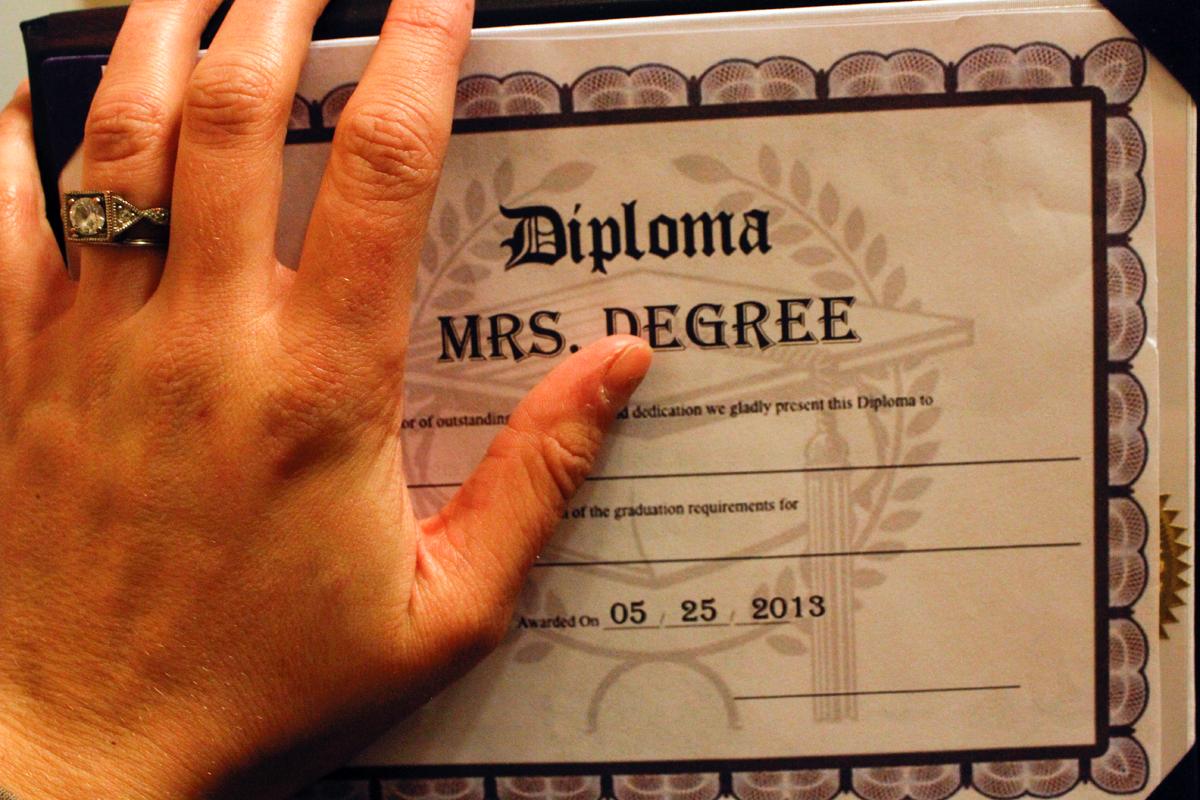
Students seek marriage in lieu of education
Getting an education and a degree that contribute to a career is the focus of many students at Utah State. For some, the goal is different – rather than seeking education as a means of independence and career opportunities, they see college as a means to acquire a spouse.
“I have never wanted to be a career woman,” said Kristen Bresee, whose husband is a USU student. “I don’t have goals in the academic or business world. I have more important goals at home rather than in the business world. Having a good relationship with my kids and family is more important than having a higher salary.”
Some feel the mentality of girls in Utah is to find a husband rather than planning out the rest of their lives.
“Girls, especially in Utah, come to find a husband and don’t really plan the rest of their life after that,” said Kaitlyn Rawlings, a sophomore majoring in elementary education and early childhood development.
Rawlings said she had a roommate whose goal in college was to become a mother rather than acquiring a degree.
“Being a mom isn’t the only thing, but girls could be limiting themselves and their future family if they don’t get their degree,” she said. “Lots of the time girls think that things will be easier and perfect after they are married, which is so scary, because so many things could happen. Your husband could get laid off, die or leave you. Then how are you supposed to take care of your children?”
Rawlings said she has experienced this first hand coming from a divorced family. She said were it not for her mother’s focus on education, her childhood circumstances and educational opportunities could have been negatively affected.
“If my mom didn’t have her degree, I would have suffered,” she said. “I don’t even think I would be able to go to college now if it wasn’t for her.”
According to Rawlings, knowledge and education are important aspects of rearing children and a balance between education and parenting should be sought.
“Everyone’s situation is so different,” she said. “You can’t say that one way is ultimately the right way. I think that extremes are what get to people. Being balanced in life is a good thing. You can’t be just a mom. If you get an education, you can end up using it just on raising your kids. Knowledge in that field helps you raise your kids. Parents shape how their kids are going to be. I think that if a person is planning on being a stay at home mom, a good field for them to go into would be FCHD.”
Some feel a focus on learning makes for enhanced parenting skills.
“Because of my education and career, I personally feel like it made me a better mom than I would have been otherwise,” said Patty Halaufia, head of the USU Alumni Relations office.
Halaufia said in her marriage, she wants to be able to pull her husband up when he is feel
ing down and him pull her up when she is down. She said for a marriage to be successful, both partners should contribute. Having an education and pursuing a career has helped them achieve this.
“In this state, it is really the norm to get married at a younger age,” she said. “I would have kids come up to me and say ‘Hey, I’m getting married.’ I would be like, ‘To who? You’re not dating anyone.’ They would say, ‘I met him a month ago.’ I guess they spent more time picking out their wedding dress than their future companion.”
Some feel the majority of girls attending college do so primarily for educational purposes.
“Nowadays, I don’t think too many girls go to school just to get married,” said Brady Sayama, a senior majoring in exercise science. “I think that most girls’ main focus in going to school is to get a degree, but there are definitely still girls just going to get them a man.”
Sayama said he has had experience dating both girls focused on marriage as well girls more of a career focus, and said there are notable differences between the two.
“The girls that want to get a degree seem to be more independent and they know what they want,” he said. “The girls wanting to get married seem more dependent on others, and they don’t know what they want as much. They are over-the-top, way too fast and they want things to happen way too quick, like meeting her parents after just three dates.”
Rawlings said she feels there are cultural pressures contributing to people getting married sooner. She said although some men might be threatened by the independence an education can provide, she feels it is important for her to get a degree.
“The LDS culture in Utah wants you to get married asap, and it is the man’s role to provide for the family,” she said. “You can see how it would be hard for a guy to not feel threatened of his manhood by being with a woman who has her degree and a successful career, but the guy I would want would want me to have a degree.”
Some students feel that independent women with plans for their life are less susceptible to marrying quickly because they are more satisfied with their lives and aren’t actively searching for a partner to complete them.
“Seems like to me there are more young girls who just want to get married than older ones,” Sayama said. “The girls that just want to get married are a lot easier to get to date you. The ones with their plans for life are harder to get. They seem more satisfied with life and are not looking for anyone to complete it.”
– haileehousley@gmail.com