
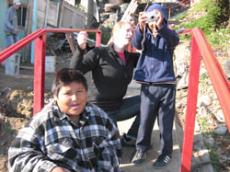
Students spent break giving a helping hand in Mexico
During the winter break, 19 USU students spent a week in Tijuana, Mexico, building houses and bathrooms and doing common household repairs for poverty-stricken families.
The students traveled with Charity Anywhere, a nonprofit organization, based out of Idaho Falls.
Bryce Jensen, senior majoring in exercise science, was one of the students who traveled to Tijuana. He said the people there are living in “pretty rough conditions” but were friendly and excited to see the improvements made to their homes.
“People were fascinated and really curious to what Americans were doing there in their neighborhood,” he said.
USU students helped 10 families during their stay, Jensen said. The students were divided into groups to work on separate projects. Jensen’s group built a bathroom for a family of five. The bathroom, 8-by-5 feet, was constructed from cement brick and wood.
Joey Stocking, sophomore majoring in business, was in Jensen’s group. He said the methods of construction used in Tijuana were primitive. Stocking said they had to mix cement by hand and use handsaws. Despite the hard manual labor, he said the family was eager to help them, teaching the group their building techniques. He said his group was also able to teach the people of Tijuana how they do things in America.
Stocking said the neighborhood in which they worked used to be a landfill. As they dug, he said they came across items like Barbies and hairbrushes.
“They were very poor conditions,” he said. “I felt very sad for them. It was a very humbling experience. It is just kind of a very different situation but it was also very cool.”
Whitney Stewart, senior in elementary education, also traveled to Mexico and helped build the bathroom. She said despite the poor conditions, the people of Tijuana were very happy and helpful.
“They have very little compared to what we have, but they were very willing to give what they had, no questions asked,” she said. “They were so willing to help.”
Jensen said one thing he really noticed was that their presence and work really united the people.
“I felt like the community sort of came together a little bit. They helped each other out. They were all in the same condition,” he said.
During their trip, Stewart said the students stayed in what used to be a hospital. The building, now owned by the Catholic Church, doubles as a walk-in clinic and a church.
Once their day’s work was complete, Jensen said they would spend time with the natives-going dancing, playing soccer, building bonfires and going to the beach.
One night they drove to the beach, and after a couple of hours, Stocking said they returned to their vehicles to leave, but his was gone. He said at first he thought he had forgotten where he parked. However, he soon realized it had been stolen.
“If I could have my car stolen at anytime, there was no better place for it to happen. Being already humbled by the whole situation, I couldn’t complain,” he said. “I worked with a family who never had a car and probably never will. It was hard for me to complain about my car getting stolen because I am so lucky to have a car.”
Stocking said he was OK after his car was stolen because, unlike some of the people living in Tijuana, he can go to work and, in a few months time, afford transportation.
The three students all agreed that traveling to Mexico and working there was a humbling experience. They said they realized how fortunate they were to live where they do.
“The problems I have aren’t that big of a deal,” Stewart said. “They are insignificant compared to what they have to deal with every day.”
-arie.k@aggiemail.usu.edu
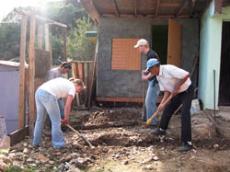
Whitney Stewart, Joey Stocking and Colin Wiest are helped by a member of a family in Mexico to dig footing for a bathroom. Construction methods used were very poor, Stocking said. The home is built on an old landfill and Stocking said they often found Barbies and hairbrushes while digging. (Joey Stocking)