
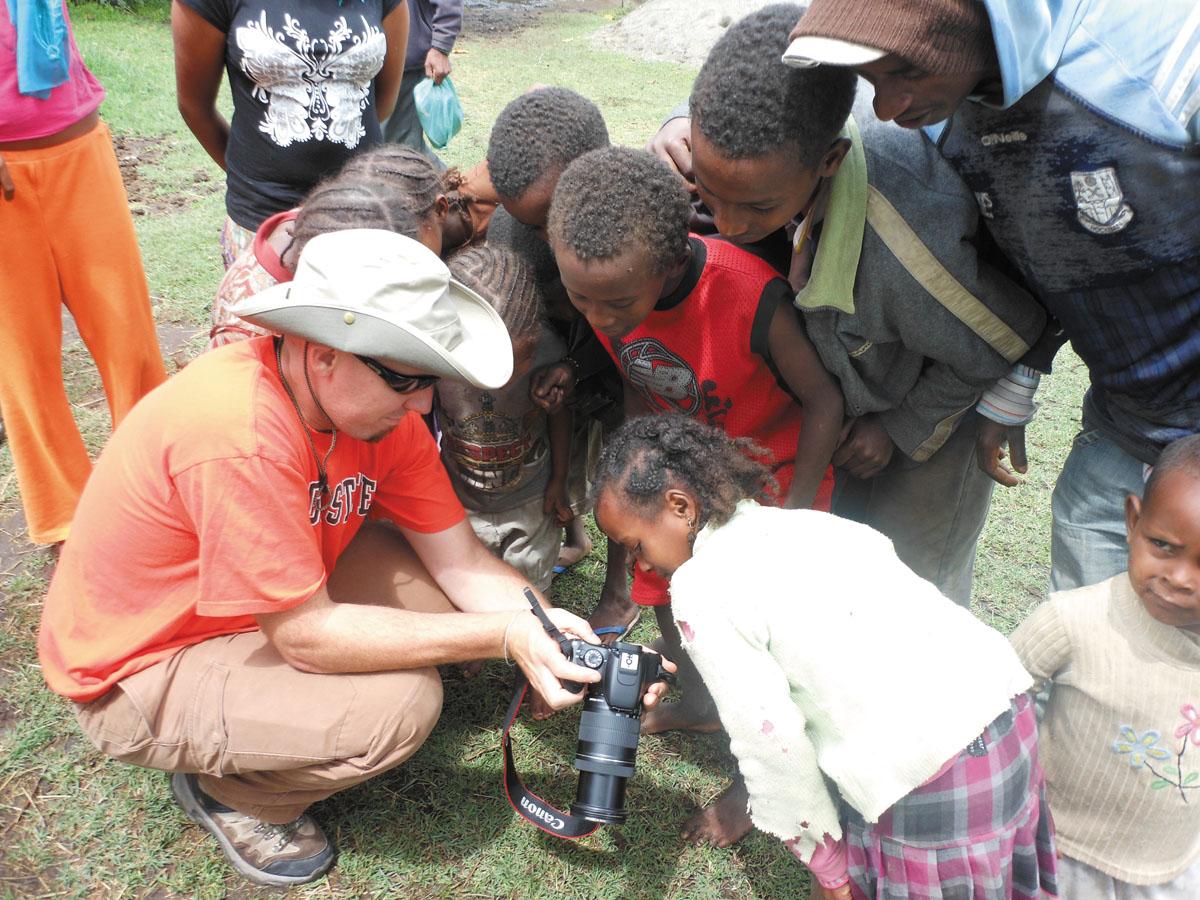
Students use stories to create change in Ethiopia
USU journalism professor Matthew LaPlante and three students reported on a trip they took to Ethiopia in the Agricultural Science Building on Wednesday afternoon.
While they didn’t bring clothing, medical services or build better homes, the students brought a different type of aid to the country by telling the stories of the people who live there.
Before becoming a professor at USU, LaPlante went to the southern rural part of Ethiopia to do a story on three different tribes that performed Mingi, an ancient practice of sacrificing infants. He wrote a story that was later published by CNN, but LaPlante said there were more stories from Ethiopia to tell.
“As often happens when you are engaged in acts of global project journalism, I left with far more questions than I had answers,” LaPlante said. “There were more stories to tell and so when I arrived at Utah State University a couple of months later, and I gave a presentation like this one, I mentioned that I was interested in going back and I said that I would be interested in bringing some students with me so that they could have an opportunity to tell their stories. It’s not like there is a lack of them there.”
USU students Mackinzie Hamilton, Danielle Manley and Dale Nicholas were the three students who went to Ethiopia with LaPlante. They conducted interviews, gathered information and told the stories of the people.
“It was a big challenge. It was kind of an audacious challenge,” LaPlante said. “It was a big financial commitment and it was a time commitment. It was a comfort commitment. They did this all for the promise of telling a story that hadn’t been told before.”
While traveling through the country, the students encountered poverty unlike any they said they had seen before. Nicholas said one of their biggest challenges was to try to stay focused on their responsibilities of telling the stories of the people without letting their emotions get in the way.
“You have to detach yourselves from the situation,” said Nicholas, who wrote his story on Ethiopian war veterans. “You can’t get emotionally involved in it or it’s going to affect how you are doing your job. Our job was to report. You are not there to do anything for them specifically. You are there to help them by telling the bigger story.”
Manley said she felt the same way when she wrote her story about an Ethiopian man who was making big sacrifices for his family. He was trying to become a professional runner to try to support his family financially.
“His family sold some of their livestock, which is their livelihood, so their son could go run,” said Manley. “He got swindled out of his money. He was just so sad. He was like ‘My parents think I’m on my way to Japan to go run in these races. I’m here, they don’t know I’m still here, they think I’m still going.’ In reality he’s just trying to save enough money to pay his parents back one day and eventually show his face because he’s so ashamed. You just want to go buy the livestock back for him or put your arms around him, but you can’t. You need to stay emotionally unattached.”
LaPlante spoke on the challenges of being a journalist in poverty stricken and problem filled nations.
“The thing that is your saving grace when you do projects like this is that you believe that what you do is good,” said LaPlante. “If you can’t wrap your mind around the higher principle of what you are doing, you will get lost. You will be compelled to try to change things, to try and help individuals, you will get bogged down. You won’t be able to do anything at all. I believe that what I do is good and important and because of that I can detach myself. I can walk past misery and filth and disease. It’s still not easy, but I can come home and feel okay about myself because I know that what I do matters.”
– rmhenline@gmail.com