
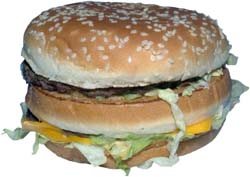
Super-sizing meals means upsized Americans
Two things in America are increasing: Portion sizes and people’s waist lines.
According to a Washington University at St. Louis Web site, two-thirds of United States citizens are overweight or obese. The question may be: Is bigger really better?
Larger consumption of food is widening society and this puts people at risk for heart disease, diabetes, stroke, high blood pressure, cancer and a decreased quality of life.
The Washington University site stated that “although it’s true that sedentary lifestyles and lack of exercise put us at risk for weight gain, it’s also true that many Americans are eating and drinking more than ever before.”
That same site compared statistics from 1977 and today. On a per-serving basis, today’s average American consumes: 93 more calories per serving of salty snacks (e.g. potato chips, pretzels and popcorn), 49 more calories per serving of soft drinks, 97 more calories per serving of hamburgers and 133 more calories per serving of Mexican food (burritos, tacos, enchiladas).
John Fauber, from Milwaukee Journal Sentinel, wrote in January 2003 that between 1977 and 1996, salty snacks, desserts, soft drinks, burgers, french fries, and Mexican food all have increased in size and calories, according to a study by the Journal of the American Medical Association.
A study at the University of North Carolina at Chapel Hill proves that research correct.
Study co-author Barry Popkin, a professor of nutrition at the university in North Carolina, revealed the only fast-food category that did not increase was pizza and even that may be headed in the same direction as restaurants have introduced extra-cheesy crusts.
Over the past 20 years:
* Hamburgers have expanded by 23 percent.
* A plate of Mexican food is 27 percent bigger.
* Snacks, whether potato chips, pretzels or crackers, are 60 percent larger.
Solid food isn’t the only problem either. Popkin’s research also showed that soft drinks have increased in size by 52 percent.
Locally, Lee Darley, a registered dietitian at the Student Health and Wellness Center, said, “If you think about soda pop … when they originally came out with the regular sodas, it was like an 8-ounce bottle. And then, you know, we went to the 12-ounce can and now we’re to the 20-ounce bottle and then the 1-liter bottle as one serving.”
Fountain drinks have also gone from big to gargantuan. In 1973, 7-Eleven introduced its popular Gulp drinks in two sizes: 12- and 20-ounces. Today, the drinks come in four sizes. The standard gulp is 16 ounces. The Double Gulp comes in at 64 ounces – that’s half a gallon and about 800 calories.
Darley also said the problem isn’t just the size, but the amount of time we give ourselves to drink these larger portions.
“Society has gotten to be a much more fast-paced society,” he said. “Women are in the work force as well. Traditionally, women were at home cooking meals but now that they’re in the work force, time is of the essence so quick meals are easy, so people are eating out more.”
Since portions sizes from eating out have gone up, Darley added, so has weight gain.
But eating out is not the only problem. Portions at home have also been increasing. Darley said since we get accustomed to eating more from other places, it continues in the home. He also said it’s easy to eat a lot without even knowing it.
“If you sit down in front of the TV and you grab the potato chip bag, you go on auto pilot,” Darley said. “You don’t really realize how much you’ve eaten because if it’s just in the bag, you just keep dipping.”
And all this means …
As of January 2003, the Journal of The American Dietetic Association found serving sizes on soda has increased 2 ounces, orange juice -1 ounce and beer – 8 ounces.
If a person were to consume an extra 2 ounces of soda a day for the whole year, by Dec. 31, that person would have added a total of 9,000 calories and a 3-pound weight gain to his/her diet. And that doesn’t include the calories or pounds gained by a person who also drinks alcohol or juice, too.
Darley said, “If you go from a regular whopper meal extra value meal that is not super-sized, it’s 1,200 calories. If you go up to super-sizing it adds an extra 300 calories.”
He figured that if a person were to super-size once a week, he/she would gain an extra four and a half pounds by year’s end.
“You can see how small portions can add up over a year,” he said. “Slowly, you’re putting it on and at the end of the year you’ll be heavier from last year’s resolution.”
And it all started …
In “Portion Distortion – You don’t Know the Half of It,” at www.newamerica.net, writer Shannon Brownlee informed readers about the truth behind bigger portions, fast-food and super-sizing.
She wrote, “Readers of certain age can remember a time when a trip to McDonald’s seemed like a treat and when a small bag of french fries, a plain hamburger and a 12-ounce Coke seemed like a full meal. Fast food wasn’t any healthier back then; we simply ate a lot less of it.”
Brownlee explained that today’s oversized appetites have to do with marketing strategies.
In 1983, when John Marin became CEO of the Taco Bell franchise he met with Elliot Bloom, a young marketer who had discovered that people didn’t care so much what they were eating at fast-food restaurants, but liked the idea that it was cheap and easy “to-go” food.
Martin figured he could capture a larger market if Taco Bell lowered its main menu prices and it worked. People didn’t spend less, they instead ordered more and cheap food induced people to order larger lunches.
By the late 1980s, several fast-food franchises had slashed their prices to the minimum and restaurants needed a new way to entice consumers. What they found was super-sizing.
By 1988, McDonald’s had introduced a 32-ounce “super-size” soda and “super-size” fries. Now, super-sizing is in several fast-food restaurants and companies aren’t losing a dime. Rather, they are making larger profits.
Darley said it’s a bonus for the producer and the consumer. The producer gets richer while the consumer is receiving a better deal.
Ashley Harris, the assistant manager of Logan’s Taco Time, said customers are eating more combo meals now and receiving discounts on fries and drinks that way. She also said that although most of their food has stayed the same in size, soft tacos have grown a little and drinks have jumped from 32- to 44-ounces.
Will it ever end?
“I think super-sizing will get to a point where it does have to slow down,” Darley said. “At some point people aren’t going to be able to drink that much even though it’s a good deal. But still, what they’re at now could allow for a steady weight gain for a long, long time.”
Until the super-sized epidemic slows, however, Darley said people can simply be more conscientious about their portion sizes. To USU students, he said they can add exercise to their lives.
“Are you walking up to school or are you taking the bus or driving? Do you take the elevator or the stairs?” he asked. “Daily activity matters. It can add up.”
-mnewbold@cc.usu.edu