
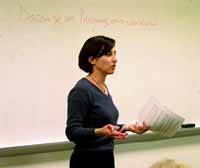
Technology changes participatory democracy, prof says
Television and the Internet are leading Americans to participate in democracy in unusual ways, a Utah State University professor found.
The Golden Anniversary Monograph Award went to USU speech communications professor Jennifer Peeples and her co-author Kevin DeLuca, University of Georgia, for the most outstanding scholarly monograph published last year.
Every year the National Communication Association awards up to three monographs, or journal articles, that have been influential within the speech communications discipline.
“We wrote the article, we got it published, and then the discipline decides which of the articles that have been published in the last year really got people talking or which are the ones that really got their interest,” Peeples said.
Peeples said she and DeLuca wrote about the 1999 World Trade Organization protests in Seattle to argue that people are influenced through media now, rather than “the old idea of what a participatory democracy was.”
Peeples and DeLuca argued that television, the Internet and other new communication technologies have led to new forms of decision-making. Peeples said that meeting together in a town hall face to face to influence each other to vote for a certain person doesn’t happen anymore. However, Peeples said, we still have a participatory democracy, it’s just different than it used to be.
“We’ve moved from what’s called a ‘public sphere,’ like town square, to the ‘public screen’ which is watching politics on the Internet or television,” Peeples said.
“The biggest thing about this paper was, it said that even though things have changed significantly, we still are participating in democracy. Average people can still take part and get their message out. They just have to do it creatively, in ways that get the attention of the media,” she said.
Now, after receiving the award, Peeples said she’s glad to know the things she and DeLuca wrote about were influential. She said it was nice to have recognition for the things they wrote because they’re “important both within the communication department and our society in general.”
John Seiter, a USU speech communications professor, has worked with Peeples for four years and said because the award was for the best articles in the field, not just the region, it was “really prestigious for USU.”
He read the monograph and said Peeples is very talented and a “phenomenal colleague.” He added her classes are always full because students love her.
Peeples earned her doctorate in speech communication and has taught four years at USU. Her classes include several speech classes and environmental rhetoric.
As for the future, Peeples plans to continue her research.
“Kevin and I are now working on another paper having to do with the [World Trade Organization],” she said. “That’s probably the biggest thing that kind of came out of this award, is that we’ll kind of continue to co-author in this general area.”
-mnewbold@cc.usu.edu