
The location for all your information
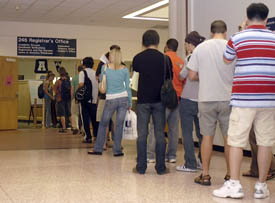
Utah State University isn’t Disneyland – it just feels that way sometimes when you’re waiting in line.
The Taggart Student Center is home to many offices and departments meant to aid and assist student in various aspects of their academic lives at Utah State University. However, with so many offices so close together, it is often hard for some students to know where to go for help.
Each office has a specific area of responsibility and is best suited to answer questions related to their field.
The second floor of the TSC is home to the Registrar’s Office, which is located in Room 246, across the hall from the USU Ballroom.
The Registrar’s Office is one of the busiest offices on campus. Students go there to make payments toward fees and tuition. It is also where students can add or drop classes.
The Registrar’s Office also is involved with grades. They provide official transcripts and can provide an avenue for students to make changes.
“If [students] discover an error in their academic record, something they want to petition to change,” USU registrar Glenn Davis said “they can come to our office and we can help them get started.”
Anyone who wants to get credit for foreign language or another subject through a test should also go to the Registrar’s Office.
They also help students arrange leave of absence or withdrawal from school there.
“Students can also come to this office when they need to verify enrollment,” Davis said.
Students may need to have their enrollment verified for insurance, employment or other reasons.
Like all the other offices on campus, the Registrar’s Office is trying to become more accessible to students through the Internet.
“Everything we do here has a form for it,” Davis said. “All of these forms are now available online.”
There are still many things that the Registrar’s Office doesn’t do. They don’t handle scholarships or evaluate credit transfers from other schools. Signing up and paying for continuing education or independent studies classes are done through the respective offices. Also, while they can explain and receive payments for student fees, they have no control over how much the fees are.
In the same room as the registrar’s office is the University Cashier. The Cashier deals more with the day-to-day business for faculty members, but does offer some assistance for students in matters of Pell grants and third-party payments, such as when a student’s employer helps with tuition.
Downstairs in the first floor of the TSC, there are more services students can take advantage of. One of these is the Financial Aid Office
“We process and award all the federal aid, grants and loans along with work study,” Judy LeCheminant, the director of Financial Aid, said.
“Scholarships flow through our office,” LeChemimant explained. “We have nothing to do with deciding who gets them, we just process them so students can use them toward their tuition.”
The Financial Aid Office has had some changes to their program and communicates primarily through e-mail. They encourage all students to check their USU account regularly to see if they’ve been sent any information.
“I’d like to encourage every student to come in a see what they qualify for,” LeChemiant said. “There’s only so much money, so I recommend people apply early – as in the February before the fall semester they want covered.”
Students confused about how to apply for federal assistance and what different options they have available to them should visit the Financial Aid Office in Room 106 across from the post office.
The Student Employment Office is in the same room as the Financial Aid people. They work together to help student with work-study programs.
Student employment also helps students find part-time and full-time jobs both on and off campus. They supply the job board – a listing of available jobs located just outside their office.
“Students can just go online, register and print out all the information on the jobs and how to contact the various employers,” said Paula Miller, the student employment coordinator. The Web address is www.usu.edu/studemp.
They do not, however, find people full-time work after graduation. For help with a search for a permanent job, Miller advises students speak with Career Services.
Down the hall in Room 102 is Admissions. Admissions has more to do with new students than current ones.
“We work primarily with high school students,” said Krystal Bryner, a sophomore in elementary education who works in the Admissions Office.
“The only thing we do for current students is work out any credit they have received through concurrent enrollment during high school or advanced placement tests. We also help people apply for residency.”
In the basement of the Eccles Conference Center are the offices of Continuing Education and Independent Study.
“Our major goal is to provide classes for adult, non-traditional students,” said Vincent Lafferty, the executive director over the program.
To accomplish this goal, USU offers many night courses for students to take advantage of.
“If we don’t offer the class for your major at night, we help by offering a path to get the student back on campus as best we can,” Lafferty said.
USU also offers distance education so that military personnel, nannies working out of state, or students from other countries can earn USU credit.
“Students get 52 weeks to complete a semester’s class,” Laura Wilson, the coordinator of Independent Study programs, said. “This allows them to progress at their own pace.”
Both Lafferty and Wilson warn that while “on-campus” students are also allowed to take advantage of these classes, there can be issues with scholarship. Financial issues are handled separately between Continuing Education and the Registrar’s Office. Students who have questions are encouraged to come in to speak with what Lafferty calls their “wonderful, friendly staff.” Information is also available on the Web at http://extension.usu.edu/continuinged.
-steveshinney@cc.usu.edu