
The show must go on
Neither ghost nor snow nor fire nor earthquake nor illness nor heat nor gloom of night nor war nor lack of money stays the actors of the Caine Lyric Theatre from the completion of their plays.
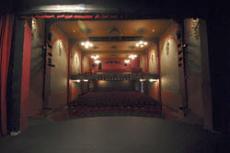
The Lyric has survived a lot since becoming a theater in 1913. The little red theater on Center Street has undergone many transformations, but following its most recent renovation in 2001 has finally come back to its roots.
When the Thatcher Opera House and bank burned down on April 14, 1912, it opened a spot for a new theater in town. Vosco Call, the founder of the Old Lyric Repertory Company said, “A couple of the local historians say Logan probably had the only paper in the United States that didn’t have the headline ‘Titanic Sunk.'” At that point, Call said a warehouse was transformed into the Lyric theater and hosted traveling theater companies who came into Logan.
It was after one such company came through in 1913 that the Lyric is rumored to have gotten its ghost. It is a tale of jealous actors. A company came through town performing “Hamlet”, and in the scenes with the gravediggers, the second gravedigger was getting more laughs than the first. Call said the story goes that after the company left town, the first gravedigger had a fresh new skull during his scene and the second gravedigger, Everett Jones, wasn’t with the company anymore.
Theatre arts Department Head Colin Johnson said anyone who works at the Lyric for a while has their own story about Everett. Common experiences people have are hearing a giggle or quiet applause or watching the chandelier sway above Everett’s balcony seat, Call said. Johnson said people working there alone at night will hear someone come in or see someone in the foyer, but when they go out to investigate, the doors are locked and they are still alone. People in the box office would sometimes see a figure on the stairs, call the police and when the police would search the building, they couldn’t find anyone.
Company Stage Manager Kris Bushman said because she is often the first one there and the last one out, she’s had a lot of Everett experiences.
“The one that scared me the most was once when I was downstairs turning off the lights. I finished turning off the lights, started climbing the stairs and all the lights came back on in the order I turned them off. I thought maybe I hadn’t pushed on the switch hard enough or something, so I went back down and turned them all off again. I started climbing the stairs, and they all turned back on. Finally I just said, ‘Everett, stop it, I want to go home.’ I turned them off and this time he didn’t do anything. It was a little nerve-wracking.”
“He isn’t malicious. Everett doesn’t hurt anyone or do mean things,” Bushman said. She said most people believe in the ghost, especially the technical staff who work late at night, although some are skeptical.
Two of those are Call and Jeremy Gordon, the public relations specialist. Call said the story got blown out of proportion when he visited a folklore class and embellished the tale of Everett based on actual events and theater lore. Call said Everett really did play in “Hamlet” in 1913 but was a temporary actor in the company because he was filling in for another actor, so it wasn’t remarkable that he wasn’t there after the play left Logan.
“I haven’t heard much of the ghost since elimination of the loud electric cowboy music from next door, so maybe that solved it,” Call said in reference to the Western bar the Lyric bought and turned into a reception area in 2001.
Gordon said he doesn’t believe in the ghost but said theater people are very attached to superstition and tradition.
“They don’t want anything to go wrong, and anything you can do to hang on to tradition or get the perfect show, you’ll believe in,” he said, adding that the story always adds interest for the younger crowd.
But even a belief in Everett hasn’t saved the Lyric from problems. Call said when the university got the Lyric, it needed a lot of work done because it had been a movie theater and warehouse from World War II until when USU got it. Snow was coming in through the vents, and the theater had to be renovated.
It wasn’t snow that worried Call the most.
“1964 was the last serious earthquake in Logan,” he said. “The electricity was out, and the Lyric was restored by then. My wife and I walked down the aisles, and stuff was crunching under our feet. We thought it was ruined.”
When they could see the theater again, he was happy to find a little bit of plaster had fallen in the aisles but none of the renovation had been damaged. However, the earthquake “caved in the fire wall and took out the tavern next door.”
The Lyric doesn’t stop for anything. Bushman said on the opening night after the 2001 restoration, one of the actors had to be hospitalized and another actor with a smaller part went on and performed with script in hand and prompts from other actors.
Call said about 10 years ago, a professional actor came down with hepatitis and the rest of the cast had to be vaccinated.
“The whole company went to the hospital and lined up to get shots in the bum. Somebody took a picture of it and I told her she could never show people,” Call said.
The theater has even survived attacks on the building. The theater has six national crests on the sides of the stage – England, Holland, Denmark, Spain, Germany and Sweden – and the American crest above the stage.
Johnson said, “Shortly after World War II occurred, someone came in, a rather unstable individual, and took a hatchet to the German crest and damaged it.” He said the eagle still has damage on its wings.
The most important function of the Lyric, Johnson said, is a training ground for advanced USU theater students during the summer when the Old Lyric Repertory Company puts on its main season of plays.
USU acquired the Lyric in 1961.
“I was very fortunate when I came to USU to make the acquaintance of Cy Clark, the common business manager for the Thatcher’s widows,” Call said. “He asked me if I thought the university would like to have the building, and I said I didn’t know about the university, but I sure would like to have it. The two widows didn’t talk to each other, and [Cy and I] got together and made a plan. One widow would have the dean over for tea. Eventually, they deeded the Lyric to USU.”
As one of few theaters nationally that still does repertory – a different play every night – Johnson said it challenges the theater students.
“We bring in national actors as guest stars to try and get as professional experience for students as possible,” Johnson said. “Our mission continues to remain as an advanced training program for students unlike other programs that were nurtured by a university but chose to then be individual from that.”
Call said repertory challenges the students to learn two or three roles and the discipline and concentration required to do so.
Ultimately it’s the history that keeps people coming back. Bushman said the actors and community feel connected to the building because of its history within Logan. The 2001 renovation even remodeled the building to look like the old 1913 theater.
From watching fireworks on the roof with the cast to sick actors and mysterious figures, the people who work at the theater and the patrons who come to the shows have a lot of stories.
-dilewis@cc.usu.edu