
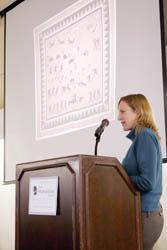
‘Through the textiles the women and men make, we are able to see the … effects of war’
The effects of war on countries are obvious-devastated landscapes, destroyed buildings, displaced people and, as Jill Stein believes, their weavings.
Weaving has traditionally been a part of many cultures. Using bright colors and designs, Stein said people’s creations typically showcase culture and traditions. During and after a war, however, she said the mood and depictions become something much different.
Stein, research assistant at the Institute for Learning Innovation in Annapolis, Md., spoke Tuesday as part of USU’s English department’s lecture series. Her lecture, also given as part of the “Weavings of War, Fabrics of Memory” textile exhibit, focused on cultures that have used the age-old tradition of weaving to depict and cope with the realities of war.
The greatest accomplishment of such works, Stein said, is the telling of a story previously unknown. She said the weavings tell the story of people largely ignored by media.
“We don’t see what is happening so much in personal lives. We see the bigger picture-this battle, that battle. Through the textiles the women and men make, we are able to see the everyday people and the effects of war,” she said. “We really need to see the consequences of war, our actions or military action on other people of the world.”
Stein spoke of the Hmong people, a minority living in Vietnam, whose woven story cloths changed drastically during the Vietnam War. Instead of weaving the traditional patterns, she said their pieces evolved to include planes, troop movements and the dead. Stein described the change as “quite jarring.”
As many refugees traveled to the United States, Stein said their weavings began to assimilate American culture. One cloth had a rock band playing in a show, something quite different than anything ever seen in Vietnam during the war.
Stein also discussed Chilean arpilleras, items made during a time of unrest similar to the experiences of the Hmong people. The arpilleras usually showed public executions and arrests.
While both groups made their weavings for profit, Stein said they were also driven by their displeasure with violence and political institutions. As they sent their work around the world to be sold, she said they also hoped to spread the news of the unstable condition of their countries. The work sold abroad was so effective in telling the stories of war and unrest, Stein said the Chilean government banned people from making them.
The thread, symbolic of the weaving and closeness of a culture, eventually helped to reunite people, Stein said.
“It brought people back together. They would come back to create something that connected them to their life before,” she said.
The story cloths and arpilleras were also a sign of hope for many, she said. While the design, colors and pictures may change, Stein said the tradition does not.
This is a practice continued in many cultures today, Stein said. When the United States invaded Afghanistan, she said women there wove pieces showing tanks and helicopters. While she hasn’t seen such products come out of Iraq, she said she can only imagine people there doing the same.
-arie.k@aggiemail.usu.edu