

TikTok’s fate hangs in the balance
One of the most popular social media apps in the world TikTok is rumored to be banned in the U.S. on Jan. 19. News of the possible banning has shocked mainstream media, sparking national conversation among TikTok loyalists, casual users and curious netizens alike, many of them wondering the same things: Will TikTok be banned, and if so, what does that mean, especially for the app’s users? Students and staff on campus at USU are asking similar questions.
Last spring, President Joe Biden signed the Protecting Americans from Foreign Adversary Controlled Applications Act into law, declaring online applications and platforms run by a U.S. “foreign adversary” would be banned in the country.
ByteDance, TikTok’s parent company, falls under this category. TikTok sued the government in response to the PAFACA Act passing, arguing the ban is an unconstitutional violation of the First Amendment right to free speech.
The question presented to the judges during the official Supreme Court hearing for the case asked whether the PAFACA Act violates the First Amendment. Though a decision has yet to be finalized, the ban is scheduled to take effect on Jan. 19, resulting in increased public discourse as the decision for the case continues to hang in the air.
“My first reaction was,‘Are we really trying to do this again?’” said Alyssa Watts, political science student at USU. “But as we’re getting closer to that potential date, it really did just hit me that this will more likely than not happen within a matter of days, which is really weird to think about.”
TikTok has become especially popular among young adults, many of whom have used the app for years as a source of global communication and connection.
“I really do believe that you can find a platform or community for anything on TikTok,” Watts said. “You’ll be able to find people you maybe couldn’t find in your everyday life.”
Videos from countries and cultures around the world can make their way to TikTok, exposing users to content curated to their specific interests and to content they wouldn’t have otherwise interacted with.
“It feels kind of like censoring almost,” Watts said. “Like saying, ‘Oh, we can only have U.S.-based media in the United States,’ and that almost cuts certain people off from other parts of the world that they may be interacting with and seeing on TikTok.”
Younger generations have found a sense of community and kinship among the subgroups and subcultures on TikTok, from LGBTQ+ communities to mental health groups.
“It could take away that community and safety of these people who might not be able to freely express themselves all the time,” Watts said.
According to Watts, the banning will most likely turn younger generations towards a new platform to take TikTok’s place.
“With or without a certain media app, those communities will still find each other, and connection will always still happen between human beings,” Watts said. “But I believe those communities are much stronger than just an app on the internet.”
Debra Monson, journalism and communications professor at USU, has seen the rise and fall of many popular social media platforms over the years.
“If it’s where you get your information, it’s where you get your understanding of what the culture is in much the same way that TV was for me and my generation,” Monson said.
For many young users, TikTok is the place to learn about what is happening in the world socially and politically, with a lot of its content being news-related.
“Getting your news on social media is not the problem. The problem is getting your news from unverified sources on social media,” Monson said. “TikTok being gone might create a vacuum in news delivery for college students.”
According to a 2024 study done by Pew Research, at least four in 10 American young adults are regularly interacting with news on TikTok.
“It’s not necessarily a freedom of speech question, it’s a freedom of access to information question,” Monson said.
According to Monson, the First Amendment doesn’t necessarily guarantee access to a platform. It simply guarantees the government isn’t allowed to arrest someone for saying something they don’t agree with.
“I think what banning TikTok does is it creates a hostile news and information environment,” Monson said. “It means that our levels of distrust across national boundaries are now moving into social media territories.”
Concerns over Chinese government access to user data on TikTok have been highly debated throughout this case. The government has kept the evidence for this claim classified from public review.
“I think a ban is going to make it much easier for other countries to look at us with skepticism when we make arguments of speech, access to information, human rights conversations,” Monson said. “It’s going to make us seem less dependable as a source, when we ourselves engage in information banning and shutting down of access.”
On Thursday, a U.S. official shared that Biden would not enforce the ban if it passed, leaving the next administration to put the ban in action.
The Supreme Court did officially hold the decision to ban TikTok as constitutional, and the ban took effect on the evening of Jan. 18.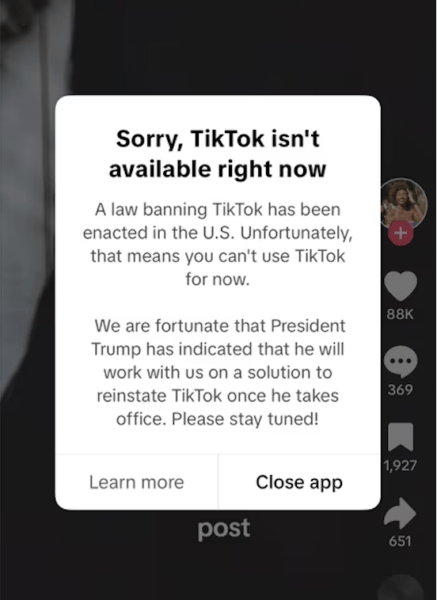
Hours after the platform had gone dark, users opened the app to find the message, “As a result of President Trump’s efforts, TikTok is back in the U.S.”
While TikTok has restored its services for now, it is no longer available in the app store. President Trump said he plans to issue a 90-day ban delay via executive order on Jan. 20.
“I’m asking companies not to let TikTok stay dark! I will issue an executive order on Monday to extend the period of time before the law’s prohibitions take effect, so that we can make a deal to protect our national security,” Trump wrote in a post on Truth Social. “I would like the United States to have a 50% ownership in a joint venture.”
This recent intervention has been met with praise from younger Americans and tech industry stakeholders, highlighting the evolving debates over technology, social media and national security.