
Transcendentalist Art Exhibit Now Open
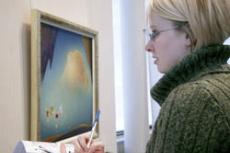
Golden rectangles, artistic spirituality and the abstract are now on display at the Eccles Art Museum in their newest exhibit, “Abstracting the Land: Southwestern Transcendentalism.”
To introduce the collection, guest speaker Lois Rudnick was invited to speak. Museum curator Victoria Rowe introduced Rudnick as director of the American studies program at the University of Massachusetts, a professor of English and American Studies, and a cultural historian.
In describing her various interests, Rudnick said, “I’m very broad, metaphorically speaking.”
Despite Rudnick’s broad range of expertise, she was not an expert on transcendentalist paintings, Rowe said.
“We sent the whole collection to Lois and she did the research to speak about it,” Rowe said.
Rudnick’s presentation described the history of transcendentalist art, the background of the various artists and the art’s relevance to the Southwest.
“She’s speaking exactly to this whole group of transcendental painters from the New Mexico area,” Rowe said.
Two of the featured artists are Agnes Pelton and Emil Bisstram, Rudnick said. She explained the two artists were part of a group of several people who founded the Transcendentalist Painters group in 1938. The transcendental artists of this time and of this group were on a “search for a state of oneness,” Runick said.
By creating this group, the artists hoped to “carry painting beyond the appearance of the physical world through new concepts of space, color, light and design to imaginative realms that are idealistic and spiritual,” Rudnick quoted from their manifesto.
She said the artists moved to the Southwest, particularly New Mexico, to further promote and enhance their type of art.
“Modern art was hardly the popular art of the region,” Runick said, but the artists were “deeply moved by the physical landscapes.”
Rowe said the collection is not only transcendental art, but includes a collection of Southwestern pottery done by an associate professor in the USU history department, Victoria Grieve. Grieve is also a curator at the museum.
When choosing what art would go best in the collection, Rowe compared the art they had with the expertise of their guest speaker. One unique aspect of the exhibit is that some of the art in the exhibit had never been out or even framed before, Rowe said.
“Oftentimes you put an exhibition together … so it tells a story,” Rowe said. “This story hadn’t been told. It was a story I wanted to tell, so I was delighted to have the opportunity to do this.”
The one-of-a-kind paintings on display represent a uniquely American form of art and way of thinking, she said.
Rudnick quoted one transcendental artists as saying it was “a remarkable fusion of the spiritual and the abstract.” The exhibit will be on display until May 3 at the Eccles Art Museum.
-liz.w@aggiemail.usu.edu