
True Blue: Student of the year
Biking to, from and across campus is an almost daily occurrence for Adam Christensen, and thanks to his efforts, other students can enjoy biking across campus whenever they want.
Christensen has been chosen as the Statesman Student of the Year because of his efforts to change campus policy to allow bikes on campus at all times and his role in the starting up of Aggie Blue Bikes.
A Twin Falls, Idaho, native, Christensen decided to come to Utah State University after having two older brothers attend here in the engineering department and decided to major in mechanical and aerospace engineering himself.
“I really liked the atmosphere and the idea that we had a canyon that close,” he said.
The outdoors have always held an interest for Christensen and he said what his parents taught him about land stewardship and outdoor awareness had a lasting impact on him. Christensen said one of his first bike memories was when he was learning to ride his bike on the lawn. He was still a little nervous and remembers jumping off to avoid crashing and – surprisingly – landing still standing, but his bike just kept going.
Now the owner of five bikes and the Aggie Blue Bike program coordinator Christensen has come a long way since that day. Sean Damitz, Utah Conservation Corps director, said Christensen has been giving input and helping since the bike coalition on campus began a few years ago, which helped to bring about Aggie Blue Bikes.
Christensen was working at the Outdoor Recreation Center when his position was changed to a full time, non-student job. He said he then began looking for “meaningful employment,” noting he just couldn’t work with fast food. At that point, he and Campus Recreation Director Kevin Kobe were talking about starting Aggie Blue Bikes and Christensen asked if there was any way he could take control of getting it started and get paid a little. With the help of Damitz under the UCC, this became possible.
“I was so lucky to be in the right place at the right time,” Christensen said while looking back on his journey with Aggie Blue Bikes.
Before starting Aggie Blue Bikes, Christensen, Damitz and Kobe had to get the policy changed that said bikes couldn’t be ridden on campus during peak hours – which would mostly be when they were ridden. With the help of ASUSU, the Faculty Senate and the Executive Council, he said they were able to get the policy changed so that bikes could be ridden on campus during peak hours.
They expected to encounter some glitches and negative feedbacks once the program started, but said they were met with positive responses.
“The only glitch we’ve had is not being able to provide enough bikes for everyone,” Christensen said.
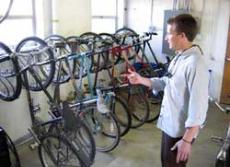
Currently all 15 bikes that are available are checked out. Christensen said that when they advertised last semester, they were met with a larger amount of people wanting to rent the bikes than they could ever handle. This semester they haven’t advertised, but are still staying in business.
Christensen said they plan to expand the program over the summer so that there will be about 60 bikes available in the fall and hopefully someday it will include 500-1,000 bikes. The bikes that are available are ones that have been donated and fixed up. Students may use their A-number to check them out for a month, with the option of renewal available upon returning them. It usually takes about one and a half donated bikes to make a complete Aggie Blue Bike.
“It’s like I’m making Frankenstein on every bike,” Christensen said.
The process is the same with every bike that comes in: take it apart, fix any wobbly wheels, paint the frame and reassemble replacing parts when necessary. Christensen said he plans to spend the summer fixing the bikes that fill a deck and shed behind the Aggie Blue Bikes, which is located to the east of the stadium.
The mission of Aggie Blue Bikes is to “help air quality, help people’s health and bring sustainability,” Christensen said.
He said he doesn’t mind doing these repairs because he wants to help improve the life of those in the community and for those who will live here in the future.
Education is more than just school to Christensen and being involved is a motto he said he lives his life by. He said we must look to the future and make the world we are living in a better place, not only for us know, but also for those who will come after us because our decisions directly affect them.
“[Christensen] represents a good model for a student who is concerned and involved in the community of Logan, Damitz said. “He is a highly motivated and dedicated student.”
After graduation, Christensen said he would love to do a cross-country bike-a-thon where participants perform service at stops along the way. Following this, he said he wants to go to law school and become a patent lawyer.
Christensen said he hopes that people will become aware of the benefits of bike riding and the positive effects it can have on you now and on everyone in the future. He said he wants people to become involved in making the world better and a more sustainable place to live in.
“It doesn’t matter if you know everything if you don’t do anything about it,” Christensen said. He has taken what he knows and put it into action, making changes that will last far into the future.
-albaugh@cc.usu.edu
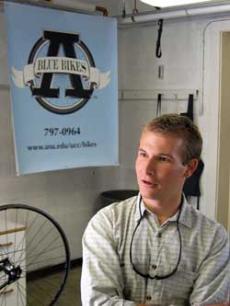
Aggie Blue Bike founder Adam Christensen was selected as The Utah Statesman’s Student of the Year for his involvement with the campus bike program. (Scott Erickson)