
Tuning up
Some in the audience will never hear a musical performance exactly like it anywhere. Others may not hear it at all. But, that’s kind of the point.
The 6th annual Multicultural Messiah concert is not just a musical performance of Handel’s revered oratorio; it also features interpretation of the performance in American sign language.
“It’s an experience when you get into it you know you’ll never forget,” said Andrew Beck, a senior deaf education major who is a signer for the program for the fourth time.
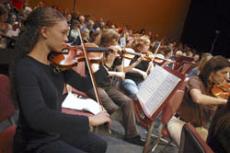
The Multicultural Messiah concert features Handel’s “Messiah” sung in English, with a portion in Spanish, by a chorus of more than 100 people and a 40-person orchestra, with 21 additional signers contributing the theatrical interpretive signing. The concert will be held today and tomorrow at the Eccles Theatre and March 30 at Peery’s Egyptian Theater in Ogden.
All performers involved are volunteers – people “from all backgrounds and all faiths become a real common unit,” said John Ribera, musical director and organizer for the event and deaf education professor at USU.
George Frederic Handel’s “Messiah,” written in 1741, is one of the best-known pieces of classical music in the world. While it is often performed at Christmastime, Ribera said Handel originally wrote for the piece to be performed in the spring.
Each year the performance has grown both in community support and in quality, said Ribera. Last year marked the first year the performance played in Ogden, and this year, the event is moving from the Kent Concert Hall to the more intimate Eccles Theatre, which will “allow the audience to interact with the performance,” Ribera said.
“To my knowledge, ‘Messiah’ has never been theatrically interpreted anywhere (outside of these performances),” said Freeman King, who directs the interpretive signing for the performance and is a professor in the deaf education department at USU.
The idea for this unique performance of the “Messiah” came from watching the film “Mr. Holland’s Opus,” Ribera said. He said he was moved as he watched how Holland, a music teacher, communicated musically with his deaf son in the film. Ribera began thinking of staging a musical performance that both deaf and hearing audiences would enjoy. Because of Cache Valley’s Latin-American population, Ribera also decided to perform a portion in Spanish.
The production takes up to three months of work with the orchestra, chorus and signers, Ribera and King said. However, despite the time commitment, many volunteers come back each year. Joan Barrett, a Millville resident in her second year of the production, said she has been in multiple other production of “Messiah,” but this one is unique. She loves the camaraderie among the performers and the spirit of the oratorio.
Everyone interviewed about the performance said the “Amen Chorus” at the conclusion of the show is a highlight. The chorus sings “amen” repeatedly for several minutes. Beck said the repetition of the song makes it difficult for the interpreters. Instead of translating the lyrics, they instead “expand on the emotional quality of the music,” Beck said, by telling the whole story of Christ during the repeated “amens.”
“It brings a tear to your eye,” said Lauralee Choate, a former USU student and a soloist in this year’s performance.
Performances of the Multicultural Messiah begin each night at 7. Tickets range from $5 to $10 and can be purchased at the Cache Center for the Arts in the Eccles Theatre, located at 43 S. Main. Proceeds go to support the speech pathology and deaf education department’s annual humanitarian trip to Mexico.
“It’s a good deal. (We) have such a high quality production that people will want to come back year after year. And people have (come back).”
-tliljegren@cc.usu.edu