
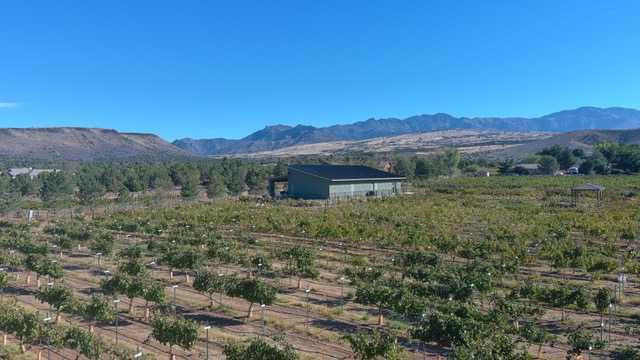
USU Agriculture makes its way to southern Utah
The donation of the Dammeron Valley Vineyards isn’t official yet, but Utah State University Extension faculty are already imagining a new model of community-based agriculture in southern Utah.
Utah State operates several extension centers and gardens throughout the state, including the USU Botanical Center in Ogden, which focuses on ornamental and horticultural demonstration gardens and offers community classes, and the Swaner Preserve & EcoCenter in Park City that functions primarily as a nature preserve. Unlike other extension centers, the vineyard would be the first site primarily focused on agriculture.
“This would be the first such facility in the southern part of the state and would focus on grape production and possible other desert agriculture opportunities,” wrote Ken White, the senior vice president of statewide enterprise in an email to The Utah Statesman.
Despite still being in the early stages, USU Extension faculty see the potential in the new center.
Benjamin Scow is an extension assistant professor in Washington County with a background in fruit production. During his time at USU, he has worked with a few vineyards, including Dammeron Valley Vineyards. He says the landscape of Utah viticulture, or grape cultivation, has changed significantly in recent years.
“About 15 years ago, there were less than five wineries in the state with an associated vineyard,” Scow said.
Now, there are close to a dozen, and Scow explained the growing industry needs new resources. The vineyard would provide a place for researchers to study water consumption, pest identification and mitigation and what grape varieties work best in Utah’s climate.
“We’re hoping that it could give an opportunity for some grad students and specialists to come down and work in a climate that’s different than Logan to better represent the state,” Scow said.
The backbone of the proposed center would be hands-on community engagement, offering workshops and classes to the public. The focus would be viticulture, but visitors could also learn about cut flowers, fruit and nut trees, horses, livestock and gardening.
Sara Bair, president of the young farmers and ranchers club, said she believes many people have a natural interest in agriculture.
“Agriculture is something that a lot of people are really drawn to, especially with plants and animals,” Bair said. “I think that it’s really essential for the future of the industry to be able to help people who don’t come from agriculture to learn how to be involved.”
With a major in agricultural education and a minor in nonformal and community-based education, Bair has seen many of the benefits of public education firsthand.
“There is not a huge percentage of the population, nationwide and in Utah, that is directly involved in production agriculture, and along with that, there are a lot of misconceptions and misinformation that can get spread,” Bair said. “In my experience, one of the best ways to fight that is to give the community the opportunity to participate, to see what farmers and ranchers are doing, and to ask them questions directly.”
Bair also has experience working in a county extension office, which runs programs like 4-H and uses university research and resources to help with everything from lawn problems to fruit production.
“I’ve seen a lot of benefits of extension from that side of things in having a resource that’s open to the public, where people can come and ask questions and we can tailor what we’re providing to the needs of the specific community that we’re in,” Bair said.
Scow is excited for the center’s hands-on component that will allow students and members of the community to learn about agriculture in a real-world setting rather than a classroom.
“We don’t have very many of those centers across the state where people can actually go and visualize how something actually functions and works and get some practice hands- on,” Scow said.
The donation is not yet finalized and may take several months or may never happen. Still, USU Extension faculty are envisioning the possibilities of community-based agriculture and its implications for the state.
“We feel like it has an excellent opportunity for success here at USU. There are programs in some of the surrounding states and there is every indication that viticulture could be a viable program and emerging industry here in Utah,” White wrote.