

USU Breakdancing Club prepares for battle
Keith Wille and Ben Allred practice scissor-kicks, baby-mills, barrel-rolls and kip-ups in the middle of a blue gymnastic mat.
Not quite a place to expect breakdancing, but that’s exactly what Wille and Allred can be found doing almost every night of the week.
“It’s creativity to the fullest,” Wille said. “Whatever your body can take.”
Wille, a junior in aerospace engineering, has been president of the Utah State University Breakdancing Club for one and a half years.
The gymnastic room on the second floor of the HPER is used to practice such an athletic type of dance. The springy blue and gray padded floor keeps the dancers from getting hurt when they fall or land wrong.
It’s a great place for the Breakdancing Club to practice flips, Wille said.
He started watching B-Boys, break dance performers, in Salt Lake City at Uprok Records three years ago. B-Boys dance in a room in the back of the store almost every weekend, and hold a battle once a month.
“I thought it was a dance that no one does. I thought it would be cool to try,” Wille said.
“On Friday and Saturday nights you’ll see someone there,” he said about B-Boys at Uprok. He said if you just ask them, they’ll teach you, or at least they’ll tell you what you’re doing wrong.
Wille said he goes to Salt Lake City whenever he gets the chance, but in Logan he teaches himself, and whoever else wants to learn.
Allred, a freshman at USU who plans to be a high school history teacher, joined the Break Dancing Club when he first came to USU.
He said in high school he got involved in capoeira, a Brazilian martial art and said breakdancing had a lot of the same physical aspects, so he and a few friends started a breakdancing club.
“If I breakdance three times a week, I have no stress,” Allred said.
As Wille practices he wears elbow pads, and his right elbow pad is covered in silvery-gray duct tape. The duct tape makes it easier to spin on the ground. He said it’s not necessary to wear pads, but they help, and “they look cool.”
Wille’s feet move quickly as he does “top rock,” meaning dancing on his feet – no hands at all. He goes into a handstand, his legs straight up in the air and moving back and forth, like scissors. Meanwhile, his hands hop up and down to keep his balance. This move is called a scissor-kick.
He then lands on his back, and does a kip-up. A kip-up is when you simply pop up from your back to your feet without using your hands. This move came from karate, Wille said.
Most injuries Wille has had are sore wrists, sore muscles, bruises and rug burns. Whenever he has been hurt, he said, it was because he knew he was doing something stupid.
An example, was of a time he lifted himself, using his hands to support his weight. As he was in the air he knew he had extended his thumbs out too far and they couldn’t support his weight when he came back down. Sure enough, he said, when his body came down his thumbs bent back and one of his thumbs popped real loud and hurt for a week.
“If you’re taught by someone, you won’t get hurt,” Wille said.
The Breakdancing Club is a place to be taught. He said the club existed unofficially for two-and-a-half years, but officially, meaning registered with the University, for one year and a half. The club meets at 8:30 p.m. Monday through Thursday each week in the HPER Building Room 203.
Wille said anyone is welcome to learn and practice with the club.
“This is important: No matter what gender or strength someone is, they can do break dancing. It’s easy to learn, but hard to stick with,” Wille said. “It’s all about friends.”
Wille explained some basic steps in break dancing. He said the six-step is the move that you learn first. The dancer puts both hands on the ground in front of then for support as their legs move in a counter-clockwise circle under them in six steps.
After that a person learns freezes. A freeze is a move that you hold for a few seconds. Usually a freeze is performed with the head, hands or elbows supporting the body, with the legs are in the air.
After the freezes come power moves. Wille said power moves are ones that nobody has done before, something that impresses. This could be a combination of moves and spins.
According to a 2002 National Public Radio report, breakdancing began as a means for Bronx rival gangs to set the location for rumbles and mediate differences.
“Bronx-area gangs in the mid-1970s would meet on neutral territory for a party, the day before a rumble was set to take place. The dance-off, which pitted the gang leaders against each other, mirrored the upcoming confrontation and was used to determine whose turf would play host to the rumble,” according to the NPR report.
The break dancing in Logan is not based on gangs and rumbles. Instead, Wille said, breaking unites people. He said people who would never talk to each other get to know each other. He gave an example of becoming friends with a “homeless guy who was gangster to the fullest.” He said if they didn’t have breakdancing they wouldn’t have ever talked.
Even though breakdancing unites people, they still have competitions, or battles.
According to the NPR report, “The winner was the one who could bust out moves that hadn’t been witnessed before; who could do something the other guy couldn’t match.
At 7 p.m. Thursday in the Taggart Student Center Ballroom, the club will sponsor a competition called “Busta Groove.” The reason for battles in Utah is to show skills against competitors.
“It’s a show-off dance,” Wille said. “[Breakdancing] is the coolest thing in the world.”
He said he thinks about it all the time. When he sees a hardwood floor, he just wants to spin on it. Moves and combos occupy every moment of the day, he said.
“This dance is infectious. Once you start you can’t stop,” Wille said.
-hrw@cc.usu.edu
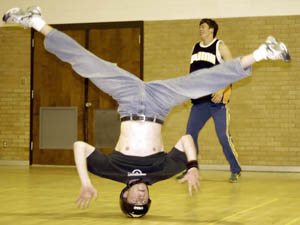
Keith Wille pulls a Headspin while practicing breakdance moves in the HPER Monday evening. (Photo by Joel Featherstone)
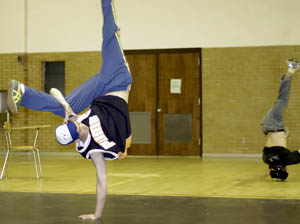
Danny Pond holds a freeze while balancing on one hand and Keith Wille practices a headspin. (Photo by Joel Featherstone)