
USU engineers compete for best gadget: Calculator quick-draw competitions, balsawood bridges take the stage
Civil engineering students gathered in the International Lounge Thursday to put their engineering abilities to the test as part of Engineering Week.
Groups of engineering students gathered in clusters around tables laden with scraps of metal, wire and plastic, building what they hoped would be the winning gadget. Nicholas Maughan, a sophomore majoring in engineering, tried to build a streamlined bottle rocket.
“It would be best if you could devise a way to make wings that pop out at the highest point of the arc,” he said.
Utah State University’s chapter of the American Society of Civil Engineers has contests every year to see who among them can build the balsa wood bridge that holds the most weight, the magnet cannon that shoots the farthest and the bottle rocket that stays in the air the longest. Other contests included the calculator quick-draw and a sumo-bot competition.
“It’s just for fun. We do it every year,” said Melissa Powell, a junior majoring in civil engineering and secretary for ASCE. “It’s a tradition.”
The sumo-bot competition had only three teams competing, but was still more competitive than last year’s competition, said Austin Jensen, a senior majoring in electrical engineering, whose robot won second place.
Jensen said it took his team two semesters to build their robot.
“We worked on it 20 hours a week at least since the beginning of the semester,” he said.
The robots are “fully autonomous,” Jensen said. They simply turn it on and let it go.
The object of the competition is to push the opposing robot out of the ring, just like in sumo wrestling.
The robots have sensors that tell them where the other robot is and they move towards each other, stopping if they reach the line marking the edge of the mat.
Jensen said his team’s robot was better than the others because it could go backward and forward.
The others had to turn around when they hit the edge of the mat. The reason they lost, he said, was the winning robot had more power.
The sumo-bot contest winners took home cash prizes of $500, $300 and $100. Since there were only three teams, everyone was a winner.
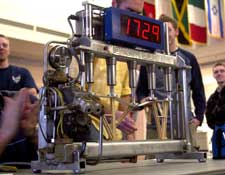
The balsa wood bridge contest drew 15 student contestants and one professor. A ring of curious students and engineers surrounded a machine in the lounge that put pressure on the 12-inch bridges until they snapped. The winning bridge held 1,729 pounds.
The bridge that broke under the least amount of weight was built by Evan Bullard, a sophomore majoring in mechanical engineering, and crumpled under 151 pounds – though some of the onlookers called it “the most aesthetically pleasing.”
“You’re welcome,” he told onlookers in response to their laughter.
Briant Jacobs, a senior majoring in civil engineering and the president of ASCE, said the contest was held every year. Jacobs’ bridge held a little more than 500 pounds. None of the officers in the presidency of ASCE had bridges that survived past 600 pounds.
“It’s amazing. You take flimsy piece-of-crap wood and it holds a couple hundred pounds,” he said. “When I made my bridge, I cut the wood with scissors.”
Jacobs said building with balsa wood can be frustrating.
“Sometimes you’re cutting and the scissors are going the wrong way. You need a 32-degree angle and you’re cutting a 35,” he said.
Brian Crookston, a senior majoring in civil engineering, said more things break than bridges in the contest – sometimes someone’s confidence gets a little bruised, as well.
“Every now and then, we’ll get someone with a big ego who says, ‘Oh, that’s exactly where I calculated it would break,” he said.
Bryan Heiner had the winning bridge, which held 1,729 pounds before breaking. The second- and third-place bridges held 1,661 pounds and 1,552 pounds. Heiner, the first-place winner, won a Hewlett-Packer calculator.
Also held Thursday was the Beta Bowl, put on by the Tau Beta Pi engineering society.
The contest, similar to Jeopardy, quizzed participants on general trivia. Eight 3-member teams participated, and the winners received digital cameras.
“I was excited to win,” said Andrew Stromness, a senior majoring in civil engineering and a member of the winning team. “I got third place last year and there are better prizes this year than last.”
-ella@cc.usu.edu