
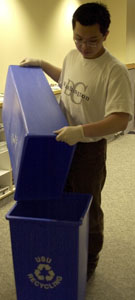
USU faces off in national recycling competition
Utah State University Recycling has entered into a 10 week competition Feb. 7 with 49 other universities throughout the nation to see which school has the highest on-campus recycling rates.
USU and Brigham Young University Recycling have also set up an in-state rivalry. The school with the highest recycling rates will win an award from the Recycling Coalition of Utah, said Jay Price, Ecological Coalition of Students president and recycling education coordinator.
There are two separate competitions: one for the resident halls and food services and one for the entire campus, he said. In the BYU-USU competition, USU is currently winning the resident halls and food services portion, but “I don’t foresee us winning the campus competition,” Price said.
“This week we had comparable numbers, but they kicked our butts the first week,” he said.
The housing competition, measured per capita, ended the first week with USU recycling at 1.11 pounds per student and BYU recycling at .99 pounds per student, according to the contest Web site, www.recyclemaniacs.org. Of the trash accumulated on campus, 17.55 percent was recycled on the USU campus, and at BYU, 27.80 percent was recycled.
Price said the higher numbers are partly due to the greater number of containers BYU has on its campus.
“The university is three times larger than ours, but they have five times more containers,” he said.
A bill was presented Tuesday to the Associated Students of Utah State University to get recycling bins in each of the 120 classrooms on campus, Price said. Each bin costs $6.36, Price said, bringing the total dollar amount needed to $1,000.
Additional bins would help USU Recycling reach its goal to increase total recycling to 30 percent by the end of the fiscal year, Price said. Last year, the university recycled 24 percent of its waste, he said.
“I see a lot of people just throwing stuff away,” said Chris Tingey, a junior majoring in English. “I think having more containers would help.”
Recycling is important for the university because it saves money, Price said.
“The nice thing about [USU] Recycling is that even with 10 student employees, we don’t use student fees to pay for costs,” he said. “We are basically breaking even, while students are paying out their ears for maintenance on campus.”
USU Recycling is able to break even because they sell the items they collect, he said.
Transporting trash is also expensive. It costs $27 a ton for trash to be picked up from the university, Price said. Besides financial benefits, Price said recycling helps society be less wasteful. The landfill in Logan is filled almost to capacity, he said.
Andy Bingham, a junior majoring in business, said, “I am a conservative kind of person and I hate the thought of wasting anything. It makes me feel good to get the most use out of something. I think Americans are very wasteful.”
Recycling statistics of all the universities involved can be viewed at the Web site www.recyclemaniacs.org. The competition will run for eight more weeks.
-ashschiller@cc.usu.edu