

USU hosts first campus-wide Native American Heritage Day
Editors note: This article was updated on Nov. 11 at 1:07 p.m. to reflect the correct organizers of the event.
Drums and song echoed through the Utah State University Mehdi Heravi Global Teaching and Learning Center on Nov. 4 as students, staff and community members came together to celebrate Native American Heritage Month with a first-of-its-kind event.
The Native American Heritage Day event was hosted by USU’s Center for Community. This celebration welcomed Indigenous leaders, educators and dancers, as well as other local organizations, to come and share the history and culture of the Native Nations. The Native American Student Council also participated by tabling at the event.
Faustine Saganey, program coordinator of the Center for Community, said her past experience at USU as a former vice president for the council and as Miss Native American shaped how she integrates culture and community connection on campus.
“The Center for Community’s mission is to support student engagement through educational programming and shared experiences,” Saganey wrote in an email to the Utah Statesman. “The event intended to offer a shared learning environment where students could gather, engage with cultural history, and connect as a campus community.”
The event began with an honor song by the Scout Society, a drum circle group who performs at powwows, drum circle competitions and other Indigenous-based events across the United States.
The opening honor song was followed by keynote speaker Melissa Tehee, associate professor of psychology at USU, and honored guest Jason Walker, chairman of the Northwestern Band of the Shoshone Nation.
Tehee spoke on the importance of recognizing USU as a land-grant institution built on Indigenous land and shared a few lines from the universities first land acknowledgement officialized in 2021.
 Elise Gottling
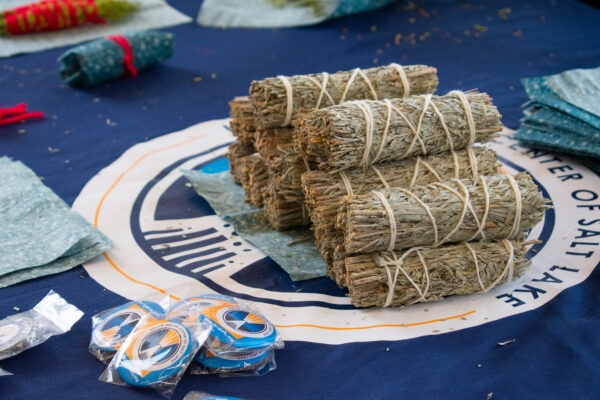
 An Urban Indian Center of Salt Lake display is shown at the Native American Heritage Day event held at the Mehdi Heravi Global Teaching and Learning Center on Nov. 4 .
“We acknowledge that USU and all in-state USU Institutions reside on the original territory of the eight federally recognized Tribes of Utah,” said USU in its land acknowledgement. “We acknowledge the painful history of genocide and forced removal from this land, and we honor and respect the Indigenous peoples still connected to the land on which we gather.”
Walker shared stories from his experience as a former student at USU and as an active leader in his indigenous community, describing how being a leader is all about recognizing and being proud of who and where you come from.
“The way students listened and engaged with both speakers stood out as one of the most impactful parts of the day,” Saganey wrote.
Refreshments were provided in the form of native Navajo frybread and chili. Guests were also invited to explore different outreach tables detailing various aspects of Native American culture, including sheep raising, weaving and herb bundling.
The herb bundling table was put together by the Urban Indian Organization of Salt Lake, the only UIO nonprofit in Utah, which provides health and social services to Native Americans living in urban areas and beyond.
Honey Duvall, a representative from the UIO, taught attendees the benefits of traditional medicine in Native culture through a hands-on herb bundling activity.
“There are various different kinds of medicines we use in our community,” Duvall said. “All different tribes utilize a specific medicine.”
Duvall said sage and cedar are some of the most commonly used herbs in Utah and are honored within Indigenous communities for their various spiritual and physical healing properties.
“You give a traditional medicine, and it holds an even higher respect than monetary gains,” Duvall said. “When someone gives you something like this, they honor you, but they also appreciate the work you’re doing in the community and the greatness you have to provide for everybody out there.”
The event included three different traditional Native dances including the hoop, fancy, jingle and round dances. Each dance told a different story and represented a unique traditional aspect of the Native community, and many attendees commented that those performances were some of their favorite parts of the day.
“The closing round dance was the moment that stayed with me,” Saganey wrote. “The round dance is a social dance often seen at powwows and community gatherings — it’s simple, welcoming, and meant for everyone to join. Students, staff, faculty, and guests stood side-by-side, holding hands and moving together in a slow, steady circle around the room.”
According to Saganey, feedback on the event from both Native and non-Native students was incredibly positive.
“Many people mentioned how engaging the tables were — especially the archival materials, cultural education displays, and hands-on demonstrations,” Saganey wrote.
“Several attendees told us they stayed longer than they planned because they wanted to continue learning and participating.”
Lyneah Israel and Cynthia Tsosie, two Native American students at USU, said attending the event was an opportunity to reconnect with their homes and families while being up at school.
“The Native population here is less than 1%, so it’s really hard to find people to connect with,” Israel said. “It’s really nice to have a taste of home from here.”
A large focus of the event was the sense of community and kinship, an aspect of native Navajo culture that Saganey says is all about connection.
“When I introduce myself, I share that I am Táchii’nii — Red Running into the Water People. Sharing clan is a way of saying, ‘This is who I am and who I come from,’” Saganey wrote. “Even when we are far from home, it helps us recognize familiarity and feel supported by one another.”
The Center for Community will continue to host other events that focus on bringing the USU community together through culture and education, including the 2025 Miss Native American pageant on Nov. 20 and the annual powwow at the beginning of next year.
“Events like this are for everyone. They create an open space for students to learn together, ask questions, and engage with history and cultural knowledge in a meaningful way,” Saganey wrote. “Native American Heritage Day offered time to learn about the Tribal Nations connected to this region — Utah is home to eight federally recognized Tribal Nations, and many students may not have had the chance to learn that before.”