
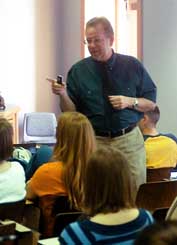
USU professor is hypnotherapist, martial artist
Professor Kim Openshaw has taught the human sexuality course at Utah State University since 1981. And from the way his friend and fellow professor Scot Allgood talks, that’s the way it was meant to be.
“That’s his class,” said Allgood, who met Openshaw 25 years ago this month.
Openshaw also teaches an adolescence class, and his desire to educate extends into the community. Openshaw started SORT – Sex Offenders Research Team. But it led to bigger and better things.
“It actually evolved into what is called the Cache Sexual Issues Coalition,” Openshaw said.
The CSIC has a council of advisers, which include Utah Rep. Larraine Pace, Sen. Lyle Hillyard and Rev. Clarence Sandoval from the St. Thomas Aquinas Catholic Church. Openshaw was pleased that CSIC developed into a community effort.
“I wanted to expand that beyond just a university network of researchers and move into the community,” he said.
“Kim has the ability to take the academic information and help community agencies bring about worthwhile change,” Allgood said.
Openshaw was also quite influential in the life of one person – Allgood himself. With everything all arranged to study electrical engineering at the University of Utah, Allgood was living in Wisconsin when he met Openshaw in 1979. Allgood decided to change majors and now runs USU’s family therapy program with Openshaw and Associate Professor Thorana Nelson.
Also, Openshaw said the study of juvenile sex offenders really started in the mid-1970s. And now the name by which they are called is changing.
“We’ve actually changed the name now,” Openshaw said. “Rather than calling them juvenile sex offenders, which means they can’t change, we look at them as juveniles who offend sexually, suggesting that they do have an opportunity to change.”
Allgood says that the term swap is a byproduct of the political correctness movement, but it’s beneficial because “it reduces the likelihood somewhat of people to live up to their diagnoses.”
The names of those who offend sexually must be posted on the Internet, and Openshaw agrees with this requirement. In fact, he said that he wouldn’t be opposed to posting the names of all those who commit crimes.
“I think if you talk with victims who have been burglarized, they have lots of feelings very similar to a rape victim,” Openshaw said. “Their space has been violated.”
He said there are, of course, significant differences in the act itself, but burglary victims tend to feel afraid to stay in their homes.
Overall, Openshaw believes that public identification of criminals does not deter crime. The best way to fight crime is probably to teach people to become principle-based.
“If people understand principles, they’re going to make wiser choices,” Openshaw said.
Sometimes, he uses hypnosis to get people to make wiser choices. As a certified clinical hypnotherapist, he uses it as “merely one of many therapeutic interventions.”
“I’m not going to have somebody hypnotized, and have them jump around like a duck,” said Openshaw, who was supervised by Corydon Hammond, the president of the American Society of Clinical Hypnosis.
Many people think of hypnosis as only a form of entertainment. Or, said Openshaw, people confuse hypnosis with “meditation, stress management techniques, and guided imagery.”
Clinical hypnosis can be used for working with trauma victims, eliminating addictions and recovering relevant information from eyewitnesses. It is even useful for pregnant women.
“[I’ve helped] women who are unable to have anesthesia, or who choose to have a natural childbirth,” Openshaw said.
The trauma victims can be hypnotized in order to help them. One of Openshaw’s favorite areas of study is resiliency – the ability of a person to bounce back from a traumatic event.
Openshaw said the victims have one of three options: Suffer nothing other than the direct results of the event; have some anxiety, depression or post-traumatic stress disorder; or they are severely affected, which could include substance abuse or repetition of the behavior.
Research has revealed that those who experienced terrible events are divided evenly into the three categories.
“When we did research on victims of sexual abuse, we found very similar findings,” Openshaw said.
He said this “third-third-third breakdown” is helpful in breaking down the common myth that most people who are sexually abused go on to become sexual abusers themselves.
“They may do very well in life,” said Openshaw, noting that some of the subjects of a famous study went on to become CEOs, professors and doctors.
Openshaw said it’s almost impossible to pinpoint those characteristics that cause people to sexually offend.
“There is no one thing,” Openshaw said. “In fact, you could not go down the streets of anywhere, and tell me who’s going to be a sexual perpetrator because it is a heterogeneous group.”
Women in FCHD
Openshaw believes there are more women than men in the department of family, consumer and human development because of societal expectations of women.
“The females are the primary person to take care of the family, for the most part, by socialization,” Openshaw said. “Stereotypically, they don’t have to be, but that’s what we’ve done in our
society.”
He said the first reason women choose this major is to be more effective in the family. The second reason is that it opens doors to many other fields, like social work, marriage and family therapy and probation services.
One USU alumna, Diane Stewart, was even called to an “office that’s designated by the president of the United States.”
Openshaw was an adviser to Diane Stewart, who graduated from USU to direct CAPSA, work with Utah Attorney General Jan Graham in the victims and violence program and eventually get nominated and appointed to be the director of the Office on Violence against Women.
Hobbies
As a family therapist, Openshaw is, of course, a family man.
And he has kept his family close. Although he was raised in Magna, Utah, he and all of his nine children and seven grandchildren live in Cache Valley.
Openshaw enjoys getting his children involved in his hobbies, which include coin collecting, rock hounding and learning martial arts.
“I have a second degree black belt in Yamabushido,” Openshaw said. “I am training several of my children in this art at this time.”
Openshaw also is fond of taking his wife and children outdoors.
“I enjoy traveling and seeing mother nature as opposed to doing the Disney thing,” Openshaw said.
Openshaw said he also has a lot of favorite movies, the most recent one being “A Beautiful Mind.” He said it demystifies schizophrenia – exactly what the National Alliance for the Mentally Ill has tried to do for years.
Openshaw noted that in “A Beautiful Mind,” John Nash led a successful life despite his handicap. And that’s not uncommon.
“So many of them are capable,” Openshaw said. “Because we are ‘normal,’ we don’t give them sufficient credence and credibility to allow them to become successful.”
-marklaroc@cc.usu.edu