
USU ROTC steps up to Ranger Challenge
For a team that eats pain for breakfast, their motto is clear: “What most call hell, we call home.”
But as members of this year’s Army ROTC Ranger Challenge team can attest, even hell has its good points.
“Even though it may be somewhat torture when we’re going through it, the greatest thing we get out of it is the feeling and the high,” said Cadet Capt. Justin Card.
In somewhat sunny Monterey, Calif., 22 universities came to compete in the Army ROTC Ranger Challenge: the Army’s equivalent of the WAC, PAC Ten, and Big West conferences combined.
This year’s Utah State University team, which consists of veterans Card and Latimer Smith and newcomers Blake Bingham, Stan Bell, Mark Bryner, Megan Miles, Matt Kuhni, Josiah Griffin, Ben Scott and Matt Jones, has put in the hours and, at the outset, felt confident of their chances in the competition.
“I think we’re going to win,” Cadet Matthew Jones said. “We’ve got a good rope bridge time, an outstanding team, and our PTs [physical training] are really good across the boards. I don’t see any reason why we shouldn’t win.”
Though stopping short of selling their souls to the program, the team has spent upwards of 20 hours every week for the last three months in hard preparation with a heavy emphasis on endurance.
“Last year we realized that endurance was one of the biggest things we lacked,” Card said. “So this year we focused a lot more on running longer, farther and harder.”
Card also expressed how important it is to prepare mentally as well as physically.
“Physically, the competition is really hard,” Card said. “But the biggest thing is that if you’re mentally prepared, you can do it. Really, mentality is the biggest obstacle that we have – knowing we can do it and keeping our head in the game. If we can do that we’ll do fine.”
Miles said, “Preparing for the competition was like a part-time job. I feel really good about the hours that we’ve put into this, both individually and as a team.”
0500 Wednesday – Wake Up
0530 – Opening Ceremonies
The field was well-lit in the morning hours as Master of Ceremonies greeted the teams and encouraged them to start as a team and finish as a team and to pay full attention to accomplishing the task before them.
Representing the “bad, the best, the brightest,” each team presented themselves and gave their team’s motto.
One team from Arizona State University sang a parody on the song “I like big butts,” replacing butts with rucks (an integral part of the competition), another school sang out the Flintstone Vitamin jingle (“We are Flintstone kids, 10 million strong and growing”), and BYU finished up the pack by yelling out, “Meet the Mormons.”
After presenting the colors, the competition began.
0600 – APFT – Army Physical Fitness Test
In the chill morning air on a field covered with dew, the first competition, which consisted of three separate portions, tested the cadets on endurance and strength.
First, each member of the team was given two minutes to do as many push-ups as they could.
Second, two minutes were devoted to doing as many sit-ups as possible.
Finally – the two-mile run.
In order to receive the maximum of 100 points per event, each man on the team was expected to do 75 push-ups, 85 sit-ups, and run the two miler in under 13 minutes. The females could max out at 43 push-ups, 85 sit-ups, and a 15-minute run.
According to competition rules, if an individual maxed out in all three events, each additional push-up, sit-up or shaved-off second, gave them more points.
USU’s team ended with an average score of 344 points, placing second in the small school division and fifth overall.
“I think they did pretty well this morning,” said specialist Matthew Otis, a spectator at the event. “They could have done a little bit better, but I was impressed with what they did.”
The team coach, Lt. Col. Rand Curtis, was also very pleased with his team’s performance.
1000 – The One-Rope Bridge
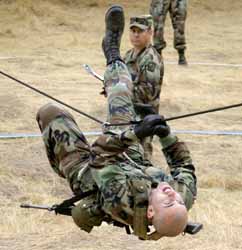
The one-rope bridge consists of nine people on a team tying a rope from one wooden pole to another which is 60 feet apart and attempting to get all the people across the rope without touching the ground, said Sgt. Scott Womack, one of the teams’ coaches.
While winning the event consists mainly of getting all team members across the rope quicker than everyone else, the teams were also given penalties for using unapproved knots, or letting themselves or the equipment touch the “danger area” which is an area on the ground between the two poles.
Simulating what it would be like to escape and evade somebody by crossing a river, USU pulled off a fine show coming up with an average time (the event is run twice) of 1 minute and 24.5 seconds.
That was just enough to place them in first overall for the event, with second place University of California Davis following by just one second.
One of the judges commented that their combined time was the fastest he had seen in three years of judging the event.
“We are a textbook example of a good ropes team,” Bryner said. “We made five mistakes on the second run for a time of 1:30, but I still don’t think there’s a better rope team in the world.”
1345 – The Obstacle Course
“If the obstacle course were based on pure athleticism, we would win. We have one of the most physically fit units in the army,” Bryner said.
The obstacle course is a team event that tested the cadet’s endurance, upper body strength and ability to negotiate barriers. Consisting of obstacles like a 16-foot rope climb, a 12-foot tunnel crawl, two balance beams, two belly crawls (one of which was underneath barbed wire) and an 8-foot-6-inch wall, the teams raced for the fastest time.
Opting to run the course with nine men (one cadet was slightly injured), USU automatically took a 30 second penalty. Running the course with the second fastest raw score of 6:02, they took third in the small school division and fifth overall after adding 40 seconds in penalties.
1600 – BRM: Basic Rifle Marksmanship
What would the Army be without its weapons?
Using A-2 M-16s (the same the Army used in Vietnam) to fire 20 rounds in two minutes at five separate silhouette targets 25 meters away, this event is perhaps the most highly skilled in the competition.
Otis said, “I think the toughest part of the Ranger Challenge for our team is going to be the BRM. That’s mostly because we haven’t prepared very well for it.”
After the event was finished, almost every school felt they had performed poorly.
“BRM was an exciting experience to get behind the barrel of an M-16, like they used in Vietnam and bore away the white parts like they do in cartoons. Unfortunately, none of us did very well,” Bryner said.
Card pulled off the high score for the team by hitting 17 rounds out of 20, but it wasn’t enough to save the team ranking. Overall, USU placed 14th in the BRM test.
After their first hot meal of the day, the team moved on to the first half of the land navigation event: The written exam.
Friday 1900/Saturday 1000 – Land Navigation
The land navigation event, which is used to measure a cadet’s knowledge of map reading and navigation in an unknown area, is broken into two parts: the written exam and the practical exam.
“Yesterday’s test had some questions that were impossible. We checked ourselves and rechecked ourselves for a few minutes. Overall, it was a good test,” Bryner said.
Administered individually, the written exam counted for 25 percent of the overall score and tested cadets on their ability to read a contour map and identify certain points, such as hilltops, ridges, saddles, draws, spurs, valleys and cliffs.
“During the exam, each cadet must be able to use both the Map Reference System and a Magnetic Azimuth,” Cook said.
The morning after the written exam, the teams were taken to a previously unspecified area and given maps with 23 contact points. The 10-man team then split into three teams who tried to reach as many points as possible in an hour.
“I felt really good about the land navigation,” Bell said. “I think that’s one of our best events.”
Coming in with no penalties and 16 out of the 23 points, USU placed third in the small school division and fourth overall.
But, difficult as it was, the morning race to win land navigation was just a precursor to the hardest endurance test of the weekend.
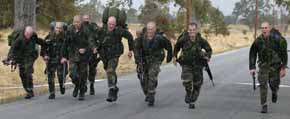
1305 – Ruck March
“Ruck marching is something units in the Army do all the time,” Capt. Rees Roberts said. “We’ve always got to be prepared to cover a lot of ground on our feet with all our equipment.”
Probably the most grueling event of the competition, the ruck march consists of a 10K run/jog over tough terrain carrying a rucksack that weighs anywhere from 35 to 50 pounds. Additionally, the team must stay together and cross the finish line at the same time in order to avoid penalties.
A typical rucksack contains all items necessary for sustenance, ammunition and survival. In addition to the personal items, the team must also carry some team equipment like a radio and batteries.
The team spent a lot of time preparing for this event, having run at least three full ruck marches before the Ranger Challenge.
Curtis was certainly anxious for his team.
“It’s like watching your wife give birth,” Curtis said. “You know your men are out there in pain and you can’t do anything about it.”
But there wasn’t much to worry about. Running in the rain, USU pulled off a time of one hour, 12 minutes and two seconds, which placed them first overall.
“I feel great about the run,” Bell said. “I love it. We really burned that course. I definitely got tired, but I feel great now.”
1700 – Closing Ceremonies
According to Griffin, one of his personal philosophies has been a quote by Erwin Romal who, during World War II, said, “the more you sweat in training, the less you bleed in war.”
In spite of all the sweat during training, the “war” for first place at the Ranger Challenge, was full of sacrificed blood, sweat, and tears.
Gaining several plaques for placing in the top three in five out of the six events, USU also came home with something to show for their blood and sweat: first place in the small school division and second place overall.
There was a lot of celebration, and some mixed emotions from the team.
“We did our best,” Bell said. “You can’t ask for anything more.”
Cadet Ben Erickson said that though he was “happy the team took first out of the small schools,” he was “disappointed that we didn’t get to take first overall.”
Curtis said, “I think they’ve done really well. I’m ecstatic.”
Card was also very pleased with his team’s accomplishments.
“I’m tired right now and I want to go to bed, but I can’t believe it. I’m way impressed with the team and how well we did. Next year we’re taking it. This year we just left the door wide open,” Card said.
In the end, the “West Point of the West” came through for each other and for their school.
Now, with the event over, the shoes shined, and the barracks empty, the team can feel free to relax a bit. In fact, Sunday a six-hour stop in Las Vegas is scheduled. Six hours in “Sin City” on a Sunday? It’s a good thing these guys have already been through hell.
-mattgo@cc.usu.edu
USU ROTC steps up to Ranger Challenge (Photo by John Zsiray)