
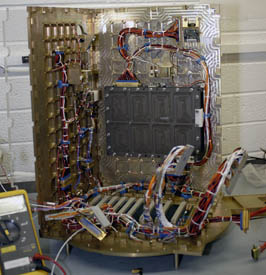
USU Sat II places 4th but may still fly
Although disappointed by a fourth-place finish in Reno, Nev., earlier this month, Utah State University engineering students are already rebuilding and redesigning in preparation for the next Nanosatellite competition two years from now.
Built on a $200,000 budget in less than two years, USU Sat II, a micro-satellite built completely by students, was one of 13 entries in the University Nanosatellite program. The winning university would be awarded the chance to launch their satellite into space. The was sponsored by the Air Force Office of Scientific Research, NASA and the American Institute of Aeronautics and Astronautics (AIAA).
“We built around a modular platform that can be reassembled in different ways. We thought that’s what NASA and the Air Force were looking for,” said Joel Quincieu, chief engineer for USU Sat II and USU graduate student. “We were very surprised. The whole satellite was built very professionally.
“We spent a lot of money on good hardware and good engineering.”
Charles Swenson, a USU professor and faculty adviser to the project, said the team is still being debriefed on why it didn’t win. Swenson said the competition focused on three criteria – how much of the work was student driven, if the satellite was really flyable and relevance of the satellite’s mission to NASA and the Air Force.
“USU was told they were No. 1 in being flyable,” Swenson said, “but didn’t do as well in the category of relevance.”
While USU did not win the competition, it will have another chance to compete at in the same program two years from now, Swenson said. The mission for the next competition will be revised, he said.
USU Sat II is designed to take measurements of the ionosphere, a portion of the atmosphere that can create complications in systems like Global Positioning System (GPS), Quincieu said.
The idea behind USU Sat II is the ease at which it can be taken apart and reassembled, Quincieu said. The reproducibility of the satellite will make construction faster and cheaper, two elements crucial to competing in the aerospace world, he said. The grid design is currently undergoing through a patent process.
“The satellite could be rebuilt for a completely different mission. We could even put it very high in orbit,” Quincieu said.
Even with the next competition two years away, USU Sat II may still have the opportunity to fly. Quincieu said many private customers have shown great interest in flying the satellite for their own projects.
“[The satellite] is at low cost to customers because it’s already built – which is a pretty positive thing for USU,” Quincieu said. However, he said, “customers only believe you design this well if you fly it” so asking a company to put out the $300,000 needed for a rocket launch is asking them to take a risk.
Swenson said USU Sat II is a combination of ingenuity on the students part, as well as information gained from USA’s last satellite project, USU Sat I. One of the biggest challenges to the project, Swenson said, was the budget. Swenson said a similar satellite could cost up to $4 million to build in the commercial world.
Costs were offset, he said, by a grant from SDL as well as using parts from previous satellite projects. But the budget was still tight, Quincieu said, with the aluminum structure of the satellite costing $10,000 and computer parts alone – $20,000.
The inexperience of the team at the beginning of the project was also another challenge, Quincieu said.
“Most didn’t even know the shape of a satellite. I had to look at the team I had and say, ‘What am I going to do with them?'” he said. “[They] had to adapt very quickly.”
One student joined the project in April with no previous experience, Quincieu said, but seven months later was helping to design computer hardware.
“It was a shock first coming in,” said Dan Swenson, a junior in the USU engineering program who worked on the satellite. “In most internships you just get to be a part of the paperwork, but I got to be part of the entire process.”
Dan said he was disappointed by the outcome of the competition, but is now only more motivated to do better the next time around.
“I learned how important marketing is,” he said. “If you don’t market well, no matter how good your project is, it won’t do you any good.”
“We didn’t want to build this satellite with shortcuts – slapping it together with duct tape. It was a good experience in managing a team of students,” Quincieu said. “The work is very complicated and some just dropped the ball. We had 30 to 40 volunteers that left because it was so complicated and because of the expectations.”
Students were expected to act and design as a professional engineer, which could be tough at times for students trying to juggle schoolwork, he said. About 80 percent of the work on the satellite was finished during the summer by a team of students hired full-time, he said.
Benefits of the project our numerous, Swenson said, but hands-on experience is the most obvious.
“We hope to provide a better workforce. Space exploration is important to our country and even to our daily lives,” Swenson said. “We want to excite the next generation to participate in that occupation.”
Quincieu said regardless of competition outcomes, USU has already accomplished something it hasn’t done before.
“We are showing to the aerospace world that USU can build a satellite between one year and 18 months. USU is capable of building a satellite that can fly,” he said. “Two years ago we were not so sure about that.”
-bnelson@cc.usu.edu
Smoke blackens the exterior walls around the apartment windows where the fire was started. The fire is believed to be caused by electrical failure. The fire at this apartment complex located on 500 South between 200 and 300 West began around 8 (Photo by Michael Sharp)