
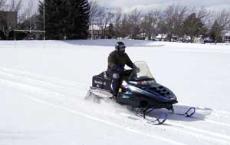
USU snowmobile design cleans up at national event
USU’s electric snowmobile team recently dominated the Society of Automotive Engineers’ annual Clean Snowmobile Challenge, winning every award for which they were eligible. The SAE challenge was held March 13-18 in Houghton, Mich.
“We stomped it, not only as a first-year team, but as a first-year team with an electric snowmobile,” said Nate Hansen, Utah State University’s electric snowmobile team leader.
Hansen said the team’s goal is to create an electric snowmobile with lower noise and pollution. Thus far, their work has proven to be successful, he said. At the competition, they won Best Zero-Emissions Design, Best Zero-Emissions Range, Best Zero-Emissions Overall and the Rookie of the Year award.
Despite their direct competition with gas snowmobiles, they were not eligible to win awards in the main categories because they were not scored against them. The SAE challenge has separate categories for zero-emission snowmobiles and gas snowmobiles. Because of smaller range, the judges consider electric snowmobiles only as utility vehicles, so USU was unable to be declared the overall winner. Hansen said he is disappointed by this, but thinks their stellar and surprising performance in all areas had an impact on people’s impressions of an electric snowmobile’s capabilities. He said he is in the process of appealing these rules for the 2007 competition.
“Our simple but strong design served us well and impressed people. We know how to use parts and use them well,” Hansen said. “By far, we had the cleanest at the snowmobile challenge. It was much cleaner and much quieter, too. In terms of clean and quiet, we have a perfect solution.
Their snowmobile is virtually silent, Hansen said, the only obvious sounds being mechanical. He said he hopes next year’s team will be able to eliminate those noises.
The snowmobile still needs work, Hansen said. The most important changes that need to take place deal with the weight of the snowmobile and its range, he said, but both can be improved by simply putting in different batteries.
“The biggest need of improvement is range. It is an obtainable goal somewhere down the road,” Hansen said. “Our first test drive was three miles and now we can go 10 miles. We have more than tripled our range.”
The snowmobile weighs about 950 pounds. He said its weight needs to be decreased greatly and hopes steps will be taken in the future to decrease the total weight.
Bob Silver, a member of the team and a senior in electrical engineering, said, “Ours is much heavier, but at the same time, it is just as fast.”
The snowmobile can accelerate from zero-500 feet in 10.9 seconds and is excellent for utility purposes, Hansen said. He also said it has great towing capability. They recently towed a 1995 Jeep Grand Cherokee weighing 4,345 pounds with the snowmobile, he said.
USU’s electric snowmobile team has 12 members. Paul Carpenter, a senior majoring in electrical engineering, was a member of the team this year. He said he helped with the data collection of the censor networks of the snowmobile and also analyzed its main power system. Carpenter said he was pleasantly surprised at USU’s performance in Michigan.
The electric snowmobile team is in constant need of funding. Hansen said they were unable to build the snowmobile they wanted because of a tight budget. If it had not been for last-minute donations, Hansen said USU would not have been able to compete in the SAE Clean Snowmobile Challenge.
“We know what needs to be done; It is just a question of time and money and the resources to do it,” Hansen said.
He said he began working on the snowmobile in the late ’90s with his father.
“It’s funny, because neither one of us rode snowmobiles, but we noticed they were noisy and stinky,” he said.
The two worked on the snowmobile on and off for several years, he said. The electric snowmobile is now the focus of Hansen’s senior design project. He said he is happy to be working on it at USU because it gives it a home. There are also greater resources available at the university, he said.
“We have made more advancements within the last six months than my dad and I did in six years,” Hansen said. “There are much greater thinkers here. Many talented brains are better than one mediocre brain.”
He said the electric snowmobile will be used in Greenland this summer by the National Science Foundation to collect pollution samples. Hansen said he hopes this will increase the team’s recognition and funding.
-ariek@cc.usu.edu