
USU Winter Workshop inspires sign
Marty and Susan Fahncke’s 7-year-old son is deaf. Frustrated with the quality of their son’s education at the Utah School for the Deaf and Blind, the Fahnckes drove from Kaysville to attend Saturday’s 11th annual Deaf Education Workshop.
Marty Fahncke said he wanted to be exposed to new ideas and to build a support network the family can draw on to help their son. They did not go home disappointed.
Sponsored by Utah State University’s Department of Communication Disorders and Deaf Education, the seven-hour seminar attracted 75 people, including current and future educators of the deaf, college professors, audiology graduate students and eight USU deaf students. Deaf educators from Colorado, Utah, Idaho and Arizona spoke at the workshop held Saturday in Old Main.
Sheryl Goodwin Muir, the information coordinator at the National Center on Low-Incidence Disabilities in Colorado, discussed the importance of parental involvement for deaf students. Muir told the educators not to fall into the trap of believing that parents are uninvolved, uncaring and unsupportive.
Parents want to help their deaf child succeed, Muir said. Teachers need to create a variety of ways in which parents can become more involved in their child’s education. Parents want to communicate with their deaf children and most want to learn sign language.
“Full communication is our goal,” Muir said. “Anything you want to say, or sign, to your child, you can.”
Parent-child communication is vital, she said, because children spend more time at home than at school – perhaps two or three times more. Fahncke said Muir was “dead on” in regard to parents’ desire to help their deaf children.
Elizabeth Parker, a professor in USU’s Deaf Education Department, said the deaf in Kenya are not permitted to drive vehicles, vote or work alongside hearing people. Each year, she leads a team of volunteers to the Ngala School for the Deaf in Nakuru, Kenya, where they spend two weeks teaching deaf children simple sewing and business skills.
Emma Lozada, a preschool and kindergarten teacher at the Idaho School for the Deaf since 1994, has spent several years working with deaf children. Lozada, who grew up deaf, pointed to research, which showed that most deaf children can only read on the fourth grade level by the time they graduate from high school.
“Children are starving for language,” she said, but the majority of language acquisition happens outside the classroom. When parents can only sign at the preschool or kindergarten level, it is harder for their deaf children to become proficient, especially in reading, Lozada said.
Curt Radford, a graduate of USU’s Deaf Education program, has been the principal of Sequoia School for the Deaf and Hard of Hearing in Mesa, Ariz., for three years. Radford, who is deaf, asked educators to “think outside the box of special education.” He said to focus on individual students’ needs instead of a specific educational philosophy.
The Sequoia School has 900 hearing students who study alongside 50 deaf pupils. The students may attend classes taught in American Sign Language or spoken English. Radford called on deaf educators, speech-language pathologists and audiologists to expect, and help deaf students perform at or above grade level.
“If you inspire a deaf student [to succeed],” Radford said, “one day he will inspire you.”
-acbeck@cc.usu.edu
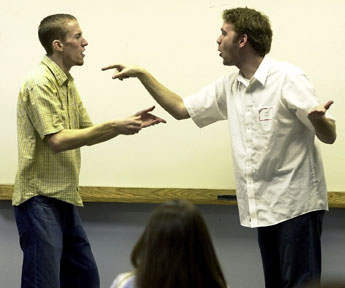
Brandon Dopf and Jonathan Roberts sign while telling a story during the American Sign Language Storytelling at the Deaf Awareness Winter Worskshop Saturday. The workshop featured speakers who discussed difficulties involving deaf students. (Photo by Michael Sharp)