
Utah not out of drought yet
Ski enthusiasts may be glad to know Utah’s six-year drought may be coming to an end, but people shouldn’t be too quick to celebrate.
“The end is in sight for Utah’s six-year drought, but not quite yet,” said Esmaiel Malek, director of the climate center at Utah State University. “The forecast is for drought for the next 90 days.”
Increased snow pack means there will be more water stored up in the spring. If this year turns out as good as last year for amount of precipitation, Utah’s drought may well be over, Malek said.
Chris Kay, a senior majoring in public health, said he was thinking about skiing when he saw snow on the mountains last week. Kay, a telemark skier (downhill skiing on cross-country skis), said he hopes Beaver Mountain, which usually gets its snow base later than resorts in the Salt Lake Valley, will be able to open earlier this year.
Last year, Utah came out ahead in water supply. Water measurements are taken in year-long periods beginning Oct. 1 and ending Sept. 30. During the 2004-05 water year, Utah had above-normal precipitation, especially southern Utah, according to the National Weather Service.
The average rainfall for Utah is 11.88 inches a year and an average of 24.89 inches of rain fell last year. Although in Cache County, the average rainfall is 18.62 inches a year, the valley received 27.20 inches of rain last year, giving a surplus of 8.58 inches, Malek said.
“If this trend continues, we’ll be in good shape,” Malek said.
The 2004-05 water year was the first time water levels have been above normal since the 1997-98 year, according to the NWS. The snow pack from last year is almost gone, Malek said, but it’s growing again.
Only the southeastern corner of the state still has water levels below normal and Malek said, depending on precipitation levels this year, the rest of the state may not be able to stay in the black.
Malek said things are already looking good for the new water year. Logan has three precipitation measurement stations at 5 SW in College Ward, at KVNU radio station and at USU. As of Friday, the station in College Ward had received 0.91 inches of rain, almost half of the October average for Logan. Receiving that much so early in the month hopefully bodes of good things to come, Malek said.
“Things are in favor of the southwest part of the U.S.,” Malek said. “The northwest part is still suffering from drought.”
Malek said Utah dams are full for now, but it’s still important to conserve water.
“This water has to be conserved,” he said. “If you don’t need to water your lawn, don’t.”
Malek said it can’t be determined yet whether this trend is the start of El Niño, a phenomenon caused by warm Pacific currents along the equator off the western coast of South America.
The change in currents affects weather and climate worldwide.
In North America, El Niño causes mild winters in Canada and the northern U.S. and wet winters from Texas to Florida, according to the National Oceanic and Atmospheric Administration. In extreme examples, flooding, downpours and mudslides have occurred.
However, since it may not be an El Niño winter and weather patterns during those years can be unpredictable, anyway, Malek said Utahns should behave as if the drought were continuing by being careful with their water. He said a good site to track the severity of the drought is www.drought.unl.edu/dm/monitor.html.
Malek said there is no major danger of flooding in the spring due to increased snowpack.
-ella@cc.usu.edu
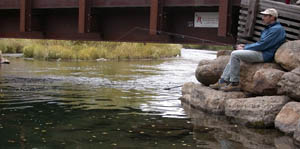
Logan resident, Albert Wiebe, fishes under the bridge at Spring Hollow campground Saturday afternoon. Although Utah has received above-average moisture this year, officials say Utah is not out of drought conditions yet.