
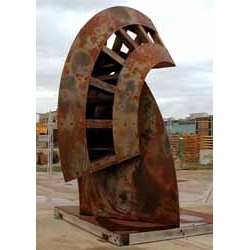
Utah State’s campus is chock-full of works of art
You’ve walked by and through them. You might have even walked under them or climbed on them. Almost every building of campus has one in or near it.
Utah State University students’ opinions of the sculptures are as diverse as the sculptures themselves.
Click here to see slideshow of other sculptures
“I think that one’s really cool,” said Danika Foley, a junior in landscape architecture, referring to “Synergy,” the circular sculpture of six hands clasping wrists made by Springville, Utah resident Gary Price in 1966.
“It’s inspiring,” said Chase Petersen, a freshman in biology. “I think it shows unity.”
One sculpture that causes the reactions – positive and negative – is commonly called “the french fries.”
“They’re kind of ugly, but fun to look at,” said Carrie Stoddard, a junior majoring in music. “They get your attention.”
Located on the south side of the Biology and Natural Resources Building, the “fries” sculpture is actually called “Snafu” and was made by Joseph Kinnebrew in 1999.
Jay Heuman, art aficionado and assistant curator of education, gave his interpretation of the piece.
“A uniform color acts as a unifying device; it pulls everything together,” Heuman said. “There is an element of protrusion, and yet it’s contained. There’s the potential for motion.”
Professor of art Eileen Doktorski let one of her classes visualize their responses to “Snafu.”
One student made a large ketchup bottle, she said. Others made a burger and a soft drink to go with it.
“Looking at art requires you to use your imagination as well as making it [does],” Doktorski said. “If you have a strong reaction and you don’t like this piece, that’s a great time to discover something about yourself.”
The Nora Eccles Harrison Museum of Art director Victoria Rowe agreed that “Snafu” gets the most reaction.
Of course, some reactions are not appreciated. One student threw ketchup on the piece, causing acidification.
“It’s OK not to like something,” Rowe said.
But rather than defacing a campus sculpture, it is better for students to try to figure out why they don’t like it, she said. In her exploring art class, Rowe asks the students to try to determine the artist’s reason for creating a sculpture in a particular way. For example, if “Snafu” were not painted yellow, it would be viewed differently. But as it is, it’s a pop icon, Rowe said. The students’ knee-jerk reactions to it speak volumes about American culture. McDonald’s is in the collective consciousness of today’s youth, and because of that, “Snafu” becomes almost Warholian pop art.
Rowe said the university collection is actually separate from the museum’s collection, but the museum cleans, maintains and preserves the sculptures.
Many of the sculptures were purchased by the Charter Member Endowment or the President’s Fund for Sculpture. George Emert, the previous university president, was instrumental in getting many of the sculptures on campus, Rowe said.
Two pieces came as a result of a campuswide contest two years ago. John Ohran and Robert Winkler won, by creating “Concentric Arcs,” west of the Science Engineering and Research Building, and “Four Without,” near the Biology and Natural Resource Building, respectively. The sculptures were bought by the President’s Fund for Sculpture.
Others were gifted, or created by professors on campus and given to the university. One of the first works on campus, “Untitled Mosaic,” a 30-foot wall-mural made by tiny pieces of glass tile, located in the west entry of the Biology and Natural Resources Building, was created by two professors and three students and donated in 1962.
Another piece created by a former USU professor of sculpture, Larry Elsner, is called “Opus.”
“He was commissioned by the Marie Eccles Caine Foundation to create a piece for the plaza area,” Rowe said.
The plaza – the area by the museum and the entrance to the Kent Concert Hall at the Chase Fine Arts Center – contains many sculptures. One of them, “Pioneer Handcart,” may be placed between the Logan LDS Institute and the Haight Alumni Center, Rowe said.
She said it’s unusual for a university to be so supportive of campus art.
“The University of Utah and some of the other campuses in this state have taken their art out,” Rowe said. “They are no longer supporting their sculptures on campus.”
She said the other universities choose not to maintain a collection due to high caretaking costs and lack of purchasing funds.
Whatever the artist’s intention, some sculptures have a practical purpose.
Stoddard likes to study under the shiny silvery sculpture “Sojourn,” by Old Main.
“It has a curve in the back so I can lean up against it,” Stoddard said. “The trees are not forgiving to the contours in your back.”
Rowe added that with all the new construction, students may see more art on campus soon.
“When you build a new building, one percent of the budget for that goes towards the arts,” Rowe said.
-marklaroc@cc.usu.edu