
Utah’s air pollution: A decades-old problem
Utah is known for struggling with air pollution, with the American Lung Association rating the Salt Lake City-Provo-Orem area as No. 9 worst for ozone pollution, and No. 19 worst for short-term particle solution pollution.
More specifically, Utah is known for having some of the worst wintertime air pollution in the world due to yearly temperature inversions. These events are caused when a bubble of cold air gets trapped under a layer of warm air between mountains, preventing the polluted air from escaping.
Seth Lyman, a research professor in the Utah State University Department of Chemistry and Biochemistry, said when polluted air stays trapped for a long time, it can lead to unhealthy air quality.
“The reason that we have those problems more than some surrounding areas is that Utah — especially in the wintertime — has low wind,” Lyman said. “We’ve got mountains everywhere that kind of block wind and make it so pollution that’s emitted stagnates and stays there rather than blowing away quickly.”
USU experts are studying two notable types of pollution, ozone and PM2.5, that can have negative impacts on health.
Lyman said the ozone layer higher in the atmosphere is crucial because it blocks and absorbs UV light from the sun. However, ozone near the surface can cause health problems in the lungs.
“Wintertime ozone is a reactive gas, so it’s three oxygen atoms combined together, and normal oxygen that we breathe is two oxygen atoms,” Lyman said. “That third oxygen atom can react to our lung tissue and cause respiratory problems.”
Lyman said the Uinta Basin area struggles with an abundance of ozone formation, partly because the emissions from the oil and gas industries get trapped in the cold air bubble. To combat this issue, Lyman said oil and gas industries need to get better equipment and look at their facilities more often.
“It’s probably not possible for us to get to a place where we don’t have any emissions of pollution caused by the oil and gas industry, but I work at the Vernal campus and I’ve been here since 2012, and over that 12-13 years that I’ve been here, we’ve seen a pretty dramatic reduction in the emissions of pollution from the oil and gas industry,” Lyman said.
PM2.5 pollution refers to particulate matter that is 2.5 microns or smaller.
Randy Martin, associate research professor of environmental engineering at USU, said the danger of PM2.5 pollution comes from its size.
Martin said the particles between 2.5-10 microns will get caught in one’s nasal passages and upper respiratory tract and won’t make it down to the lungs.
“But the smaller stuff, stuff that’s 2.5 microns and smaller, will actually filter its way all the way down through your whole respiratory system and get into the alveolar regions of your lungs, where the oxygen exchanges into the capillaries and starts causing damage there,” Martin said.
Martin said if the particles are smaller than 1 micron, they can get into the bloodstream. In Utah, many particles are about 0.8 microns. Martin said what the particles are made of may not be as big of an issue compared to what they may be carrying.
“That particle can also be carriers for other compounds, and it’s a lot of those other compounds that could be problematic,” Martin said. “You hear PFAs, chemicals, you hear of microplastics, you hear of lead and metals, and there have been several studies where they found lead and mercury in people’s brains, and that’s because it gets into your circulatory system and makes its way through.”
Professors at USU are also putting in the work to help reduce air pollution.
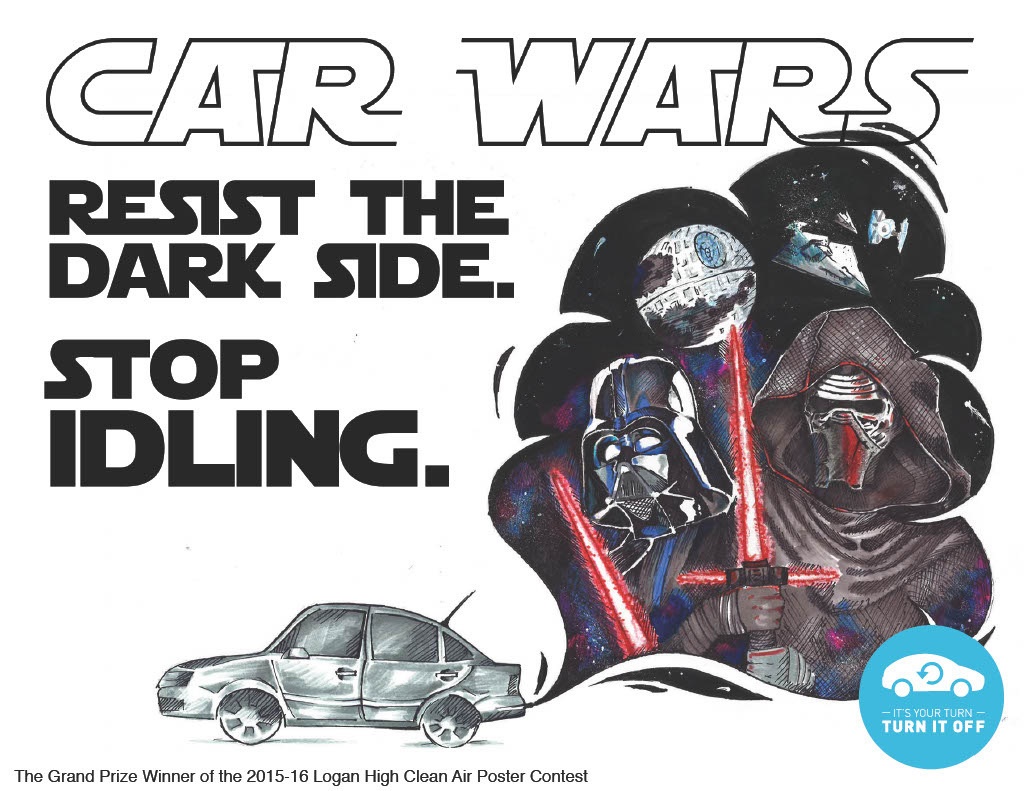
Edwin Stafford, marketing professor at USU, found a unique solution to improve air quality in Utah. Stafford and his colleague Roslynn Brian McCann co-lead the annual Utah High School Clean Air Marketing Contest, which focuses on teaching kids about air pollution and marketing.
Stafford said they started this competition back in 2015 with about 75 kids. They have hosted the contest since, and it has grown exponentially in the last few years.
“We had 1,200 students involved last year, and we had high schools from southern Idaho to southern Utah involved,” Stafford said.
According to Stafford, the goal is for students to take what they learn about air pollution and marketing and apply it in their designs for the contest.
“The whole purpose of the contest is for the kids to make public service announcements on how they would educate other high schoolers, or maybe Utahns in general, on how to keep the air clean,” Stafford said. “So, we teach them about not idling your car, carpooling, taking public transit, riding your bike and walking. We have all of these different things that the students learn, and then they use that as messages for their public service announcements.”
Stafford said most of the students, along with their parents, didn’t receive much of any education on air pollution throughout their K-12 experience.
“Our contest really may be the only formal education that many kids get about air pollution, and we think that’s really kind of amazing, given that air pollution is probably the most salient environmental health issue that kids face in Utah, and yet many of the students tell me that they didn’t hear anything about it until our contest,” Stafford said.
Not only does the competition teach students about air pollution — it also starts a conversation about it.
“We got feedback from the kids about the contest, and one student wrote that she’s told her parents not to idle, and now they don’t idle anymore because she told them not to,” Stafford said. “And so, we have further explored this, and we found that many of the kids, about two-thirds of the kids, on average, will engage their parents about the clean air contest.”
Stafford said he enjoys this opportunity to make a difference in students’ lives.
“It’s very personally gratifying to see that I’ve had an impact on kids —helping them with their education, with their career path, and at the same token, teaching them about air pollution,” he said. “So, I mean, it starts out with the air pollution, but then the contest does allow them to, you know, to grow in other ways as well.”