
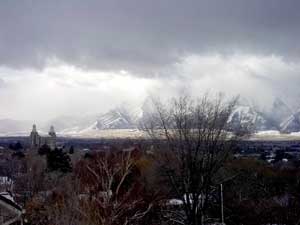
Valley dodges EPA violations
The warm temperatures that graced Cache Valley during the final days of 2005 helped the county dodge a Clean Air Act violation for now, officials said.
“I didn’t expect it to be like this right now,” Grant Koford, an environmental health scientist with the Bear River Health Department, said last week.
“We snuck out of 2005 without exceeding the standard. We had some cold days, but we didn’t have the snow on the ground. We’re not going to have a problem until the snow starts falling.”
But with the valley floor blanketed in white Sunday, air quality becomes a greater concern, and aside from the regular inversion threat, Koford said new Environmental Protection Agency policies could pose additional problems for Cache County this winter.
Current EPA standards allow for 65 micrograms per cubic meter of air of fine particulate matter pollution, also known as PM 2.5, Koford said. So far this winter, the valley has experienced a low number of days that exceed the EPA standard.
But Koford said the EPA could finalize a new standard in September, lowering the bar from 65 micrograms of PM 2.5 to 32.
“Not only Cache County, but the whole state will be in trouble then,” he said. “I think that’s the case throughout the country if they go that low. That’s going to cause some work for a lot of people.”
It would take eight days of levels greater than 32 micrograms for the EPA to step in, Koford said. And while the county wouldn’t face EPA action until June 2007, because of how air quality is reported, Koford said officials are trying to take precautionary steps.
The Cache Valley Air Task Force submitted a six-part plan for reducing pollution in Cache Valley to the County Council on Dec. 6. The report was unanimously endorsed, Koford said.
The plan includes a public information campaign and efforts to reduce driving in half during inversions, reduce exposure for “at risk” people and reduce wood burning in the valley.
Koford said that while a lower standard for PM 2.5 may be hard for Cache Valley to achieve, the goal is well intentioned.
“They’re targeting the sensitive and ill individuals that inversion hits first,” he said. “We start losing some visual when it gets to be about 25-30 [micrograms of PM 2.5]. Asthmatics will start to say the feel it about that time.
“If that’s the case, then that’s where it needs to go, but it’s a heck of a drop all at once.”
-acf@cc.usu.edu