
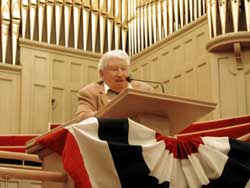
Veterans share war stories
Friday, veterans from America’s greatest conflicts came together at the Logan Tabernacle to share stories of their wartime struggles and remind the citizens of Cache Valley that freedom is not free.
The program, entitled “Voices of Cache Valley Veterans,” was put on by the Friends of Utah State University Libraries and the Concert and Lecture Series at the Tabernacle as part of USU’s Special Collections and Archives Veterans’ History Project.
“A veteran’s personal story of war adds human color and insights not found anywhere else,” said Randy Williams, project coordinator and curator of the USU Fife Folklore Archives.
After a brief introduction by Williams, five veterans from World War II, Korea, Vietnam, and the Gulf War each took the floor for a few moments to share some of their wartime experiences with the
audience.
First was former Marine Rex Thompson who stormed the beaches at Iwo Jima in the Pacific during World War II. Thompson began his remarks by modeling his vintage World War II Marine cap. He then began to explain a bit.
“How are you ever really ready?” asked Thompson about the training he and his fellow soldiers underwent before being shipped out to battle. He related his story of leaving the landing craft and watching some of the biggest toughest soldiers hiding in the bomb craters crying while Lil’ Kid Casey, the smallest man in the unit ran courageously from one end of the beach to the other, relaying messages from commander to commander.
He then recognized audience member Lloyd Lewis, who was also on the beach that morning. Lewis was fighting next to his twin brother Boyd Lewis when a bomb struck almost on top of Boyd. Lloyd gathered his brother’s remains into a sack, walked away to bury them in a shallow grave, then returned to the battle with increased
determination.
“He was going to win that battle all by himself, and almost did,” Thompson said.
Thompson also held up an original copy of the famous Iwo Jima flag raising photo, signed by the photographer Joe Rosenthal, and told of being present when the photo was taken. Thompson also reminisced about his fallen comrades.
“Why did I live to come home and see my wife and little girl and the others didn’t?” asked Thompson with a slight waver in his voice.
After Thompson, retired Air Force Lt. Col. Blair Hale told of how his B-17 bomber was shot down over the North Baltic Sea. Hale bailed out of the flaming aircraft and was the only member of the 10-man crew to survive. After being taken captive, he was sent to a prison camp for U.S. and British aviators called Stalag Luft 3, where he was held until Jan. 1945 when the 10,000 prisoners were forced on a 60-mile march and three-day train ride in the dead of winter to another prison camp deeper within Nazi Germany.
After nearly two years as a prisoner, Hale said the greatest day of his life was April 29, 1945 when General Patton’s tank division rolled into the camp, tearing down the tall barbed wire fences.
“It was a wonderful thing to see the American stars and stripes replace that flag on the tall flagpole at the gate,” Hale said. “It was the first time I had ever seen 10,000 men cry.”
With tears in his eyes, Hale talked about the feelings he felt when the boat carrying the liberated prisoners finally steamed past the Statue of Liberty.
Hale ended by quoting George Washington as saying, “Every citizen who enjoys a free government owes their service in the defense of it.”
Following Hale’s remarks, retired Master Sgt. R. Dell Tripp shared his experience about the Korean War. Tripp talked about a night march he went on before parachuting behind enemy lines.
“All you could see were tracers, bomb blasts and artillery going off,” Tripp said. “To this day I still can’t stand to watch fireworks.”
Tripp was the jump master for his plane in a parachute operation involving about 100 airplanes. He landed about 10 feet from a North Korean soldier who was so surprised that he threw down his gun and surrendered.
Retired Air Force Lt. Col. Paul Huber talked about flying F-4 bomber/fighter jets in the Vietnam War. On March 15, 1968 Huber was shot down over Laos. Fortunately he and his fellow pilot were rescued within a few hours.
“Freedom is not free … but it is worth it,” Huber said.
The program was wrapped up by Lt. Col. Jeff Bateman, professor and department head of aerospace science at USU. He explained the importance of having a sense of humor in the military and also recognized the sacrifices made by the veterans in attendance.
At the end of the program all of the veterans present, approximately half the audience, stood to the applause and cheers of the other audience members.
USU student Jenae Ripplinger, a junior majoring in social work, expressed her disappointment that more students were not present to recognize these great men.
“These are the real heroes, the real celebrities,” Ripplinger said.
The event was part of a program organized by the Library of Congress and supported locally by USU libraries to collect the memories and accounts of U.S. veterans. Those wishing to volunteer for this project should contact Williams at 797-3493 or by e-mail at randy.williams@usu.edu.
-sjeppesen@cc.usu.edu
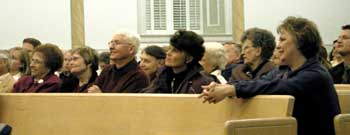
Listeners crack a smile as Cache Valley war veterans tell of some of the comedic times while in the military service. (Photo by Jessica Alexander)